





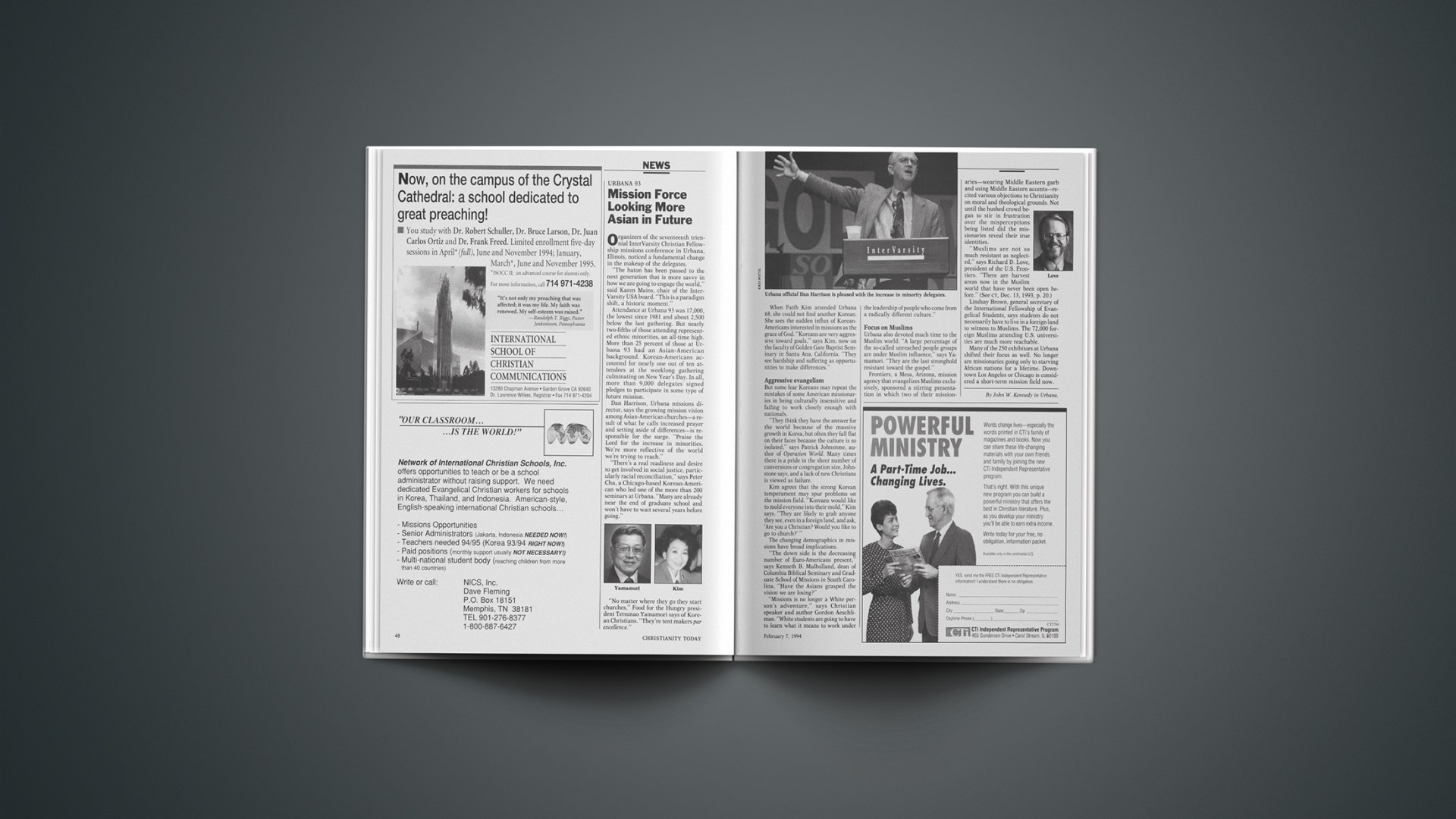
Organizers of the seventeenth triennial InterVarsity Christian Fellowship missions conference in Urbana, Illinois, noticed a fundamental change in the makeup of the delegates.
“The baton has been passed to the next generation that is more savvy in how we are going to engage the world,” said Karen Mains, chair of the InterVarsity USA board. “This is a paradigm shift, a historic moment.”
Attendance at Urbana 93 was 17,000, the lowest since 1981 and about 2,500 below the last gathering. But nearly two-fifths of those attending represented ethnic minorities, an all-time high. More than 25 percent of those at Urbana 93 had an Asian-American background. Korean-Americans accounted for nearly one out of ten attendees at the weeklong gathering culminating on New Year’s Day. In all, more than 9,000 delegates signed pledges to participate in some type of future mission.
Dan Harrison, Urbana missions director, says the growing mission vision among Asian-American churches—a result of what he calls increased prayer and setting aside of differences—is responsible for the surge. “Praise the Lord for the increase in minorities. We’re more reflective of the world we’re trying to reach.”
“There’s a real readiness and desire to get involved in social justice, particularly racial reconciliation,” says Peter Cha, a Chicago-based Korean-American who led one of the more than 200 seminars at Urbana. “Many are already near the end of graduate school and won’t have to wait several years before going.”
“No matter where they go they start churches,” Food for the Hungry president Testunao Yamamori says of Korean Christians. “They’re tent makers par excellence.”
When Faith Kim attended Urbana 68, she could not find another Korean. She sees the sudden influx of Korean-Americans interested in missions as the grace of God. “Koreans are very aggressive toward goals,” says Kim, now on the faculty of Golden Gate Baptist Seminary in Santa Ana, California. “They see hardship and suffering as opportunities to make differences.”
Aggressive evangelism
But some fear Koreans may repeat the mistakes of some American missionaries in being culturally insensitive and failing to work closely enough with nationals.
“They think they have the answer for the world because of the massive growth in Korea, but often they fall flat on their faces because the culture is so isolated,” says Patrick Johnstone, author of Operation World. Many times there is a pride in the sheer number of conversions or congregation size, Johnstone says, and a lack of new Christians is viewed as failure.
Kim agrees that the strong Korean temperament may spur problems on the mission field. “Koreans would like to mold everyone into their mold,” Kim says. “They are likely to grab anyone they see, even in a foreign land, and ask, ‘Are you a Christian? Would you like to go to church?’ ”
The changing demographics in missions have broad implications.
“The down side is the decreasing number of Euro-Americans present,” says Kenneth B. Mulholland, dean of Columbia Biblical Seminary and Graduate School of Missions in South Carolina. “Have the Asians grasped the vision we are losing?”
“Missions is no longer a White person’s adventure,” says Christian speaker and author Gordon Aeschliman. “White students are going to have to learn what it means to work under the leadership of people who come from a radically different culture.”
Focus on Muslims
Urbana also devoted much time to the Muslim world. “A large percentage of the so-called unreached people groups are under Muslim influence,” says Yamamori. “They are the last stronghold resistant toward the gospel.”
Frontiers, a Mesa, Arizona, mission agency that evangelizes Muslims exclusively, sponsored a stirring presentation in which two of their mission aries—wearing Middle Eastern garb and using Middle Eastern accents—recited various objections to Christianity on moral and theological grounds. Not until the hushed crowd began to stir in frustration over the misperceptions being listed did the missionaries reveal their true identities.
“Muslims are not so much resistant as neglected,” says Richard D. Love, president of the U.S. Frontiers. “There are harvest areas now in the Muslim world that have never been open before.” (See CT, Dec. 13, 1993, p. 20.)
Lindsay Brown, general secretary of the International Fellowship of Evangelical Students, says students do not necessarily have to live in a foreign land to witness to Muslims. The 72,000 foreign Muslims attending U.S. universities are much more reachable.
Many of the 250 exhibitors at Urbana shifted their focus as well. No longer are missionaries going only to starving African nations for a lifetime. Downtown Los Angeles or Chicago is considered a short-term mission field now.
By John W. Kennedy in Urbana.







