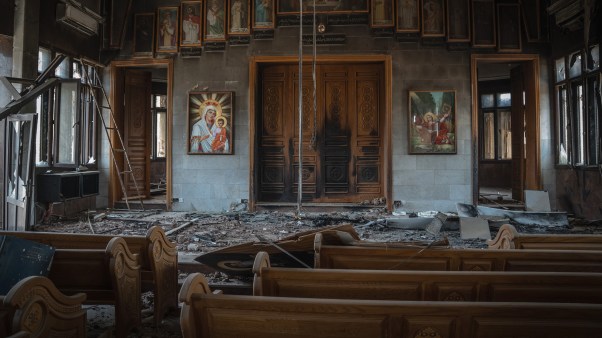

Sunday services in southern Sudan start at an early hour these days, and with uncharacteristic punctuality. Churches, which are overflowing, make highly visible targets, so congregations are dismissed before the government’s bombers are likely to arrive.
The dangers are very real. In recent weeks, civilians have been killed by bombs in Nimule and nearby villages on the Ugandan border. The area around Aswa hospital also was bombed by government planes in early March. Seven were killed.
Heavy fighting between government and rebel troops is going on in other areas, and some believe the government is assembling forces in neighboring Ethiopia and the Central African Republic to begin a “final assault.” Factional fighting between rebel groups also has left hundreds of civilians dead.
The civil war in Sudan is four decades old, but since 1989 it has been pursued with new vigor by Islamic fundamentalists who took power and who seek to subdue and impose strict Islamic law on the south. The conflict pits a Muslim and Arabic-oriented north against a central animist and Christian south (CT, May 17, 1993, p. 82). However, conflict within the southern rebel movement, based on ideology and ethnic leadership differences, has complicated matters.
In the past few years, attacks from the north, combined with deadly fighting within the southern rebel Sudan Peoples Liberation Army movement, have killed and displaced hundreds of thousands of civilians. Now a new offensive by the Khartoum-based government, which began in February, has ended an uneasy equilibrium, created by a lull in fighting and by tons of outside relief supplies.
Tens of thousands of people are again on the move, fleeing fighting and famine. At least 100,000, many living in Ame, Aswa, and Atepi camps, have fled south where thousands already are housed along the Ugandan border.
This is taking place in a land where disruption due to war and drought already was widespread. “Almost everyone in southern Sudan has been displaced,” says New Sudan Council of Churches (NSCC) worker Joseph Ikalur.
War, drought, famine, disease, and refugees are familiar elements in today’s world. But some observers say the Sudan situation is worse than Ethiopia, Somalia, and the former Yugoslavia and warn that it could become the worst human catastrophe since World War II.
A growing church
What sets Sudan apart from places such as Somalia is the growth of a strong local Christian church. “What moved me most,” Archbishop of Canterbury George Carey said after a recent visit, “has been the strength of the people’s faith, coupled with the desperation of their plight.”
Many in southern Sudan say the church is all that can bridge barriers between politics and tribe. Ikalur says, “The church is the only institution offering hope to Sudan.”
Until recently, Christians were a tiny minority. Only a few Episcopal, Presbyterian, and Catholic churches existed a few years ago, but today they have hundreds of congregations. One pastor in the district of Upper Nile baptized more than 9,000 new believers in 1992. NSCC director Roger Schrock says 5,000 new hymns have emerged in the past few years as a result of a “movement of the Spirit” in the area of Bor, now in government hands.
Bishop Nathaniel Garang of the Episcopal Church of Sudan says that before the war only about 15 percent of the south was Christian; today, three-fourths of the population is Christian.
“There is no other hope than relying on God for safety,” says Paul Bol, general secretary for the Presbyterian Church of Sudan.
Other leaders note that faith provides essential absolutes in a time of uncertainty and suffering. Christianity is attractive also because it provides an alternative to Islam, identified with oppressive policies of the north.
Another big reason for the church’s growth has been its role in seeking well-being for all south Sudanese, regardless of faith. Relief has been pouring in from the United Nations’ Operation Lifeline Sudan, and from secular and religious relief organizations.
Most impressive, perhaps, has been the spirit of ecumenical unity in which this work is being conducted. Prohibited by the government from contact with the south, the northern-based Sudan Council of Churches (SCC) has nevertheless worked cooperatively with the NSCC, which was formed in the south and is based in Nairobi, Kenya.
In the south, various denominational leaders recognize that all belong to the body of Christ. Schrock says, “I’ve never been where the sense of unity of the church was so highly valued.”
The church has played a significant role in peacemaking efforts. The southern resistance movement divided in 1991 into two warring factions. Many in the south say that, as a result, they are suffering as much at the hands of their “brothers” in the south as from the northern “Arabs.” The church has worked to end the fighting between these factions.
Lack of leadership
A lack of adequate church leadership at the local level has been a serious problem in southern Sudan. This is caused in part by the rapid growth of the church, which is unable to train leaders fast enough. However, many church leaders had been based in the north and have remained there, cut off from their people in the south. Others have fled or been forced out.
Paradoxically, this leadership crisis also has been a source of strength for the church. To cope, many churches have called on lay members to serve as evangelists. Educational centers in the south, such as the Dhiaukuei Bible School near Akot, are working to train leaders. Some suggest the church has grown partly because the missionaries left, forcing them to draw upon their own resources. Still, the absence of church leaders has led to some feelings of desertion by the southern church.
The church in the south faces other problems. Critics charge that its theology does not adequately incorporate African traditions and culture. And new converts need discipling. “The number of baptisms may be large,” says Ikalur, “but sometimes the depth of faith may not be great.”
By Howard Zehr in Sudan.