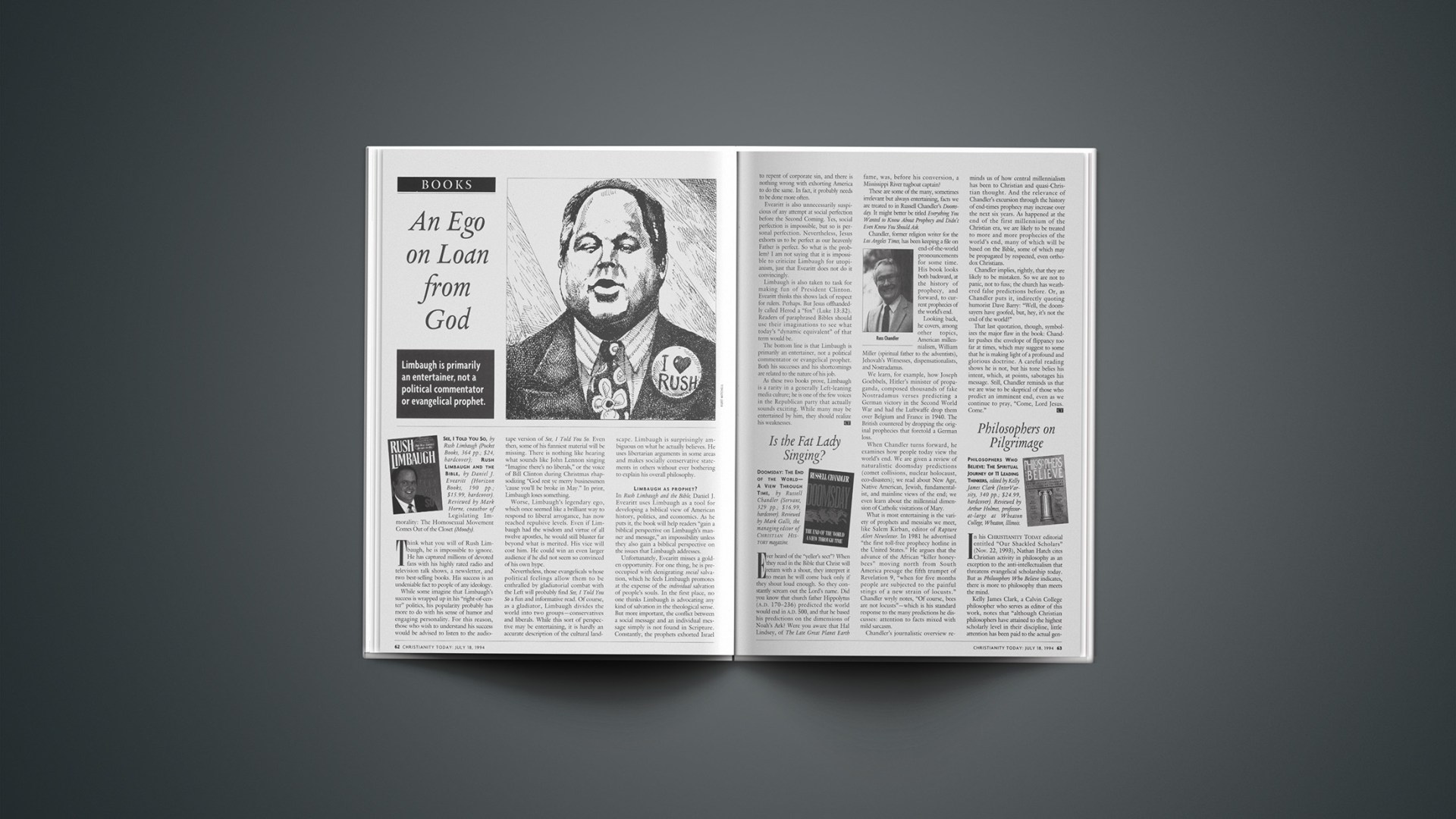

“Philosophers Who Believe: The Spiritual Journey Of 11 Leading Thinkers,” edited by Kelly James Clark (InterVarsity, 340 pp., $24.99, hardcover). Reviewed by Arthur Holmes, professor-at-large at Wheaton College, Wheaton, Illinois.
In his CHRISTIANITY TODAY editorial entitled “Our Shackled Scholars” (Nov. 22, 1993), Nathan Hatch cites Christian activity in philosophy as an exception to the anti-intellectualism that threatens evangelical scholarship today. But as “Philosophers Who Believe” indicates, there is more to philosophy than meets the mind.
Kelly James Clark, a Calvin College philosopher who serves as editor of this work, notes that “although Christian philosophers have attained to the highest scholarly level in their discipline, little attention has been paid to the actual generation, development and sustenance of their beliefs.” This volume, however, attempts to alter the balance as 11 influential Christian philosophers present autobiographies of their respective spiritual journeys.
They represent Presbyterian, Christian Reformed, Episcopal, and Roman Catholic traditions—that span itself is an index to the breadth calf the movement. They teach at the University of Calgary, at Claremont, Loyola Marymount, Maryland, Notre Dame, Oxford, Pittsburgh, Toronto, and Yale. (Others could be named at Cornell, Michigan, Pennsylvania, Syracuse, USA, etc.) Six of them, by their own accounts, are adult converts who, like Justin Martyr, were philosophers before they became Christians. The most familiar name outside of professional philosophy is Mortimer Adler, formerly of the University of Chicago, who tells how he became a believer ten years ago. It was not just an intellectual conversion.
Their stories differ greatly. Some were nurtured in a Christian environment; another was given a Sufi upbringing. Some faced intellectual struggles, others spiritual hunger; some experienced family tragedy, and others displayed moral degeneracy. Yet each was ultimately led to Christ.
Clark hopes that through these narratives readers will be strengthened in their own spiritual journeys. He writes, “The grapplings of faith and reason in an accessible manner by people of prodigious intellect provide encouragement for those struggling in their faith.”
But not only are these accounts encouraging, they are also informative. In some instances, readers receive guidance, as in Alvin Plantinga’s exhortations to those trying to balance their faith and their philosophical pursuits. Frederick Suppe writes a frank account of his struggles with issues of homosexuality. Reading these autobiographical accounts, one is reminded of Augustine’s Confessions. In similar fashion, they not only reveal facts about the authors, but provide reflections for the reader regarding his or her own life.
“Philosophers Who Believe” also presents background material to explain the current status of Christian philosophy. In his introduction, Clark suggests two causes for the explosion of Christian philosophical work: the 1983 founding of the Society of Christian Philosophers (CT, April 17, 1987) and the influence of Plantinga’s inaugural address at Notre Dame, entitled, “Advice to Christian Philosophers.” The SCP has enabled secret believers to come out of the closet and helped seekers in their pilgrimages. And its journal, Faith and Philosophy has achieved a first-class professional reputation. Moreover, Plantinga’s move to Notre Dame led to the establishment of a Center for Philosophy of Religion that has attracted perhaps the finest collection of Christians in this field anywhere in the world.
The subsequent activity among Christian philosophers is a testimony to Augustine’s claim that faith is understanding’s step, and understanding is faith’s reward. “Philosophers Who Believe” bears witness that there is no inherent conflict between faith and intellect.
Copyright © 1994 Christianity Today. Click for reprint information.
ctjul94mrw4T80185619