Women’s Ways

A fresh look at the stories of 30 women of the Bible.

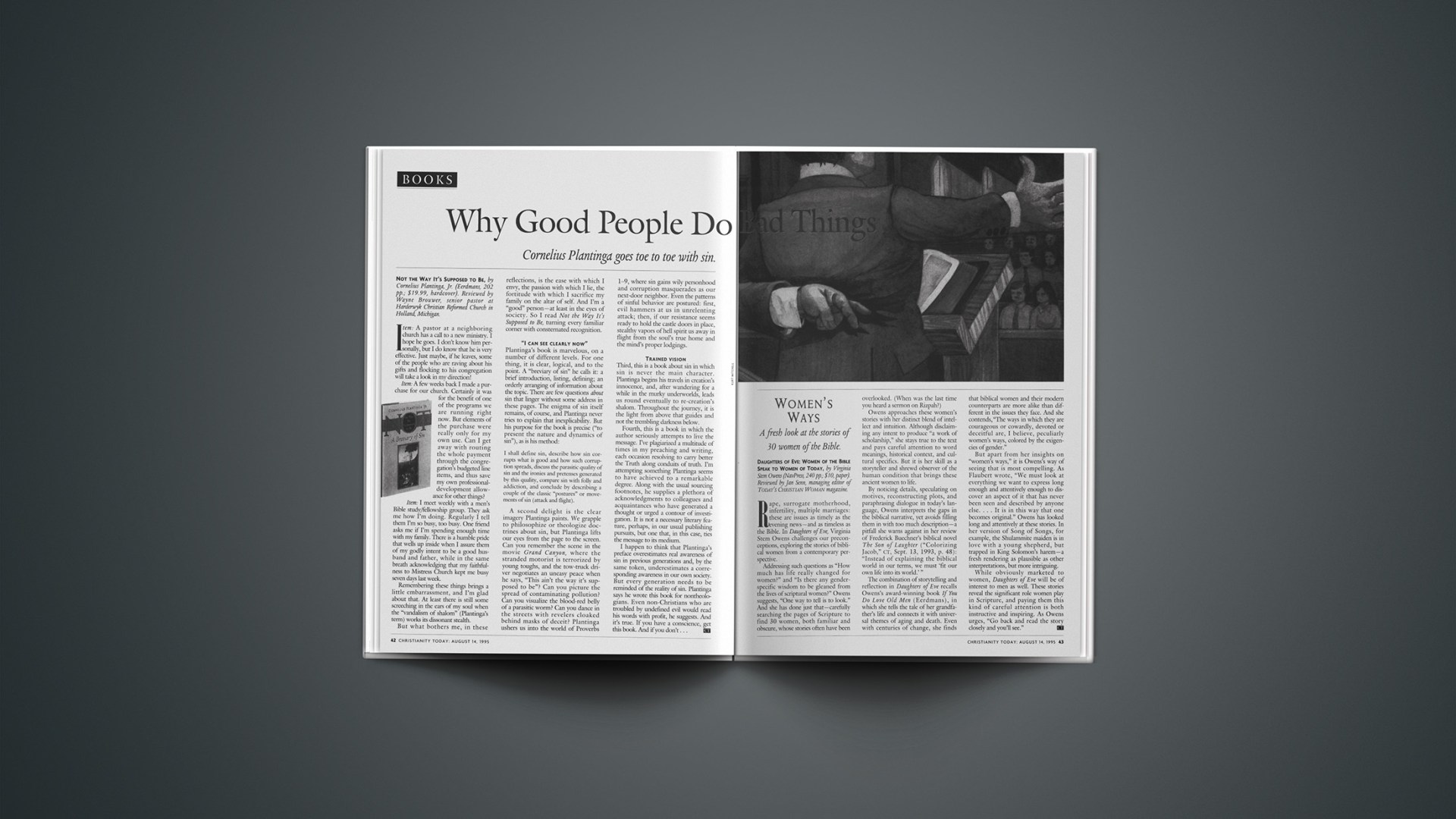
Daughters of Eve: Women of the Bible Speak to Women of Today, by Virginia Stem Owens (NavPress, 240 pp.; $10, paper). Reviewed by Jan Senn, managing editor of Today’s Christian Woman magazine.

Rape, surrogate motherhood, infertility, multiple marriages: these are issues as timely as the evening news-and as timeless as the Bible. In Daughters of Eve, Virginia Stem Owens challenges our preconceptions, exploring the stories of biblical women from a contemporary perspective.

Addressing such questions as “How much has life really changed for women?” and “Is there any gender-specific wisdom to be gleaned from the lives of scriptural women?” Owens suggests, “One way to tell is to look.” And she has done just that-carefully searching the pages of Scripture to find 30 women, both familiar and obscure, whose stories often have been overlooked. (When was the last time you heard a sermon on Rizpah?)

Owens approaches these women’s stories with her distinct blend of intellect and intuition. Although disclaiming any intent to produce “a work of scholarship,” she stays true to the text and pays careful attention to word meanings, historical context, and cultural specifics. But it is her skill as a storyteller and shrewd observer of the human condition that brings these ancient women to life.

By noticing details, speculating on motives, reconstructing plots, and paraphrasing dialogue in today’s language, Owens interprets the gaps in the biblical narrative, yet avoids filling them in with too much description-a pitfall she warns against in her review of Frederick Buechner’s biblical novel The Son of Laughter (“Colorizing Jacob,” ct, Sept. 13, 1993, p. 48): “Instead of explaining the biblical world in our terms, we must ‘fit our own life into its world.’ “

The combination of storytelling and reflection in Daughters of Eve recalls Owens’s award-winning book If You Do Love Old Men (Eerdmans), in which she tells the tale of her grandfather’s life and connects it with universal themes of aging and death. Even with centuries of change, she finds that biblical women and their modern counterparts are more alike than different in the issues they face. And she contends,”The ways in which they are courageous or cowardly, devoted or deceitful are, I believe, peculiarly women’s ways, colored by the exigencies of gender.”

But apart from her insights on “women’s ways,” it is Owens’s way of seeing that is most compelling. As Flaubert wrote, “We must look at everything we want to express long enough and attentively enough to discover an aspect of it that has never been seen and described by anyone else. . . . It is in this way that one becomes original.” Owens has looked long and attentively at these stories. In her version of Song of Songs, for example, the Shulammite maiden is in love with a young shepherd, but trapped in King Solomon’s harem-a fresh rendering as plausible as other interpretations, but more intriguing.

While obviously marketed to women, Daughters of Eve will be of interest to men as well. These stories reveal the significant role women play in Scripture, and paying them this kind of careful attention is both instructive and inspiring. As Owens urges, “Go back and read the story closely and you’ll see.”

Copyright © 1995 Christianity Today. Click for reprint information.

ctcurrtk5T90435814
Also in this issue

Scandal? A forum on the evangelical mind: Mark noll, Alister McGrath, Darrell Bock, and Richard Mouw

Cover Story

Scandal?

conversation with Mark Noll, Alister McGrath, Richard Mouw, Darrell Bock; moderated by Michael Maudlin

Scandal? (continued from previous article)

conversation with Mark Noll, Alister McGrath, Richard Mouw, Darrell Bock; moderated by Michael Maudlin

Reclaiming the Soul of Science

ROSENBERGER CASE

Jennifer Ferranti

CANADA

Warren Bird

PUBLIC EDUCATION

Jennifer Ferranti

NEW ERA UPDATE

Joe Maxwell

WOMEN'S CONFERENCE

Paige Comstock Cunningham

VIETNAM

Kim A. Lawton, with additional reports from Andrew Wark

CAPITAL PUNISHMENT

Randy Frame

Inward Bound

Randall Lehmann Sorenson, Rosemead School of Psychology

Wire Story

SOUTHERN BAPTISTS

Timothy C. Morgan, with reports from Associated Baptist Press

BOOKS

Wayne Brouwer

Classic & Contemporary Excerpts from August 01, 1995

The Gospel According to Prozac

Clark E. Barshinger, Lojan E. Larowe, and Andres Tapia

In a Children's Cancer Ward

Diane Komp, Yale Univ.

The UN's Antifamily Manifesto

Diane Knippers

Editorial

A Tenuous Victory for Religious Freedom

Steven McFarland

CONVERSATIONS

Kevin Dale Miller

Get the Numbers Right

Irving Hexham, University of Calgary

LETTERS to the EDITOR

An Evangelical Mind Is a Terrible Thing to Waste

Michael G. Maudlin

View issue

Our Latest

News

Died: John M. Perkins, Who Lived and Preached Racial Reconciliation

The civil rights leader believed in a gospel bigger than race or self-interest.

Review

Decoding the Supreme Court

Three books to read this month on politics and public life.

The Bulletin

Cost of Iran War, Quiet Southern Border, and Anglican Church Split

Mike Cosper, Clarissa Moll, Russell Moore

The financial and moral toll of war, immigration slows but ministry continues, and why denominations split.

The Year of the Evangelical

America prepared for a bicentennial, and religious identity dominated the presidential campaign.

Q&A: Eric Mason on Ministering to Men and Witnessing in Politics

Interview by Benjamin Watson

The Philadelphia-based pastor discusses how the church can engage Black men and have a biblical approach to government.

Review

‘The Secret Agent’ Explores Memory and Authoritarianism in Brazil

Mariana Albuquerque

The Oscar-nominated film reminds viewers to learn from the past—and to share our stories with the next generation.

Jan Karon Looks Back on 89 Years of God’s Faithfulness

The author of the Mitford Years series married at 14, protested segregation, and wrote her first book at 57.

The Just Life with Benjamin Watson

Michel Lusakueno: Why the World Can’t Ignore Congo

Exploring the sobering connection between modern convenience and human suffering.

Apple PodcastsDown ArrowDown ArrowDown Arrowarrow_left_altLeft ArrowLeft ArrowRight ArrowRight ArrowRight Arrowarrow_up_altUp ArrowUp ArrowAvailable at Amazoncaret-downCloseCloseEmailEmailExpandExpandExternalExternalFacebookfacebook-squareGiftGiftGooglegoogleGoogle KeephamburgerInstagraminstagram-squareLinkLinklinkedin-squareListenListenListenChristianity TodayCT Creative Studio Logologo_orgMegaphoneMenuMenupausePinterestPlayPlayPocketPodcastprintRSSRSSSaveSaveSaveSearchSearchsearchSpotifyStitcherTelegramTable of ContentsTable of Contentstwitter-squareWhatsAppXYouTubeYouTube