“When a foreigner lives with you in your land, don’t take advantage of him. Treat the foreigner the same as a native. Love him like one of your own. Remember that you were once foreigners in Egypt. I am God, your God” (Lev. 19:33-34, The Message).
“For I was hungry and you gave me something to eat, I was thirsty and you gave me something to drink, I was a stranger and you invited me in” (Matt 25:35, NIV)
"Dress me in the clothes / I wore in the day's round.
/ Lay me in a wooden box.
/ Put the box in the ground." — Wendell Berry's "Testament"
As lifelong city folk, rural life was new to my husband and me when we moved from Washington D.C. to an intentional Christian community on a farm in Illinois five years ago. For the first few years, we probably resembled the over-protective parents that Hanna Rosin critiques in The Atlantic as we warned our growing children to avoid electric fences, machine shops, farm implements, tractors, and even the creek.
The farm has become a unique setting for our kids to experience risk and reality. As parents, we've since learned about the bravery and self-assurance that comes from letting kids face dangers on their own. We've also observed surprising lessons about life and death.
Last fall, my farmer husband was ready to butcher the two-dozen geese that lived in our strawberry fields all season, weeding and otherwise creating a lot of noise and chaos. Our five-year-old daughter and three-year-old son wanted to follow their daddy out to the machine shop on that cold morning to watch. I was hesitant. I wondered if it would be good for them to witness the death and de-feathering of the geese they helped raise from goslings in our basement. But my daughter was so eager that I sent them out anyway.
When I went to check on them, I found my son with a look of sadness and disgust. "I don't want to stay here anymore," he said. My daughter, on the other hand, couldn't stop talking about it. "Look at this, Mom! They let me help! This is so cool!"
I led my son back to the house while she stayed in the machine shop the rest of the day. It wasn't the first time I thought: Was my daughter too excited by such gruesomeness? Were we teaching her things inappropriate for her age? Would my son be forever traumatized by what he'd witnessed?
Our culture is used to outsourcing anything related to death. Barely any of us kill the food we eat, so we can easily overlook death's role in the process. Even lifelong meat-eaters are uncomfortable with a hunter's enthusiasm in killing food to feed his family. Many who have purchased countless boneless, skinless, chicken breasts can't imagine a farmer killing a bird with her own hands.
When people die, we pay others to care for them and make arrangements. Our involvement is mostly distant and conceptual, focused on memories and prayers, rather than the embodied reality of death. I was fascinated when a friend told me about a funeral she attended where the family held a wake for a few days before they buried their loved one themselves. Are we missing part of the process of grieving because we have lost the practice of facing death with all its pain and sadness?
During the Easter season especially, the gruesome reality of farm life gives us a tangible connection to life and death. It helps us, young and old, understand our creator and our place on earth. Death is sad. It's tragic despite our belief in a God of new life and resurrection. 1 Thessalonians 4:13 says the temporary sleep of death shouldn't make us grieve like those who have no hope, but this doesn't mean we won't grieve at all. Our grief takes on a different face because we have hope.
So, as parents living on a farm, we allow our children to see death on a level they can understand. We're surprised to find, in some ways, they are better equipped with the imaginative capacity to hold these complex tensions of life and death.
This week I took my children to the small cemetery on the farm property. We came to see the vibrant patch of daffodils that grow beside the five headstones. But while we were there, we said a prayer. When I finished with, "Thank you God for being stronger than death," I caught my daughter nodding her head in agreement. As we walked down the path toward home, she said simply, "Maybe when I die, I will be buried there."
Even though many of us might be startled by such a straightforward approach to the end of life, I believe that is what we should long for. Our culture's approach to death is often denial: the way we treat our elderly loved ones, the ways we outsource death, and the lengths we go to pretend we aren't aging. But Hebrews 2: 14-15 suggests we have nothing to fear, that Jesus' death freed those of us who were imprisoned because of our fear of death.
So how can we live with an embodied and realistic view of death and give our children the tools to keep holding those complex tensions together? Maybe a first step is to look at our own lives and recognize the ways we push death away from us. We don't all have to live on a farm to learn these lessons but we shouldn't shy away from the pain that comes with living in a world where death is all around us.
I hope my son won't lose his tenderness in the face of slaughter. I hope my daughter will always take genuine delight in the things about farm life that are new, strange, or beautiful. But most of all, I hope they will both understand what my husband and I are also learning, that the tragedies of death can never be stronger than the goodness of the God who has claimed victory over it. Perhaps this is a lesson that all of us can learn.
Christiana N. Peterson grew up in Texas and received a PhD in Creative writing from St. Andrews University in Scotland. She has published poetry in Catapult Magazine and Curator Magazine as well as articles on farm life at Flourish. You can find her blog and links to her other writing at thebeautyofthishour.wordpress.com or on Twitter at @renewsustain.
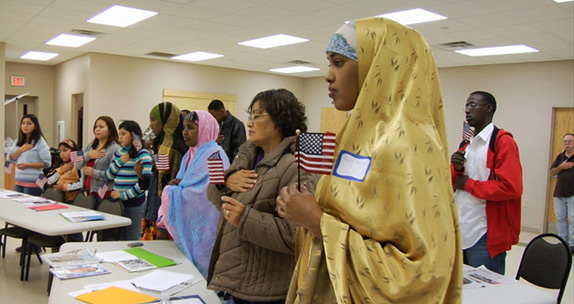
These are familiar passages to many in the Bible Belt, including the residents of Shelbyville, Tennessee. But putting such words into practice is much easier said than done. That’s the premise of Welcome to Shelbyville, a documentary airing tonight (10/9c) on PBS’s Independent Lens.
It’s a fascinating look at how a small town grapples with a rapid influx of foreign refugees, including a growing Latino population and, in more recent years, many Muslims from Somalia. Most of the film was shot in the days prior to the 2008 Presidential election, when America was already facing many changes. But for this small Tennessee town, the changes seemed to come faster than many residents were prepared for.
There are some expected comments from local rednecks and old-timers, mostly borne out of misunderstanding or fear, but there are some encouraging scenes involving local churches who are putting feet to the gospel, trying to roll out the red carpet for their new neighbors. It’s a challenge, but it’s a challenge they are working hard to meet – whether through large events, door-to-door visits, or ESL classes. There are some sensitive (and some not so sensitive) insights from pastors and religious leaders.
“The movement of people from one place to another, how we acclimate to other cultures, and the resulting fusion of humanity has always fascinated me,” says director Kim Snyder. “During my Masters work in foreign relations at Johns Hopkins, I was most interested in social change as it played out in more personal rather than national or historic narratives. Welcome to Shelbyville evolved out of a deep desire over the past decade to tell stories that would not only raise awareness about complex social problems, but that could go one step beyond to highlight people and communities that were tackling these problems with innovative solutions that might ignite social change.
“Welcome to Shelbyville chronicles a year in the life of one town in the rural South grappling with the challenges of rapid demographic change. With focus on Shelbyville as a microcosm of current day trends in immigration that are landing an increasing number of newcomers in rural locales, my intent was to provide a snapshot of this phenomenon through the voices of ordinary citizens, both U.S. and foreign-born, who are often navigating these challenges without much precedent or guidance.”
It’s worth watching for any community or congregation that is serious about putting feet to the gospel, and reaching out to the strangers among us. Here’s the trailer: