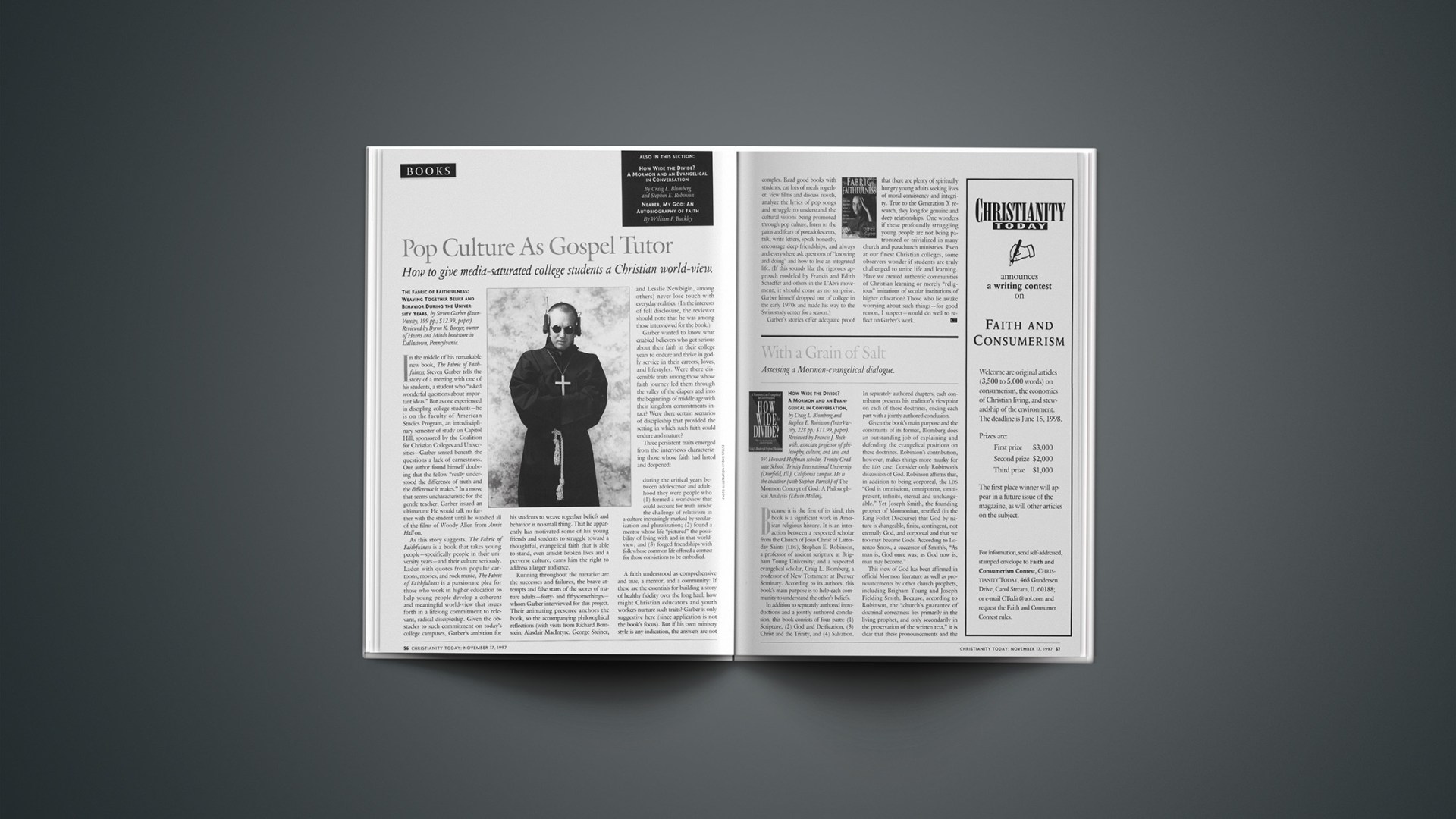

The Fabric of Faithfulness: Weaving Together Belief and Behavior During the University Years, by Steven Garber (InterVarsity, 199 pp.; $12.99, paper). Reviewed by Byron K. Borger, owner of Hearts and Minds bookstore in Dallastown, Pennsylvania.
In the middle of his remarkable new book, The Fabric of Faithfulness, Steven Garber tells the story of a meeting with one of his students, a student who “asked wonderful questions about important ideas.” But as one experienced in discipling college students—he is on the faculty of American Studies Program, an interdisciplinary semester of study on Capitol Hill, sponsored by the Coalition for Christian Colleges and Universities—Garber sensed beneath the questions a lack of earnestness. Our author found himself doubting that the fellow “really understood the difference of truth and the difference it makes.” In a move that seems uncharacteristic for the gentle teacher, Garber issued an ultimatum: He would talk no further with the student until he watched all of the films of Woody Allen from Annie Hall on.
As this story suggests, The Fabric of Faithfulness is a book that takes young people—specifically people in their university years—and their culture seriously. Laden with quotes from popular cartoons, movies, and rock music, The Fabric of Faithfulness is a passionate plea for those who work in higher education to help young people develop a coherent and meaningful world-view that issues forth in a lifelong commitment to relevant, radical discipleship. Given the obstacles to such commitment on today’s college campuses, Garber’s ambition for his students to weave together beliefs and behavior is no small thing. That he apparently has motivated some of his young friends and students to struggle toward a thoughtful, evangelical faith that is able to stand, even amidst broken lives and a perverse culture, earns him the right to address a larger audience.
Running throughout the narrative are the successes and failures, the brave attempts and false starts of the scores of mature adults—forty- and fiftysomethings—whom Garber interviewed for this project. Their animating presence anchors the book, so the accompanying philosophical reflections (with visits from Richard Bernstein, Alasdair MacIntyre, George Steiner, and Lesslie Newbigin, among others) never lose touch with everyday realities. (In the interests of full disclosure, the reviewer should note that he was among those interviewed for the book.)
Garber wanted to know what enabled believers who got serious about their faith in their college years to endure and thrive in godly service in their careers, loves, and lifestyles. Were there discernible traits among those whose faith journey led them through the valley of the diapers and into the beginnings of middle age with their kingdom commitments intact? Were there certain scenarios of discipleship that provided the setting in which such faith could endure and mature?
Three persistent traits emerged from the interviews characterizing those whose faith had lasted and deepened:
during the critical years between adolescence and adulthood they were people who
(1) formed a worldview that could account for truth amidst the challenge of relativism in a culture increasingly marked by secularization and pluralization; (2) found a mentor whose life “pictured” the possibility of living with and in that worldview; and (3) forged friendships with folk whose common life offered a context for those convictions to be embodied.
A faith understood as comprehensive and true, a mentor, and a community: If these are the essentials for building a story of healthy fidelity over the long haul, how might Christian educators and youth workers nurture such traits? Garber is only suggestive here (since application is not the book’s focus). But if his own ministry style is any indication, the answers are not complex. Read good books with students, eat lots of meals together, view films and discuss novels, analyze the lyrics of pop songs and struggle to understand the cultural visions being promoted through pop culture, listen to the pains and fears of postadolescents, talk, write letters, speak honestly, encourage deep friendships, and always and everywhere ask questions of “knowing and doing” and how to live an integrated life. (If this sounds like the rigorous approach modeled by Francis and Edith Schaeffer and others in the L’Abri movement, it should come as no surprise. Garber himself dropped out of college in the early 1970s and made his way to the Swiss study center for a season.)
Garber’s stories offer adequate proof that there are plenty of spiritually hungry young adults seeking lives of moral consistency and integrity. True to the Generation X research, they long for genuine and deep relationships. One wonders if these profoundly struggling young people are not being patronized or trivialized in many church and parachurch ministries. Even at our finest Christian colleges, some observers wonder if students are truly challenged to unite life and learning. Have we created authentic communities of Christian learning or merely “religious” imitations of secular institutions of higher education? Those who lie awake worrying about such things—for good reason, I suspect—would do well to reflect on Garber’s work.
Copyright © 1997 Christianity Today. Click for reprint information.