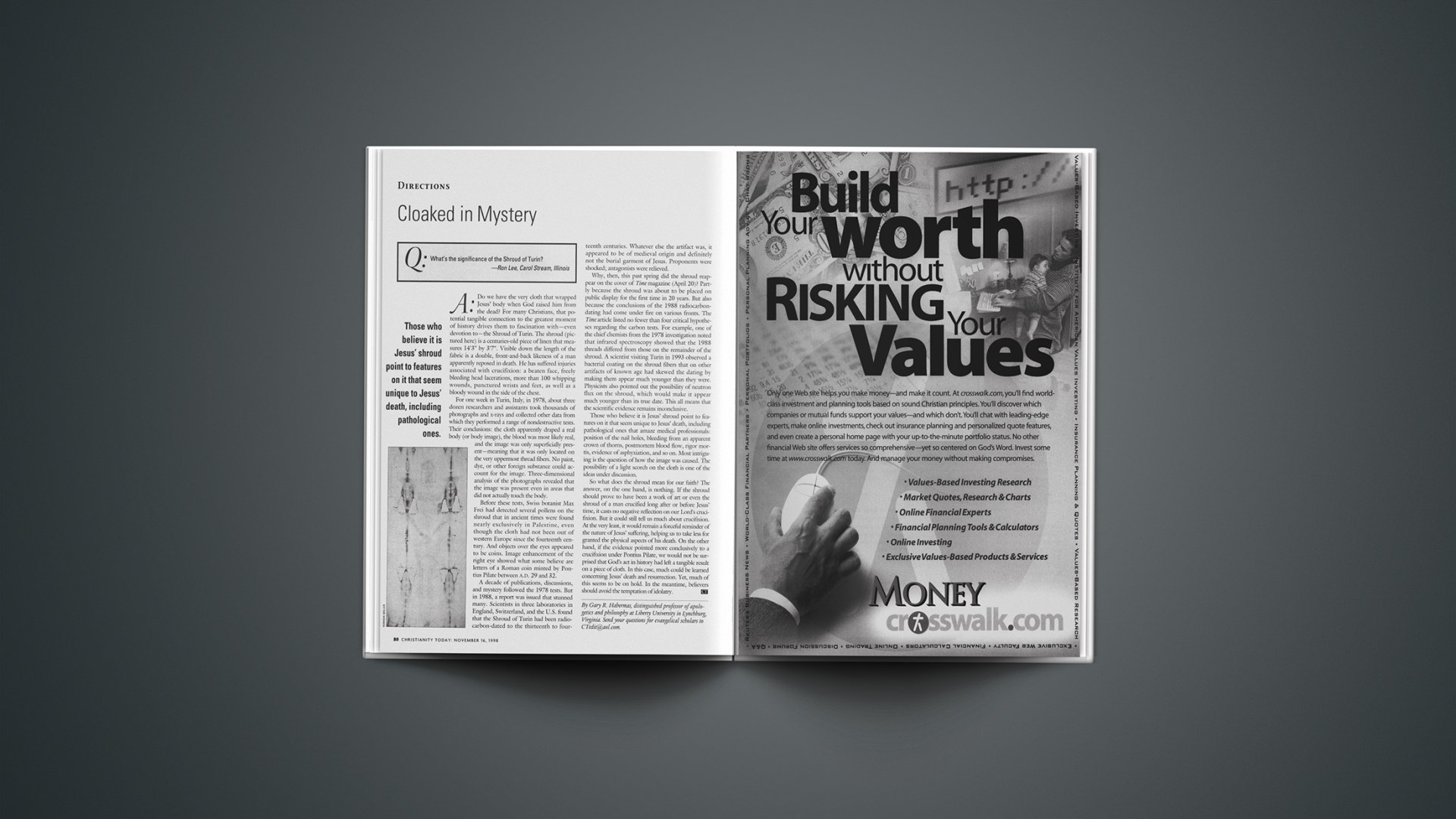

Q: What's the significance of the Shroud of Turin?
—Ron Lee, Carol Stream, Illinois
A:Do we have the very cloth that wrapped Jesus' body when God raised him from the dead? For many Christians, that potential tangible connection to the greatest moment of history drives them to fascination with—even devotion to—the Shroud of Turin. The shroud (pictured here) is a centuries-old piece of linen that measures 14'3" by 3'7". Visible down the length of the fabric is a double, front-and-back likeness of a man apparently reposed in death. He has suffered injuries associated with crucifixion: a beaten face, freely bleeding head lacerations, more than 100 whipping wounds, punctured wrists and feet, as well as a bloody wound in the side of the chest.
For one week in Turin, Italy, in 1978, about three dozen researchers and assistants took thousands of photographs and x-rays and collected other data from which they performed a range of nondestructive tests. Their conclusions: the cloth apparently draped a real body (or body image), the blood was most likely real, and the image was only superficially present—meaning that it was only located on the very uppermost thread fibers. No paint, dye, or other foreign substance could account for the image. Three-dimensional analysis of the photographs revealed that the image was present even in areas that did not actually touch the body.
Before these tests, Swiss botanist Max Frei had detected several pollens on the shroud that in ancient times were found nearly exclusively in Palestine, even though the cloth had not been out of western Europe since the fourteenth century. And objects over the eyes appeared to be coins. Image enhancement of the right eye showed what some believe are letters of a Roman coin minted by Pontius Pilate between A.D. 29 and 32.
A decade of publications, discussions, and mystery followed the 1978 tests. But in 1988, a report was issued that stunned many. Scientists in three laboratories in England, Switzerland, and the U.S. found that the Shroud of Turin had been radiocarbon-dated to the thirteenth to fourteenth centuries. Whatever else the artifact was, it appeared to be of medieval origin and definitely not the burial garment of Jesus. Proponents were shocked; antagonists were relieved.
Why, then, this past spring did the shroud reappear on the cover of Time magazine (April 20)? Partly because the shroud was about to be placed on public display for the first time in 20 years. But also because the conclusions of the 1988 radiocarbon-dating had come under fire on various fronts. The Time article listed no fewer than four critical hypotheses regarding the carbon tests. For example, one of the chief chemists from the 1978 investigation noted that infrared spectroscopy showed that the 1988 threads differed from those on the remainder of the shroud. A scientist visiting Turin in 1993 observed a bacterial coating on the shroud fibers that on other artifacts of known age had skewed the dating by making them appear much younger than they were. Physicists also pointed out the possibility of neutron flux on the shroud, which would make it appear much younger than its true date. This all means that the scientific evidence remains inconclusive.
Those who believe it is Jesus' shroud point to features on it that seem unique to Jesus' death, including pathological ones that amaze medical professionals: position of the nail holes, bleeding from an apparent crown of thorns, postmortem blood flow, rigor mortis, evidence of asphyxiation, and so on. Most intriguing is the question of how the image was caused. The possibility of a light scorch on the cloth is one of the ideas under discussion.
So what does the shroud mean for our faith? The answer, on the one hand, is nothing. If the shroud should prove to have been a work of art or even the shroud of a man crucified long after or before Jesus' time, it casts no negative reflection on our Lord's crucifixion. But it could still tell us much about crucifixion. At the very least, it would remain a forceful reminder of the nature of Jesus' suffering, helping us to take less for granted the physical aspects of his death. On the other hand, if the evidence pointed more conclusively to a crucifixion under Pontius Pilate, we would not be surprised that God's act in history had left a tangible result on a piece of cloth. In this case, much could be learned concerning Jesus' death and resurrection. Yet, much of this seems to be on hold. In the meantime, believers should avoid the temptation of idolatry.
By Gary R. Habermas, distinguished professor of apologetics and philosophy at Liberty University in Lynchburg, Virginia. Send your questions for evangelical scholars to cteditor@christianitytoday.com.
Copyright © 1998 Christianity Today. Click for reprint information.