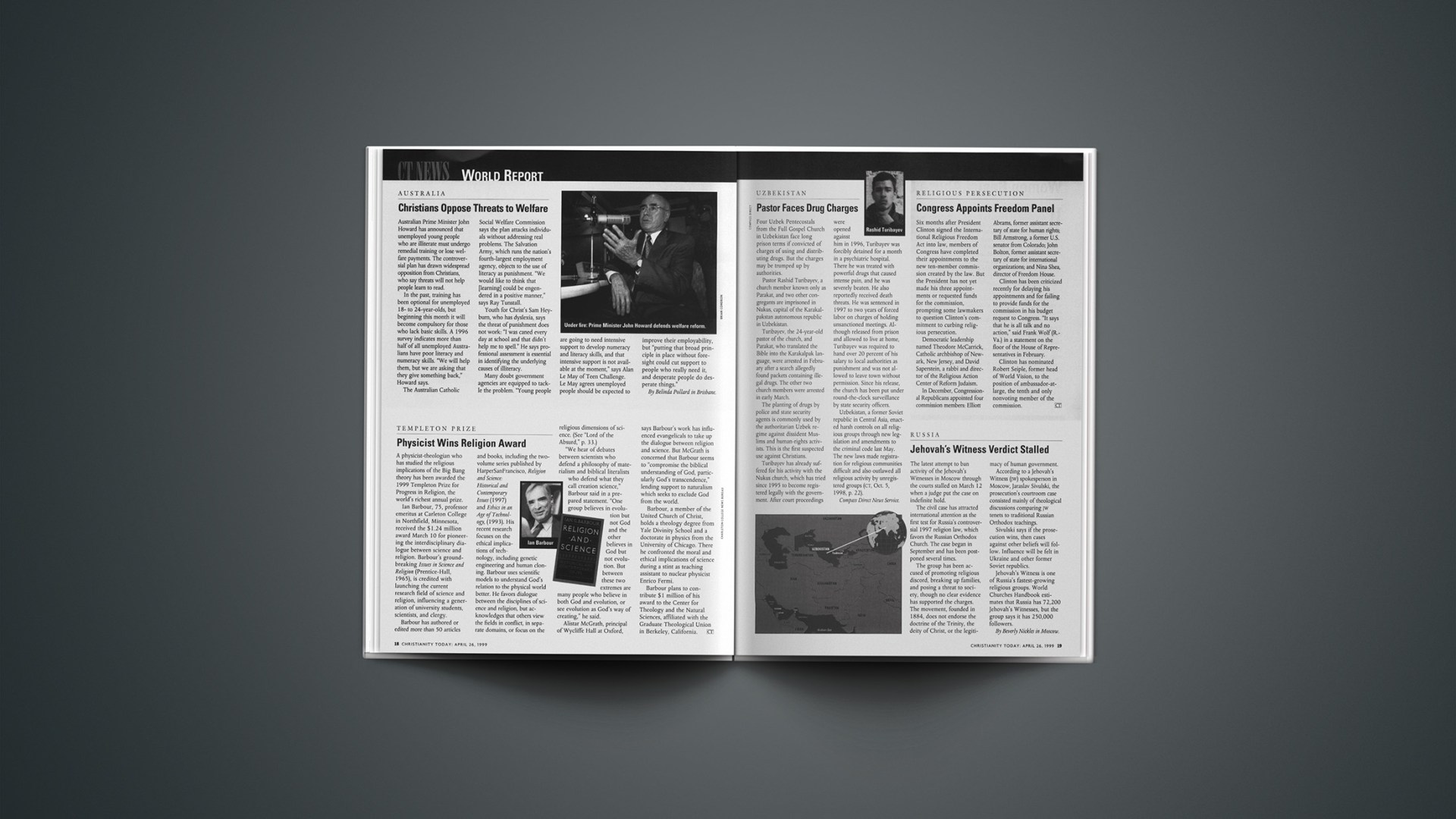

A physicist-theologian who has studied the religious implications of the Big Bang theory has been awarded the 1999 Templeton Prize for Progress in Religion, the world’s richest annual prize.
Ian Barbour, 75, professor emeritus at Carleton College in Northfield, Minnesota, received the $1.24 million award March 10 for pioneering the interdisciplinary dialogue between science and religion. Barbour’s ground-breaking Issues in Science and Religion (Prentice-Hall, 1965), is credited with launching the current research field of science and religion, influencing a generation of university students, scientists, and clergy.
Barbour has authored or edited more than 50 articles and books, including the two-volume series published by HarperSanFrancisco, Religion and Science: Historical and Contemporary Issues (1997) and Ethics in an Age of Technology, (1993). His recent research focuses on the ethical implications of technology, including genetic engineering and human cloning. Barbour uses scientific models to understand God’s relation to the physical world better. He favors dialogue between the disciplines of science and religion, but acknowledges that others view the fields in conflict, in separate domains, or focus on the religious dimensions of science. (See “Lord of the Absurd,” p. 33.)
“We hear of debates between scientists who defend a philosophy of materialism and biblical literalists who defend what they call creation science,” Barbour said in a prepared statement. “One group believes in evolution but not God and the other believes in God but not evolution. But between these two extremes are many people who believe in both God and evolution, or see evolution as God’s way of creating,” he said.
Alistar McGrath, principal of Wycliffe Hall at Oxford, says Barbour’s work has influenced evangelicals to take up the dialogue between religion and science. But McGrath is concerned that Barbour seems to “compromise the biblical understanding of God, particularly God’s transcendence,” lending support to naturalism which seeks to exclude God from the world.
Barbour, a member of the United Church of Christ, holds a theology degree from Yale Divinity School and a doctorate in physics from the University of Chicago. There he confronted the moral and ethical implications of science during a stint as teaching assistant to nuclear physicist Enrico Fermi.
Barbour plans to contribute $1 million of his award to the Center for Theology and the Natural Sciences, affiliated with the Graduate Theological Union in Berkeley, California.
Copyright © 1999 Christianity Today. Click for reprint information.