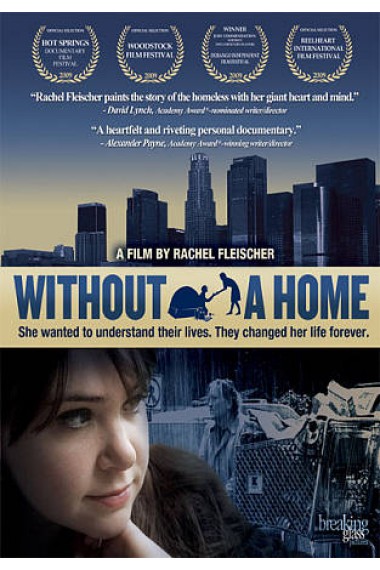
The tagline to the new documentary Without a Home says it all: “She wanted to understand their lives. They changed her life forever.” The tagline might have also added that she – budding young filmmaker Rachel Fleischer – also played a role in changing some of their lives too, at least a few of the 90,000 homeless in Los Angeles.
The following post contains details from the first and second seasons of Orange Is the New Black. (Don't say we didn't warn you.)
I love my Don Drapers and Walter Whites, but we were long overdue for a Piper Chapman. She's the main character of Orange Is the New Black, a Brooklyn yuppie serving time for crimes committed in her adventurous youth (based on the real-life Piper Kerman, whose memoir inspired the show). Her story is not, at least after two seasons, a tale of redemption.
With nothing but time to face her own darkness, Piper is no longer recognizable as the innocent woman who first entered prison. Antiheroes like Draper, White, and Chapman help us explore the darker side of our humanity at a distance. Through Piper, we step into a society-within-a-society—a low-security women's prison—in which women are forced to come to terms with their literal crimes and the ways they became the women who committed them. Stripped of the ability to slip into roles defined by the men in their lives—girlfriend, mother, wife—the inmates find freedom to face those choices that have led them to prison and the internal strength to figure out how to move forward.
Orange Is the New Black is not for everyone; it comes with all the warnings of a typical premium cable show. Yet, it's a show worth talking about. Its cast is refreshingly diverse, and its nuanced treatments of race and sexuality have given recognizable flesh to complex realities that can all too easily become theoretical. Because the show has done so well at this, its handling of another of society's great dividers—religion—has been such a major disappointment.
In many ways, OITNB is a show about how people delude themselves—not just into committing crimes, but also into the beliefs that shape their understanding of who they are. The axiom "prison breaks you" becomes most powerful as it challenges these inmates' most deeply-held convictions. But for a show that does such a good job of plunging beneath labels and inhabiting so complex realities, it fails to portray faith in a way that is at all recognizable to its lived experience.
The first season built up to a cliffhanger that hinged on the outcome of a violent fight between Piper and her "born-again" rival who, after failing to convert Piper like she boldly proclaimed Jesus promised she would, declares herself an "angel of the Lord" and stabs her. Pennsatucky is a Christian character unlike any other on TV: a meth addict who became an accidental poster child of the pro-life movement when she killed an abortion clinic worker—never mind that it was because she insulted her during her fifth abortion—and embraced her newfound "religion" by spouting off Scripture and declaring herself a faith healer.
There is a single moment where you understand Pennsatucky's faith as connected to actual human emotion; as she basks in the attention and acceptance from the pro-life protestors who rally to support her at her trial, her entire countenance transforms in what could be understood as her moment of "conversion"—but from that moment on she becomes a broadly drawn stereotype. Pennsatucky comes off as a Christian who adopts the guise of faith as a way to empower her own ignorance and assert her power over anything threatening. And there is some biting truth in this—we see countless examples of people abusing religion to gain personal power.
In a post-first-season article on "How 'Orange Is the New Black' Fails on Religion" for The American Conservative, B.D. McClay speculates why a show so careful to craft complex characters would draw such a simplistic caricature:
The show seems aimed at an audience of Piper Chapmans: upper-middle-class, very educated, largely secular. They aren't friends with Pennsatucky; they don't know anybody like her. Pennsatucky might be their waitress, or sell them some snacks at a gas station. But that's about as close as their world and hers will ever come to touching. So it doesn't matter, really, that none of these things about Pennsatucky make sense. They aren't meant to make sense. They're meant to be frightening.
It's a biting critique that rings true of both OITNB and TV portrayals of religious characters in general. Christian characters are often boring prudes à la Ned Flanders on The Simpsons, overly politicized like Sally Langston on Scandal, or a bizarre amalgamation of beliefs and lifestyle choices that make me wonder if the writers have ever met an actual Christian, like Pastor Casey on The Mindy Project. When Christian characters are sincere, they're usually kindly older women, grandmother types, resigned to let the kids have their fun and dole out sage advice as requested. It was frustrating to see this one painful narrative represent Christian faith on OITNB, a show that masters other aspects of the melting pot so well.
Season two's response to the loud "born again" is the older Catholic nun, Sister Jane Ingalls. Where Pennsatucky is loud, ignorant, hateful, and violent, Sister Ingalls is thoughtful, accepted, and respected for her quiet but solid faith. She comes to the forefront of the story at the end of the season, when she joins a prisoner-led hunger strike and quickly becomes consumed by fanatical devotion to the cause.
Through flashbacks it becomes clear that her blinding commitment to political activism, and the public attention and celebrity they brought her, are what landed her in prison in the first place. (She is apparently based on a real-life nun, Sister Ardeth Platte, who "cut a chain link fence surrounding a Minuteman III silo in northern Colorado, then used baby bottles to draw a sign of the cross in their own blood.") Her narcissism lost her the support of her superiors, who eventually asked her to leave the sisterhood.
It's another cynical view of faith, but tempered by the possibility of something more genuine. Sister Jane is seen as a wayward nun who has missed the point; in her first days as a nun she is instructively told by the Mother Superior that "Christ only comes to those humble in their devotion to the Lord," and her life plays out this truth: as she grows addicted to the rush of subversive resistance, she admits that she has never felt God's presence. It's a tragedy, but not one without hope of redemption.
This is where religion has, or could have, real traction on OITNB. Redemption and salvation are more than just abstract spiritual concepts in prison. Most of the inmates long for the day their lives can be different from what they are now and what they were before, and they have run out of places to turn. Grace and mercy are even more deeply felt when there is so much to be forgiven.
Orange Is the New Black has made so much noise because it takes seriously women whose stories we don't often hear—black women, Latina women, older women, poor women, transgender women—and asks us to consider the real human beings behind them who have had to make difficult, often painful choices most of us will never have to make. It's so far mostly missed an opportunity to do the same for Christians, but, like the women in Litchfield prison, it still has time to turn it around.
As a little girl from a well-to-do show-biz family (her father, Charles Fleischer voiced the lead character in the movie Who Framed Roger Rabbit?), Rachel had a sensitive heart for the homeless. So when she grew up, she decided to buy a camera, go to Skid Row, and document their stories. And she found, as many documentarians do, that it was difficult to stay behind the camera and remain an objective observer. Watching Fleischer get to know these folks, and then wrestle with just how much she should (or shouldn’t) get involved in their lives is part of this 74-minute film’s draw. Any of us who have worked with homeless people have weighed those same things: How much should I get involved, and how do I help without enabling?
It’s one thing to see Fleischer give one person a ride to a destination a few blocks away. It’s another when one of her subjects asks for $50 to pay rent, or to spend the night at her house because he’s out on the street. How will she respond? She wants to do the right thing, but doesn’t always instantly know what that is. Fortunately, as Fleischer immerses herself into these lives, she’s also meeting professionals in ministries and organizations that have worked with homeless people for years, and she learns the ropes quickly – including the stark fact that some homeless folks might say they want help, but in the end, they really don’t want to put forth the effort to change. Such stories are heartbreaking, and we see a few of them here. But we also see a few stories that are working their way toward a hopeful, redemptive ending.
Along the way, we meet heroin addicts who are high on the stuff, a guy who plays a homemade banjo on the street for a living, and a family that goes through eviction after eviction, just biding time till the dad can find steady work. And we watch Fleischer get involved in varying degrees, always asking herself, “Where do I draw the line?” It’s easy to put yourself in her shoes and ask the same question.
Fleischer told The Jewish Journal that her faith definitely influenced the project and the way she went about it: “Tikkun olam, the idea of helping people and repairing the world, has always been, as far as I can remember, a big part of who I am. And one of the things that I really love about Judaism is that it’s so much a part of our culture to help other people and give back. I think it’s a very human idea, but I also think it’s a very Jewish idea to want to give back.”
At the end of the film, it sounds like she’s got a pretty good grasp on the sociological and psychological complexities of homelessness:
“I wish it were as simple as putting a roof over everyone’s head,” Fleischer says in a voiceover. “But with or without a home, many of these people will continue to struggle. We have to be willing to examine the psychological wounds that brought so many of them to the streets in the first place, and then to respond accordingly. The feeling that initially drew me to document their lives ended up pulling me into their lives. And now I understand that as humans, we have a divine privilege to effect change, and when we do, the most extraordinary things happen.”
Here’s where you can buy the film, and here’s the trailer: