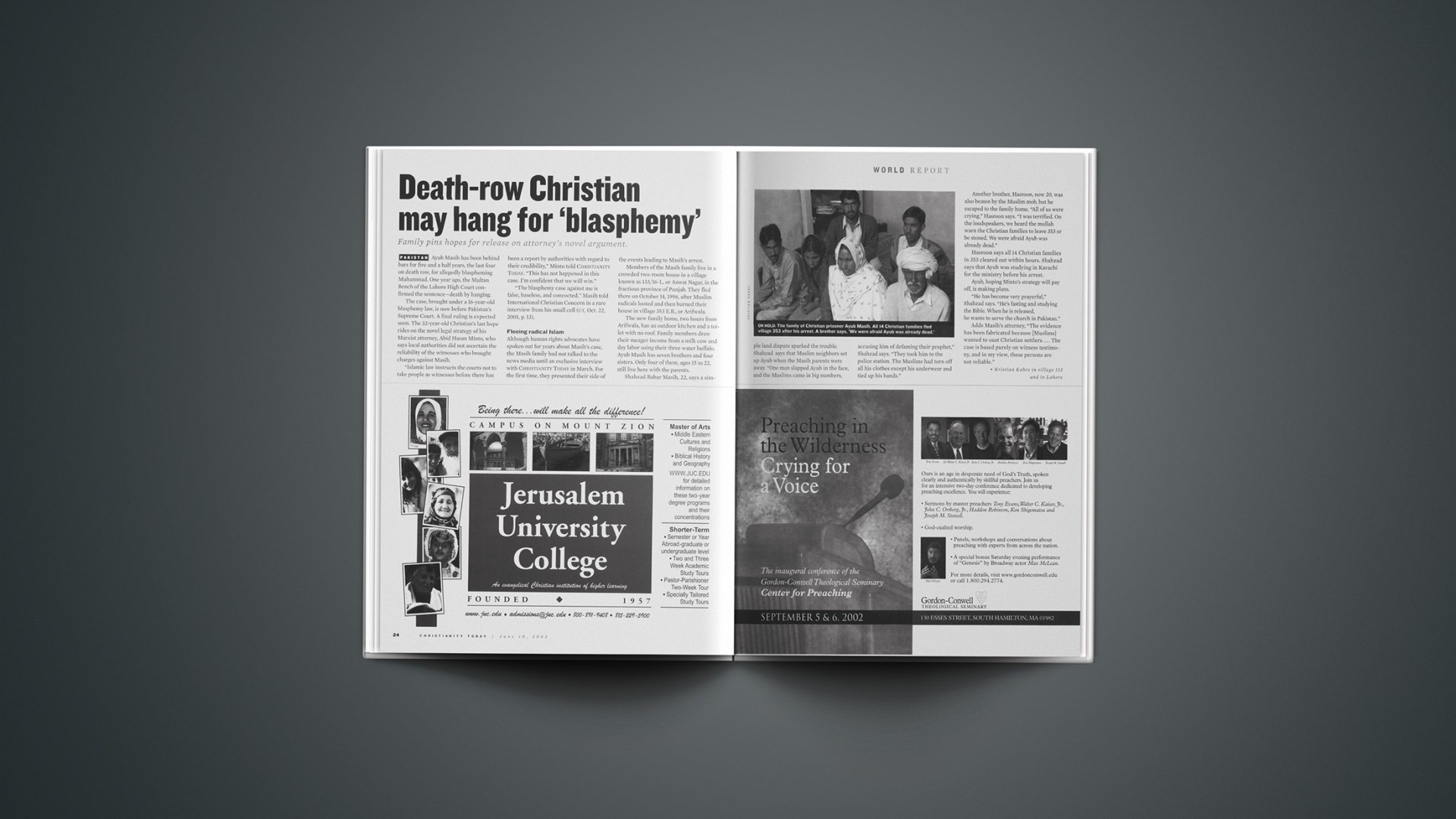

Ayub Masih has been behind bars for five and a half years, the last four on death row, for allegedly blaspheming Muhammad. One year ago, the Multan Bench of the Lahore High Court confirmed the sentence—death by hanging.
The case, brought under a 16-year-old blasphemy law, is now before Pakistan’s Supreme Court. A final ruling is expected soon. The 32-year-old Christian’s last hope rides on the novel legal strategy of his Marxist attorney, Abid Hasan Minto, who says local authorities did not ascertain the reliability of the witnesses who brought charges against Masih.
“Islamic law instructs the courts not to take people as witnesses before there has been a report by authorities with regard to their credibility,” Minto told Christianity Today. “This has not happened in this case. I’m confident that we will win.”
“The blasphemy case against me is false, baseless, and concocted,” Masih told International Christian Concern in a rare interview from his small cell (CT, Oct. 22, 2001, p. 13).
Fleeing radical Islam
Although human rights advocates have spoken out for years about Masih’s case, the Masih family had not talked to the news media until an exclusive interview with Christianity Today in March. For the first time, they presented their side of the events leading to Masih’s arrest.
Members of the Masih family live in a crowded two-room house in a village known as 133/16-L, or Amrat Nagar, in the fractious province of Punjab. They fled there on October 14, 1996, after Muslim radicals looted and then burned their house in village 353 E.B., or Arifwala.
The new family home, two hours from Arifwala, has an outdoor kitchen and a toilet with no roof. Family members draw their meager income from a milk cow and day labor using their three water buffalo. Ayub Masih has seven brothers and four sisters. Only four of them, ages 15 to 22, still live here with the parents.
Shahzad Babar Masih, 22, says a simple land dispute sparked the trouble. Shahzad says that Muslim neighbors set up Ayub when the Masih parents were away. “One man slapped Ayub in the face, and the Muslims came in big numbers, accusing him of defaming their prophet,” Shahzad says. “They took him to the police station. The Muslims had torn off all his clothes except his underwear and tied up his hands.”
Another brother, Hasroon, now 20, was also beaten by the Muslim mob, but he escaped to the family home. “All of us were crying,” Hasroon says. “I was terrified. On the loudspeakers, we heard the mullah warn the Christian families to leave 353 or be stoned. We were afraid Ayub was already dead.”
Hasroon says all 14 Christian families in 353 cleared out within hours. Shahzad says that Ayub was studying in Karachi for the ministry before his arrest.
Ayub, hoping Minto’s strategy will pay off, is making plans.
“He has become very prayerful,” Shahzad says. “He’s fasting and studying the Bible. When he is released, he wants to serve the church in Pakistan.”
Adds Masih’s attorney, “The evidence has been fabricated because [Muslims] wanted to oust Christian settlers. … The case is based purely on witness testimony, and in my view, these persons are not reliable.”
Copyright © 2002 Christianity Today. Click for reprint information.
Related Elsewhere
Previous Christianity Today’s articles on Masih’s plight include:
High Court InjusticeWhat you can do to help persecuted Christians in Pakistan. (November 14, 2001)
Condemned Prisoner Appeals for HelpSentenced to death in 1998, Ayub Masih continues to fight “baseless and concocted” blasphemy charge. (October 19, 2001)
Pakistani Bishop’s Death Sparks RiotsSuicide was in protest of the death sentence pronounced on Ayub Masih, 25, by a local judge. (June 15, 1998)
Christian Solidarity Worldwide has a special page on Ayub Masih’s story.
In 1998, Anglican Communion News Service issued a press release on Masih’s sentence with background on the blasphemy law.
For more articles, see Christianity Today’spersecution and world report section on Pakistan.