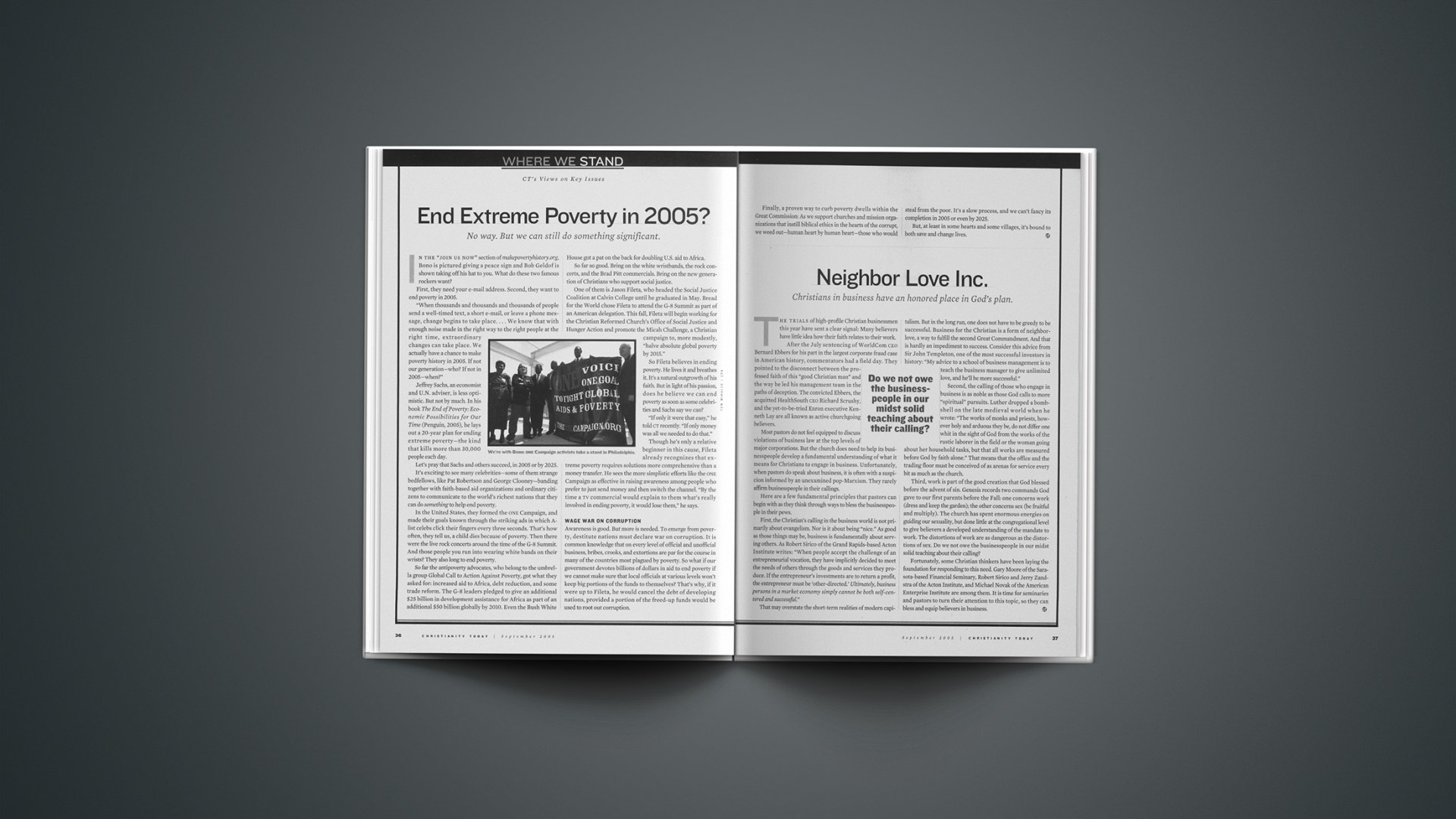
The trials of high-profile Christian businessmen this year have sent a clear signal: Many believers have little idea how their faith relates to their work.
After the July sentencing of WorldCom CEO Bernard Ebbers for his part in the largest corporate fraud case in American history, commentators had a field day. They pointed to the disconnect between the professed faith of this “good Christian man” and the way he led his management team in the paths of deception. The convicted Ebbers, the acquitted HealthSouth CEO Richard Scrushy, and the yet-to-be-tried Enron executive Kenneth Lay are all known as active churchgoing believers.
Most pastors do not feel equipped to discuss violations of business law at the top levels of major corporations. But the church does need to help its businesspeople develop a fundamental understanding of what it means for Christians to engage in business. Unfortunately, when pastors do speak about business, it is often with a suspicion informed by an unexamined pop-Marxism. They rarely affirm businesspeople in their callings.
Here are a few fundamental principles that pastors can begin with as they think through ways to bless the businesspeople in their pews.
First, the Christian’s calling in the business world is not primarily about evangelism. Nor is it about being “nice.” As good as those things may be, business is fundamentally about serving others. As Robert Sirico of the Grand Rapids-based Acton Institute writes: “When people accept the challenge of an entrepreneurial vocation, they have implicitly decided to meet the needs of others through the goods and services they produce. If the entrepreneur’s investments are to return a profit, the entrepreneur must be ‘other-directed.’ Ultimately, business persons in a market economy simply cannot be both self-centered and successful.“
That may overstate the short-term realities of modern capitalism. But in the long run, one does not have to be greedy to be successful. Business for the Christian is a form of neighbor-love, a way to fulfill the second Great Commandment. And that is hardly an impediment to success. Consider this advice from Sir John Templeton, one of the most successful investors in history: “My advice to a school of business management is to teach the business manager to give unlimited love, and he’ll be more successful.”
Second, the calling of those who engage in business is as noble as those God calls to more “spiritual” pursuits. Luther dropped a bombshell on the late medieval world when he wrote: “The works of monks and priests, however holy and arduous they be, do not differ one whit in the sight of God from the works of the rustic laborer in the field or the woman going about her household tasks, but that all works are measured before God by faith alone.” That means that the office and the trading floor must be conceived of as arenas for service every bit as much as the church.
Third, work is part of the good creation that God blessed before the advent of sin. Genesis records two commands God gave to our first parents before the Fall: one concerns work (dress and keep the garden); the other concerns sex (be fruitful and multiply). The church has spent enormous energies on guiding our sexuality, but done little at the congregational level to give believers a developed understanding of the mandate to work. The distortions of work are as dangerous as the distortions of sex. Do we not owe the businesspeople in our midst solid teaching about their calling?
Fortunately, some Christian thinkers have been laying the foundation for responding to this need. Gary Moore of the Sarasota-based Financial Seminary, Robert Sirico and Jerry Zandstra of the Acton Institute, and Michael Novak of the American Enterprise Institute are among them. It is time for seminaries and pastors to turn their attention to this topic, so they can bless and equip believers in business.
Copyright © 2005 Christianity Today. Click for reprint information.
Related Elsewhere:
The Acton Institute has many resources on its Business and Society page.
More about Gary Moore‘s Financial Seminary has a collection of amusing and provocative quotes about money, business, and spirituality.
More on the intersection of business and ministry includes
Dennis Bakke’s Ode to Joy | The outrageous way in which an energy giant’s CEO had fun at work. (July 07, 2005)
The Missions of Business | What can happen when entrepreneurs think they are missionaries first. (April 13, 2004)
Compassionate Capitalism | How Christians are using fair trade to help the world’s poor, missionaries, and shoppers. (Nov. 12, 2003)
The 40 Best Christian Places to Work | What makes them so good? (Hint: Not money) (Feb. 28, 2003)
When Business Aims for Miracles | Minneapolis-St. Paul business professionals are some of the inner city’s most effective “social entrepreneurs.” (May 25, 2001)
Coffee That Cares | A Costa Rican church underwrites an urban outreach effort with premium coffee sales (Oct. 5, 1998)
Coffee Sales Perk Up Ministry Support | Pura Vida has donated $10,000 to missions and aid organizations (Jan. 10, 2000)