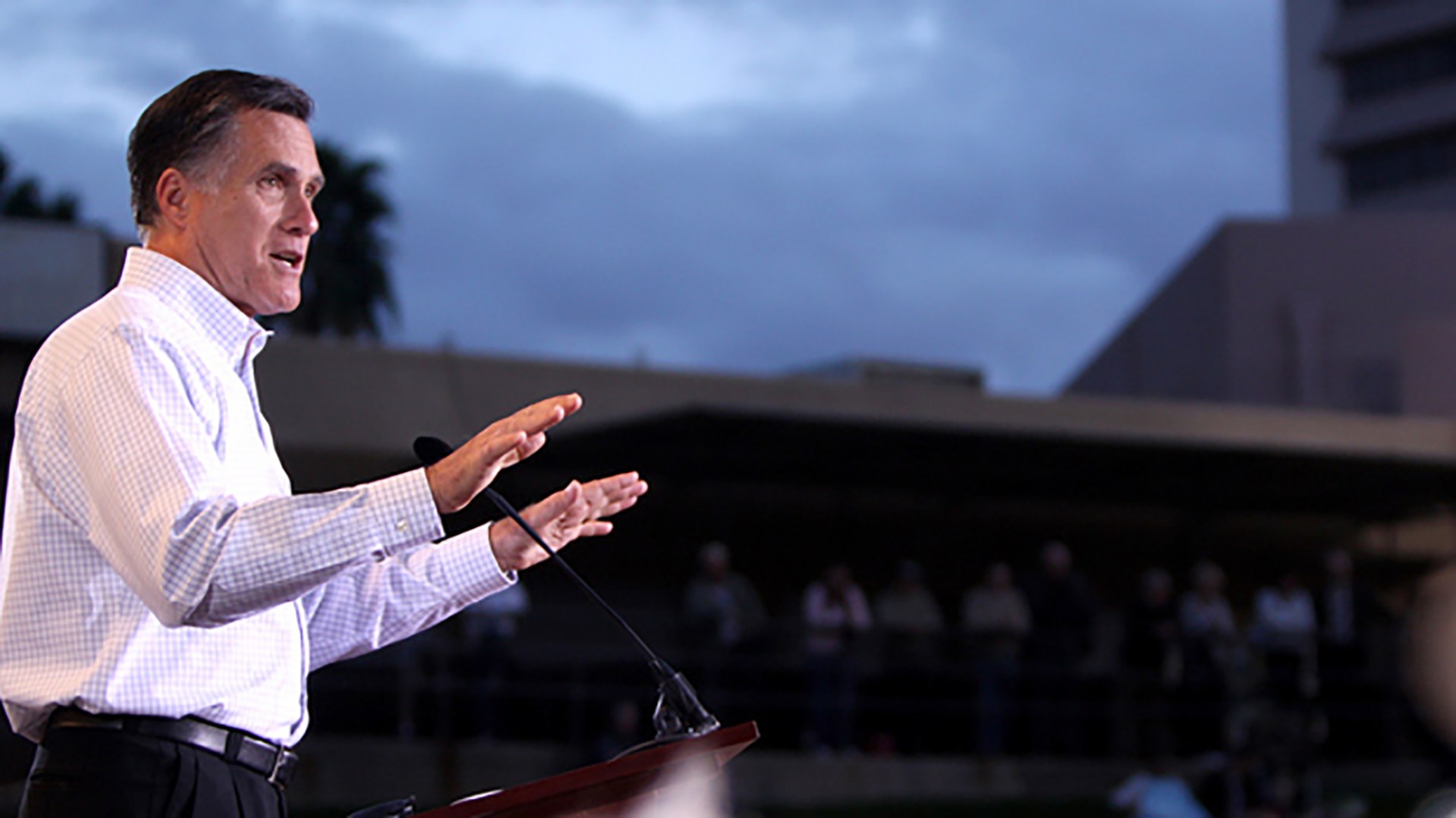
Governor Mitt Romney is gaining on President Barack Obama in national polls. Following last week's presidential debate, public opinion shifted. The polls now show the race as a tie. Among evangelicals, however, support for Romney appears to have reached its ceiling. The battle for votes now lies elsewhere.
The Pew Research Center for the People & the Press released its latest political poll Monday. The poll, taken after last week's debate, found Romney ahead of Obama among likely voters 49 to 47 percent. This was a significant shift from Pew's September poll, which had Obama ahead 51 to 43. Both polls show white evangelicals solidly behind Romney. Three-quarters of evangelical likely voters said they will support the GOP ticket. At the other end of the religious-political spectrum, both polls showed those unaffiliated with any religion remaining two-to-one in Obama's camp.
As the race moves forward, both campaigns are unlikely to seek out votes from voters so unlikely to change their minds. Instead, the focus will be on those who can still be persuaded.
If evangelicals and seculars are no longer voting blocs worth fighting over, then they are also unlikely to receive much media attention. Evangelicals mattered in the run-up to the Republican convention, but in the home stretch of the general election, they are no longer newsworthy.
Mainline Protestants and Catholics are now the key religious groups for both campaigns. In September, only 46 percent of mainline Protestants supported Romney. Today, 60 percent say they support the Republican candidate. Catholics have also shifted their support, from 40 percent supporting Romney last month to a dead heat this month. The Romney campaign will want to solidify this new support; the Obama campaign will want to recapture it.
Today's political environment is flush with data. Journalists and pundits, candidates and parties can home in on those voters most likely to fluctuate over the final four weeks of the campaign. Red states and blue states are ignored in favor of swing states whose outcomes cannot be so easily predicted.
Indeed, the major news outlets are no longer willing to shell out the money needed to survey voters in many states. The National Election Pool (NEP; a project of the major television networks and the Associated Press) will not include detailed exit poll results for much of the country. For the past two decades, NEP has surveyed voters in each of the fifty states and the District of Columbia on election day. The result is both a national picture of the electorate and detailed analysis of each state's voters. This year, NEP is scrapping 19 statewide polls because they do not have any competitive races whose outcomes are worth analyzing. Predicting the outcomes of these states is no longer worth the cost of conducting statewide exit polls.
Most of the states are so-called red states that will almost certainly break for the GOP in the presidential race (Alaska, Arkansas, Georgia, Idaho, Kentucky, Louisiana, Nebraska, North Dakota, Oklahoma, South Carolina, South Dakota, Tennessee, Texas, Utah, West Virginia, and Wyoming). Also on the list are smaller electorates that will go Democratic (Delaware, District of Columbia, Hawaii, and Rhode Island). Without a competitive Senate or gubernatorial race, solidly red or blue states are not worth surveying. Each of these states will have some pollsters asking questions for the nationwide poll, but there will not be enough people surveyed to provide a picture of each state's electorate. (See, for example, CT's map of evangelical voting trends in the 2008 election, based on that year's exit poll data.)
The lack of exit polls will limit what can be said about these states, but NEP has decided it would be better to focus its resources elsewhere than to spend them on predicting how states like Utah or Delaware will vote. Predictable is not newsworthy.
Which is why we are unlikely to hear much more about evangelical voters until the GOP primaries in 2016.