Christian educators in Israel say their 48 high-achieving primary and secondary schools may be forced to close due to funding discrimination by the state’s Ministry of Education.
“For years, the ministry has been consistently cutting the budget of Christian schools—45 percent in the last 10 years,” Christian school administrators said in a joint statement. Those cuts caused Christian schools to raise the fees that parents pay. Previously, the ministry subsidized about two-thirds of the total budget for Christian schools.
“[But] last year, the ministry issued new regulations that even limited the ability of Christian schools to collect fees from the parents. The combination of these two things, substantial budget cuts and limiting allowable fees, is actually viewed as a death penalty for these schools,” the statement said.
Many of these Christian schools existed before the state of Israel was founded in 1948 and they have a superior academic track record. Christian Arabs have the highest rate of success in Israel’s matriculation exams (Bagrut), which largely determine who is admitted to a state university. Christian schools in total educate 33,000 students, about half of whom are Christian and half are Muslim, and they instruct students in traditional academic subjects, the Bible, and Christian doctrine. Israel has 1.4 million students in K-12 schools.
The ministry provides 100 percent funding for 200,000 ultra-Orthodox students in religious, nonpublic schools. Israeli Christians believe this is unfair treatment since Israeli national law prohibits discrimination in education. “In a challenging time like this for Christians in the whole Middle East, we expect Israel to deal with this identity matter of Christians in a sensitive way,” said Botrus Mansour, director of Nazareth Baptist, a K-12 school that is nationally recognized for excellent instruction. Christian school administrators want the ministry to fully fund recognized Christian schools.
“The [ministry] did exactly that [100 percent funding] with another distinctive group, two networks of the ultra-Orthodox Jewish community. There is surely inequality in the dealing with the mentioned different groups. Both of us are in the same category of ‘recognized but not public,’ Mansour said.
“We abide to the requirement of the ministry to teach the core subjects and submit to inspection of the ministry, but [the ultra-Orthodox] don’t. Result: We receive partial funding—and such that has been sliced year after year—while [others] get full funding.”
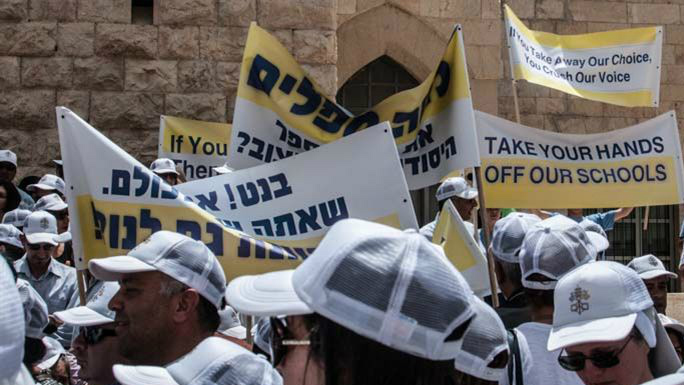
Last week in Jerusalem, more than 500 hundred parents, students, teachers, and administrators gathered to protest in front of the ministry on behalf of these schools. Many held banners that read, “If you care, be fair.” Five Christian bishops and eight members of the Knesset (the Israeli parliament) attended the demonstration.
“Our situation is untenable, and we can’t go into the parents’ pockets because many parents come from a low socioeconomic class,” said Awni Bathish, the principal of the Salvatorian Sisters School in Nazareth at the protest. Many schools have difficulty collecting fees of $1,030 a year per student that parents are charged.
In response, the ministry said, “The church schools, like other recognized but unofficial schools in Israel, are budgeted according to the parameters set down in legislation. . . . The director-general also proposed to them the following alternatives: preserving these schools’ status as recognized and unofficial for the meantime while examining the possibility of classifying them as ‘unique’ schools. Then the ministry would help these schools as it does the other ‘unique’ schools that are part of the recognized but unofficial framework.”
The ministry said if a Christian school agreed to join the public education system, it could receive 100 percent budget coverage. Officials would seek to maintain that school’s “special characteristics.” But Christian educators rejected that offer outright. Several Israeli Catholic school leaders said they were calling on Pope Francis to intervene on their behalf with the Israeli government.
Oudeh Basharat, a liberal columnist for Haaretz, a major daily newspaper, wrote:
Arab MKs [members of the Knesset] Ayman Oudeh, Osama Saadia, Haneen Zoabi, Zouheir Bahloul, Yousef Jabareen, and Aida Touma-Suliman are all graduates of Christian community schools in Israel; more than 30 percent of Arab MKs are graduates of these schools. The alumni of these schools have similarly outstanding academic achievements, even though only 4 percent of all Arab pupils study in them. For some reason, the state’s leaders seem determined to crush these producers of Arab MKs and academics.
The next step for Christian schools is unclear.
Nazareth Baptist’s Mansour said it is possible that come Sept. 1, the start of the new school year, all 48 schools would not reopen until the funding dispute is resolved. “[We want the ministry] to appreciate the work that the Christian schools have been doing in Israel for decades,” Mansour said.