
For most churchgoers, faith doesn’t conflict with science, according to the latest survey from the Pew Research Center. In fact, most of the time, religious affiliation doesn’t affect how Americans view scientific topics.
“Our analysis points to only a handful of areas where people’s religious beliefs and practices have a strong connection to their views about science topics,” lead author Cary Funk stated, “and a surprising number of topics where religious differences do not play a central role in explaining their beliefs.”
Other factors that likely play a bigger part: gender, age, race, and education.
Here’s how white evangelicals, black Protestants (two-thirds of whom identify as evangelicals, according to Pew), and Americans who attend religious services weekly feel about 20 science topics:
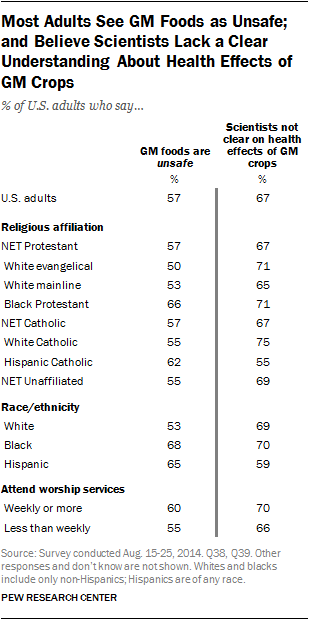
1. Two-thirds of black Protestants (68%) said genetically modified foods are unsafe, slightly higher than weekly worshipers (60%) and substantially higher than white evangelicals (50%). But 7 in 10 in each group feel that scientists don’t have a clear understanding on the health risks of genetically modified crops.
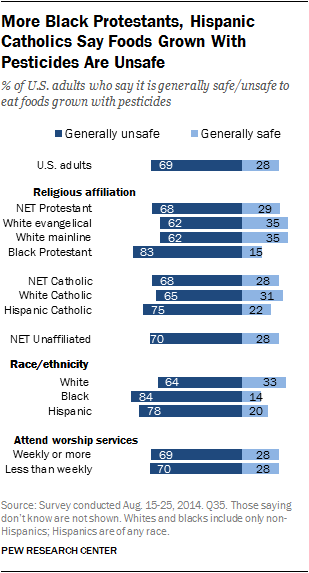
2. Black Protestants are also more wary of foods grown with pesticides. A full 83 percent said pesticides were generally unsafe, nearly 15 percentage points higher than weekly worshipers (69%) and more than 20 percentage points higher than white evangelicals (62%).
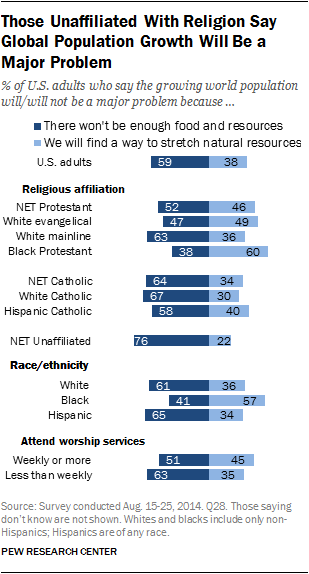
3. The majority of adults (59%) are worried there won’t be enough goods and resources for the growing global population. Weekly worshipers (51%), white evangelicals (47%), and black Protestants (38%) are less concerned. Black Protestants are most likely (60%) to say humans will find a way to stretch natural resources to accommodate everyone.
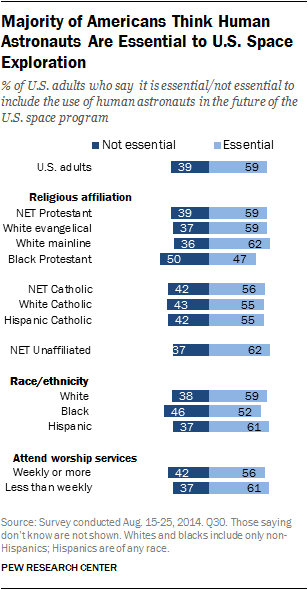
4. Human astronauts are essential to the future of the space program, said nearly 6 in 10 white evangelicals (59%) and weekly worshipers (56%). Black Protestants (47%) were less convinced.
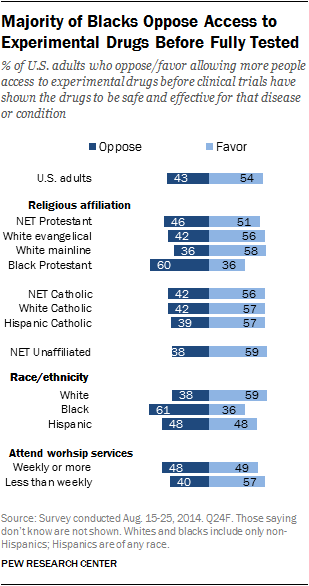
5. A full 60 percent of black Protestants oppose allowing people to access experimental drugs before the pills are proven to be safe and effective, far more than white evangelicals (42%). Weekly worshipers are evenly split on the issue (49% in favor; 48% opposed).
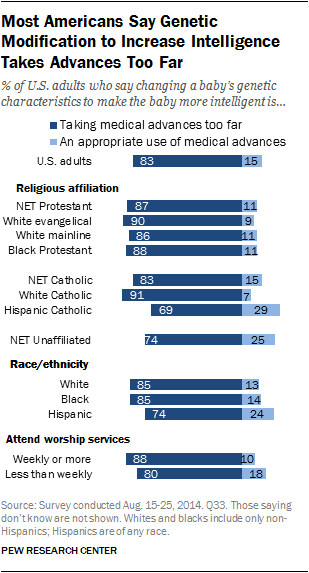
6. More than four in five Americans (83%) are opposed to the genetic modification of babies to improve their intelligence. White evangelicals (90%), black Protestants (88%), and weekly worshippers (88%) are even more united in their opinion that this takes medical advances too far.
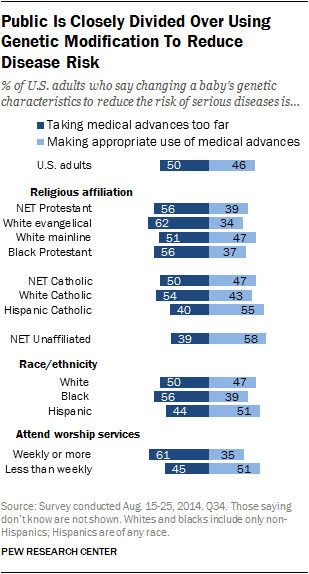
7. Modifying a baby’s intelligence is one thing; altering genes to reduce the risk of serious disease is another. More than one-third of white evangelicals (34%), weekly worshipers (35%), and black Protestants (37%) think this is an appropriate use of medical advances.
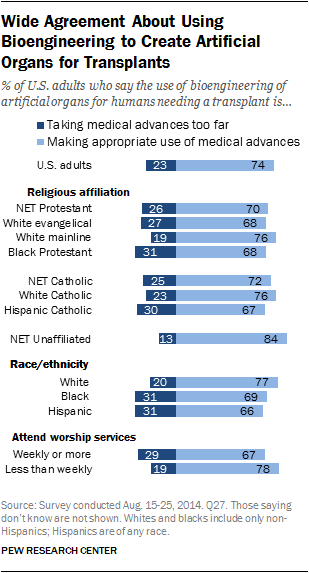
8. About one-third of black Protestants (31%) said using bioengineering to make artificial organs for transplant is going too far, slightly more than weekly worshippers (29%) and white evangelicals (27%). Just 2 in 10 infrequent worshipers (19%) feel the same way.
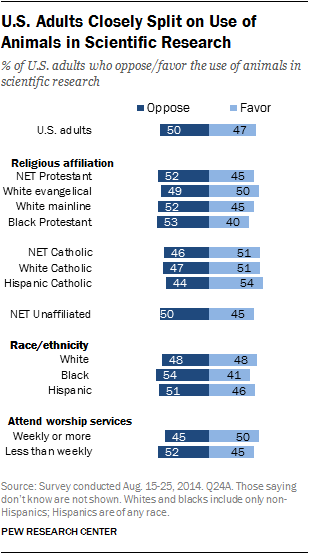
9. About half of American adults (50%), white evangelicals (49%), and weekly worshipers (45%) favor using animals in scientific research. Just 4 in 10 black Protestants (40%) agree.
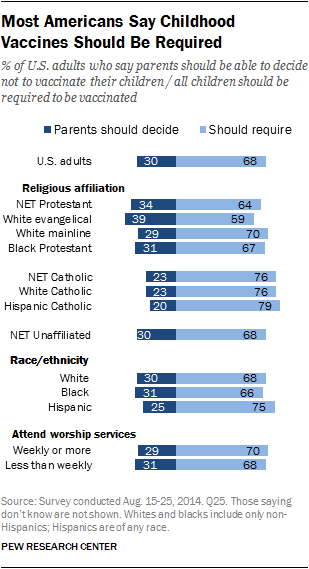
10. About 7 in 10 Americans (68%), black Protestants (67%), and weekly worshipers (70%) favor requiring childhood vaccinations. Fewer white evangelicals (59%) agree.
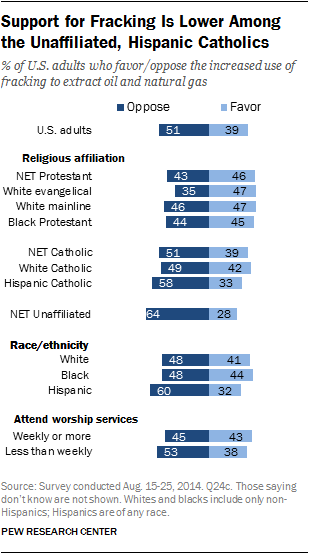
11. White evangelicals have the lowest opposition (35%) to the increased use of fracking to extract oil and natural gas, about ten percentage points lower than black Protestants (44%). Those who attend worship services weekly are less likely to oppose fracking (45%) than those who attend less frequently (53%).
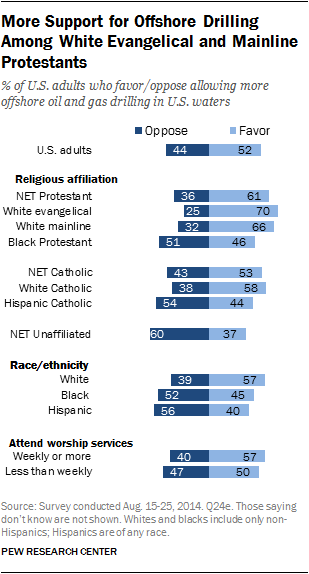
12. White evangelicals (70%) and weekly worshipers (57%) are more likely to favor allowing more offshore drilling for oil and gas in US waters, compared with about half (52%) of all Americans and just 46 percent of black Protestants.
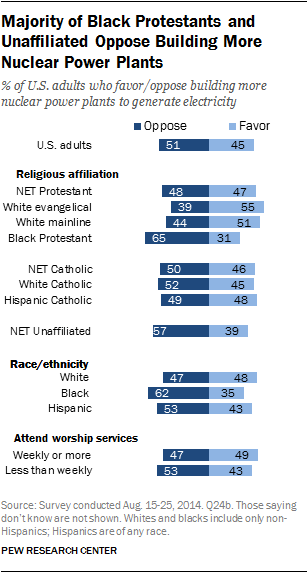
13. About half of Americans (51%) and weekly worshipers (47%) oppose building more nuclear power plants to generate electricity. White evangelicals are about ten percentage points less opposed (39%), and black Protestants are about ten percentage points more opposed (65%) to the idea.
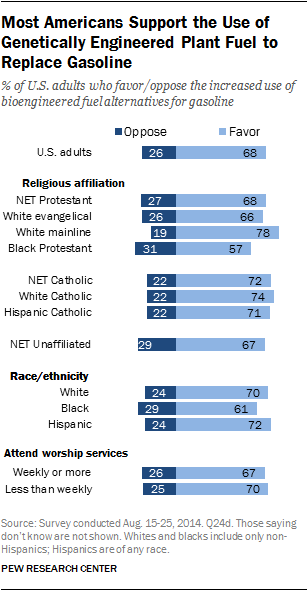
14. Almost everybody is on board with the increased use of bioengineered fuel alternatives to gasoline: 68 percent of US adults, 67 percent of weekly worshipers, and 66 percent of white evangelicals agree. Black Protestants agree, too, but less heartily (57%).
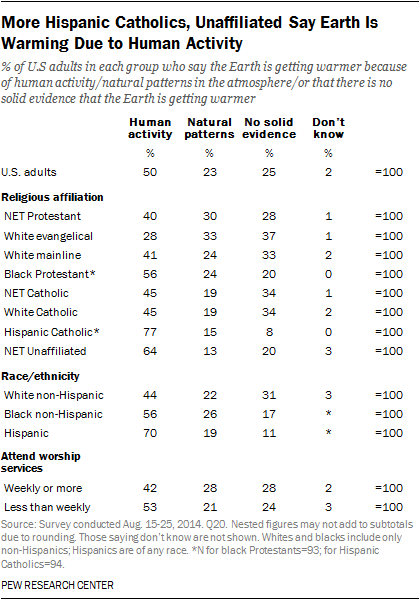
15. Almost 4 in 10 white evangelicals (37%) said there is no solid evidence for global warming, compared with 28 percent of weekly worshipers and 20 percent of black Protestants. Of the three groups, black Protestants are most likely to pin blame for global warming on human activity (56%), compared to weekly worshipers (42%) or white evangelicals (28%). White evangelicals are also far more likely (47%) to say that scientists don’t agree on global warming than black Protestants (33%) or weekly worshipers (38%).
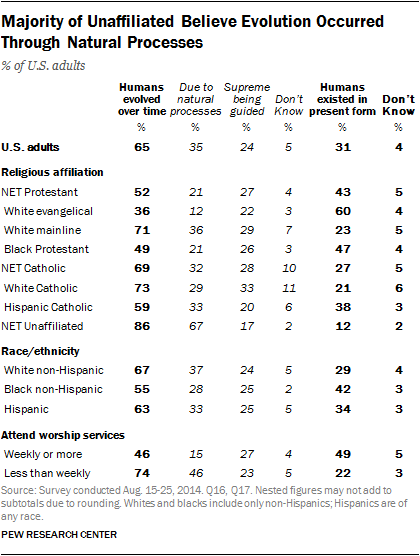
16. About twice as many white evangelicals (60%) as Americans (31%) say humans have existed in their present form since the beginning of time. Black Protestants and weekly worshipers are nearly evenly split, with slightly more black Protestants saying that humans evolved (49%) and slightly more weekly worshipers saying that humans always existed in this form (49%). Of the white evangelicals and weekly worshipers who said humans evolved over time, two-thirds said that the process was guided by a supreme being, while one-third said it was due to natural processes. Black Protestants were nearly split again, with slightly more favoring guidance by a supreme being.
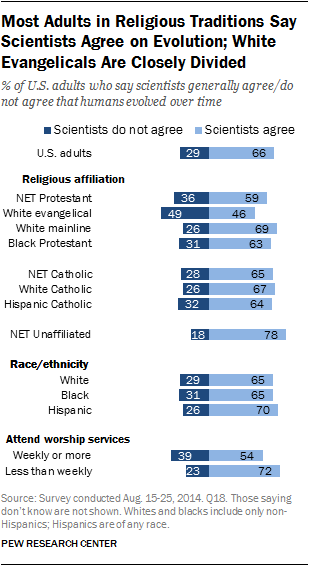
17. Most adults (66%) and black Protestants (63%) say that scientists agree on evolution, while white evangelicals are split on the issue (49% say scientists do not agree; 46 percent say they do). Weekly worshipers are much more likely to say scientists disagree (39%) than those who attend less often (23%).
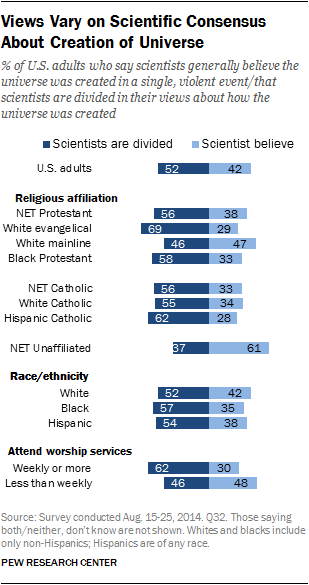
18. Nearly 7 in 10 white evangelicals say scientists are divided on the origins of the universe, more than weekly worshipers (62%) or black Protestants (58%), and far more than American adults at large (52%).
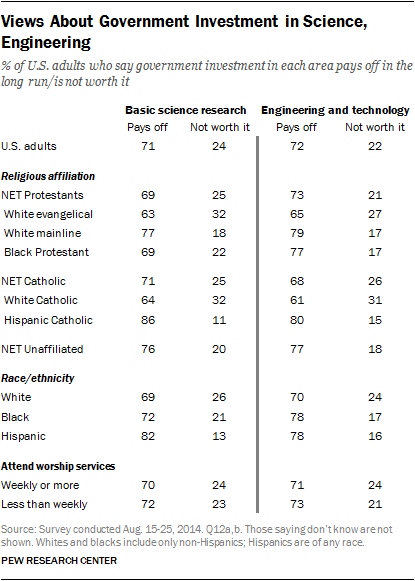
19. Roughly 6 in 10 white evangelicals (63%) and 7 in 10 weekly worshipers said that government investment in basic science, engineering, and technology pays off in the long run. Black Protestants felt that engineering and technology (77%) were more worthy of such investment than basic science (69%).
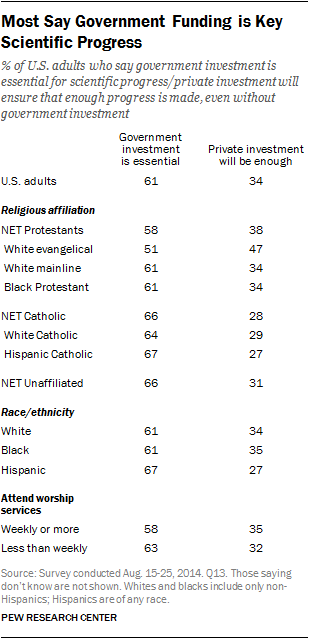
20. About half of white evangelicals (51%) said that government funding is essential to ensure that scientific progress is made. Black Protestants (61%) and weekly worshipers (58%) were even more supportive.
CT previously reported on the primary finding of Pew's latest report: churchgoers are least likely to see religion and science in conflict.