


In this series


My neighborhood, just outside of Washington, DC, has a strong sense of local community. I know the people on our block, and I love bumping into folks—at PTA meetings, sports outings, or the grocery store. My neighborhood has quaint traditions: We celebrate holidays with cookie exchanges. Local groups play music on front lawns in the summer. On these lovely nights when people are walking the block, I don’t see the divisions and divides that worry me when I read the news.
So I was surprised a couple of months ago to find out that I didn’t actually know many of my neighbors. One of my kids was collecting items for a service project. On a Saturday morning, we slowly walked the block, placing a flyer at each door. With half a stack of flyers left, we continued to the next block—a block I walk or drive often.
But the slowness of the task caused me to pause, to stop at each door, to see each place where people live. I noticed the numbers on the walls, the color of the doors. And I was surprised at how many homes I had never “seen” before. I was surprised, just one block away, how few of the people I knew. Before that day, I would have called these folks my neighbors. In reality, I didn’t know my neighbors.
Throughout the Gospels, we see the exhortation to “love your neighbor as yourself” and to “love the Lord your God with all your heart and with all your soul and with all your mind” (Matt. 22:37–40; Mark 12:29–31). But who is my neighbor (Luke 10:29)? And what does being a neighbor look like in a time of such polarization?
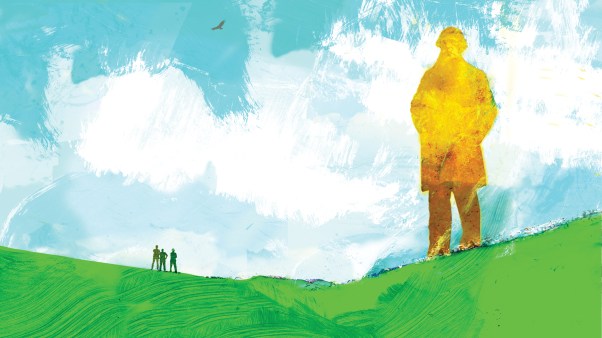
When I try to make sense of what it means to love my neighbor, I think of Acts 1:8. In this passage, Jesus exhorts his followers to bear witness to the power of his resurrection in Jerusalem, in Judea and Samaria, and to the ends of the earth. Jerusalem was essentially the disciples’ city. Judea was the larger region that contained their local city. Samaria was a region just next to Judea—a place that was adjacent and had a different ethnic group. And the ends of the earth were, well, everywhere else.
I use these categories of Jerusalem (the city where I am), Judea and Samaria (the region I’m in and the one next to it), and “the ends of the earth” (everyone else) to help me think about whom I consider my neighbor. I try to make sure I have neighbors in each of these groups.
Jesus’ invitation to his first followers to bear witness is extended to us today—to be people who bear witness to Jesus “in Jerusalem, in all Judea and Samaria, and to the ends of the earth.”
When I’m trying to navigate tricky issues, expanding my definition of neighbor like this helps. I try to use these three categories of people to stretch me to care about people just beyond my natural inclination—people in the place where I am, the place just next to me, and a place farther away.

How does an issue affect people like me? Or people who are adjacent to me—nearby, but perhaps affected slightly differently? And how does it affect people with whom I don’t have much in common, people who seem far from me? And what response to this issue would bear witness to God’s character and love to each of these different groups?
That final group, the ends of the earth, seems like a catchall: Did I miss anyone? Well, reach out to them too. One of my favorite insights about missions comes from an Indigenous Christian theologian who pointed out to me that North America might be part of what the early church imagined as “the ends of the earth.” It’s humbling to think that I am someone else’s “ends of the earth.” And at the same time, it nudges me to do the extra work of caring about someone different, perhaps even at odds with my group.
With each of these circles, I try to think, How can I love this group of neighbors as myself? How can I learn more about the realities of their daily life, their priorities, and their cares? And how can I carry that perspective with me as I think about my role as a Christian committed to social action? Are there places where I can journey alongside, add my voice as a support, and function as a neighbor in this diverse and dynamic place where we live?
Caring only about the people nearest to us or most like us doesn’t bear witness to our God, who cares for all people and calls people from all nations to become part of his family. Only seeking the good of those who live near us or live like us can lead us to perpetuate economic, racial, ethnic, or other divisions. That lifestyle doesn’t bear witness to Jesus’ power to be a peacemaker who is able to remove dividing walls and bring unity to groups separated by hostility (Eph. 2:14–15).
Our current political system encourages a self-serving posture. It leads us to ask, “How do I accumulate power and use it to push through my demands and center my priorities for my own well-being?” This perpetuates a game where there are winners and losers.
In a world like this, one of the most compelling ways we Christians can bear witness is by being generous with our hearts, passions, and interests and by using our voices, votes, and energy on behalf of our neighbors. We can love our neighbors as ourselves and love God with our heart, soul, mind, and strength.
My hope is that Christians would not play politics the way the world does, but rather—filled with an abundance that comes from being unconditionally loved, repeatedly forgiven, and embraced by a caring, powerful, and compassionate God—feel generous with our love, hope, and faith.
We can not only love the neighbors who have commonalities with us but also love the neighbors who are just over and beyond our reach. In this way, we can be people who bear witness to and live in the reality of Jesus, the peacemaker who removes walls of hostility and offers reconciliation generously.
Nikki Toyama-Szeto is the executive director of Christians for Social Action.