Today, October 31, Reformation Day, evangelicals in Argentina have an extra reason to celebrate, as their country officially recognizes the National Day of Evangelical and Protestant Churches.
A bill calling for this recognition was approved by the lower Congreso de la Nación chamber, the Chamber of Deputies, last year. In April, the bill was unanimously approved in the Senate Chamber and then signed by president Javier Milei.
“Today we are not celebrating a religious holiday,” said Christian Hooft, who leads ACIERA (Alliance of Evangelical Churches in the Republic of Argentina), at an event celebrating the day last Monday. “We are celebrating the historical identity of the faith of millions of Argentine citizens.”
Argentina’s evangelicals have long sought this recognition. The country’s Supreme Court has ruled that the country has no official or state religion, and its constitution guarantees freedom of religion, but it also states that “the federal government supports the Roman Catholic apostolic faith.”
For Renata Viglione, a Christian psychologist who coauthored the current bill, the new law recognizes religious freedom rights. “We were the only faith community that did not have its own commemoration, unlike other religions. It is not a law out of gratitude for the social work [that evangelicals do in the country], but a human right as citizens,” she said. Commemorative days for Catholicism and Judaism were established in 1995 and one for Islam in 1996.
Being added to the calendar of official commemorations constitutes an evangelistic opportunity to make the church and Jesus Christ known and to proclaim the gospel, Viglione stated.
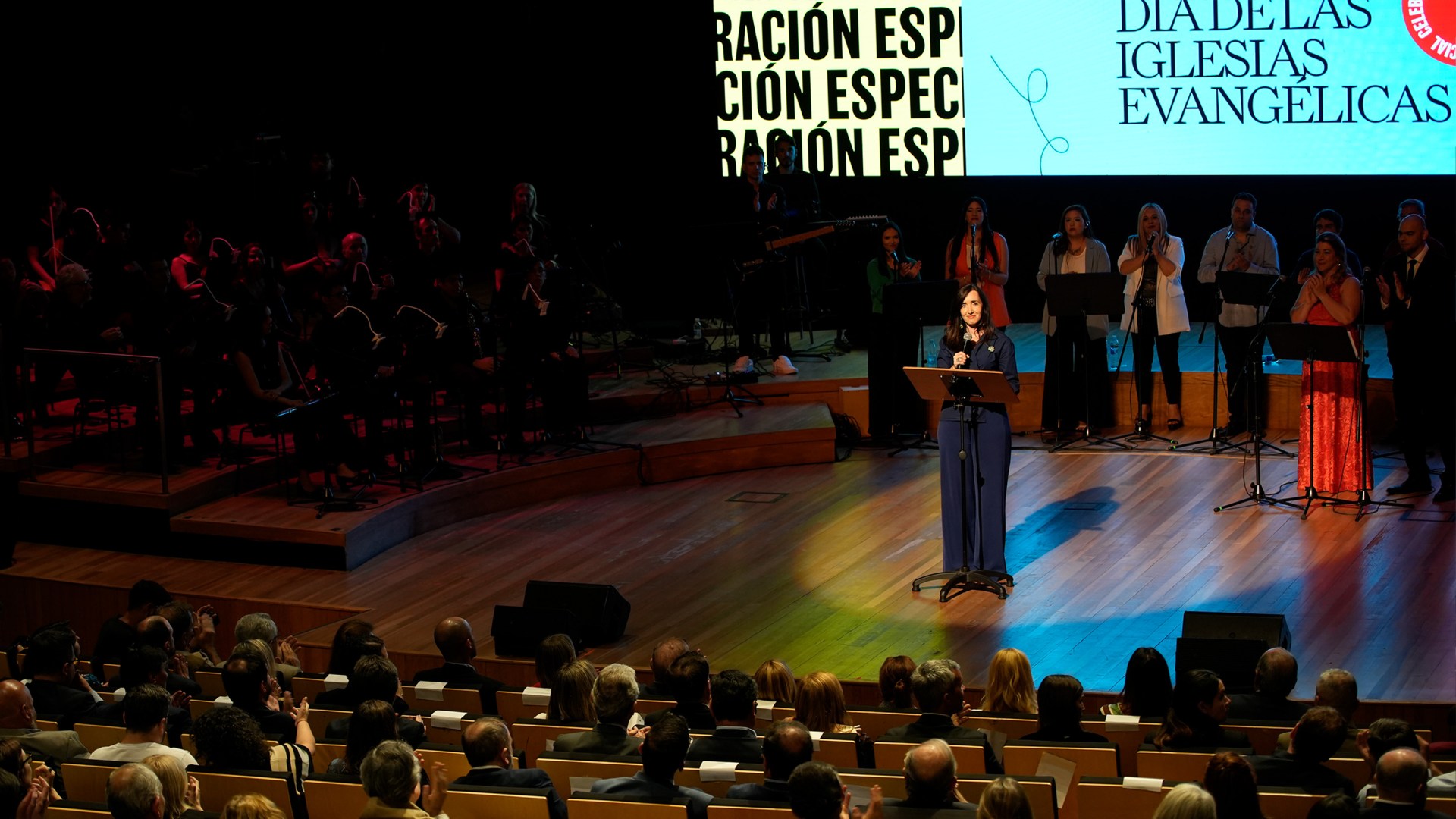
Last Monday, ACIERA celebrated the National Day of Evangelical and Protestant Churches at the Palacio Libertad building in the city of Buenos Aires. The celebration was attended by more than 1,600 people from all over the country, including Catholic, Jewish, and Muslim leaders. Tango dancers performed along with 40 musicians and 100 singers.
“On Monday, the Lord was glorified,” said Chris Swanson, senior director of crusades and development at the Billy Graham Evangelistic Association, which will hold a Franklin Graham festival in Buenos Aires in 2025. “This event represents the new value that the evangelical church in Argentina has in the eyes of authorities, which I believe will open doors, God willing, for there to be even greater freedom, and outreach for the gospel.”
At the event, Argentine Vice President Victoria Villarruel, who is Catholic, acknowledged the evangelical community’s work in “helping the most vulnerable communities” and highlighted the social and spiritual character of the work that both Catholics and evangelicals do in the country, a task “inspired by Christian love and understanding, [which] is the fundamental pillar for building a more just and unified Argentina.”
The country’s evangelical community represents 15 percent of the country’s population according to the latest CONICET survey conducted in 2019, an increase of 9 percentage points over 2008. The same survey showed that evangelicals make up 20 percent of Argentinians between 18 and 29 years old and 26 percent of those with only a high-school education.
This bill was not the first one proposed at the Congress to honor evangelicals. Rather, it was the culmination of a 10-year process involving multiple political parties and expressions of faith, dating back to deputy Pablo Tonelli’s proposal in 2014.
Dina Rezonivosky, a deputy from the Juntos por el Cambio (Together for Change) party who herself is evangelical, introduced bills in 2020 and 2022; in the latter year, deputy Vanesa Massetani (of the Unión por la Patria party) presented her own proposal.
In 2023, three more deputies from the Unión por la Patria offered additional bills. The various versions were eventually unified in a consensus bill that passed the Chamber of Deputies. Approval by the Senate and the president’s signature followed this year.
“[The National Day] is a recognition of the tireless work of pastors, leaders and Christians who anonymously visit schools, hospitals, prisons, and police stations and work for the peace of the nation,” Amilcar Matosian, who is part of the Buenos Aires Pastoral Council, told CT. “Our values for the common good, dignifying work, families and development are not seen in any event, but they are part of our culture expressed in every family and believer.”
Viglione added that the new law is the result of ten years of tireless outreach to government officials, pastors, and the community as a whole, and that it opens up greater opportunities for evangelization at the national level. “It shows us that it is not necessary to hold a political office to have a law approved. It is enough to be obedient to the Lord’s calling for each one, and to present petitions to the authorities as a citizen. We have all been called to proclaim the gospel, and that is the main objective of this law,” Viglione stated.
Leaders say there is still work to be done.
For starters, outside the city of Buenos Aires, the government does not legally recognize non-Catholic churches as churches.
“This is a first step toward the still pending modification of the Law of Worship or the creation of a new Religious Freedom Law that recognizes evangelical entities as what they are: churches,” deputy Rezinovsky told CT.
In the city of Buenos Aires, churches have achieved a more favorable legal status thanks to the modification of the Civil and Commercial Code through the Supervisory Board of Companies this year.
“In practice, we are a foundation, civil association, or development society, but nothing is further from reality,” said Matosian.
ACIERA leaders noted that another needed step is establishing evangelical chaplains in the security forces, hospitals, schools, and prisons in all Argentine provinces.
This year, the Ministry of Security of Buenos Aires created its first general evangelical police chaplaincy section, which will report to the chief of police, and invited the city’s council of evangelical pastors to appoint a representative as chaplain. Other provinces that already have evangelical chaplains are Misiones, Neuquén, and Chaco.
At Monday’s celebration, speakers highlighted the role of the evangelical church in Argentine society, including their work in rehabilitation centers and prisons and their anti-addiction and food bank ministries.
Felipe De Stefani, ACIERA’s vice president for management and planning, acknowledged that progress in these areas has been long overdue for the church in Argentina. Historically, the associaiton focused primarily on the city and province of Buenos Aires. Since Hooft became president in 2021, ACIERA has broadened its work by adding representatives from other provinces to its board of directors, as well as organizing annual meetings and other gatherings across the country.
“These factors have contributed to a deeper nationwide reach in ACIERA’s actions and have helped increase the unity of the Argentine evangelical church,” De Stefani told CT.
In his remarks on Monday, Hooft called on the church to exercise forgiveness towards those they have felt wronged by and abandon positions that cause division, which “paralyzes and inhibits us as a nation.” He added, “We must perceive and call things as they are, not get distracted, speak the truth, and leave euphemisms aside.”
Hooft also highlighted the important role of the evangelical church in seeking positive change while lamenting the poverty rate and the cultural and moral degradation Argentina is facing.
Evangelical leaders hope that Argentina is on the verge of spiritual awakening.
“Today we see a church united as never before. It engages in debate and discussion, but it works in unity for the extension of the Kingdom of God,” De Stefani said. “This portends a time of real revival in Argentina. It is coming.”