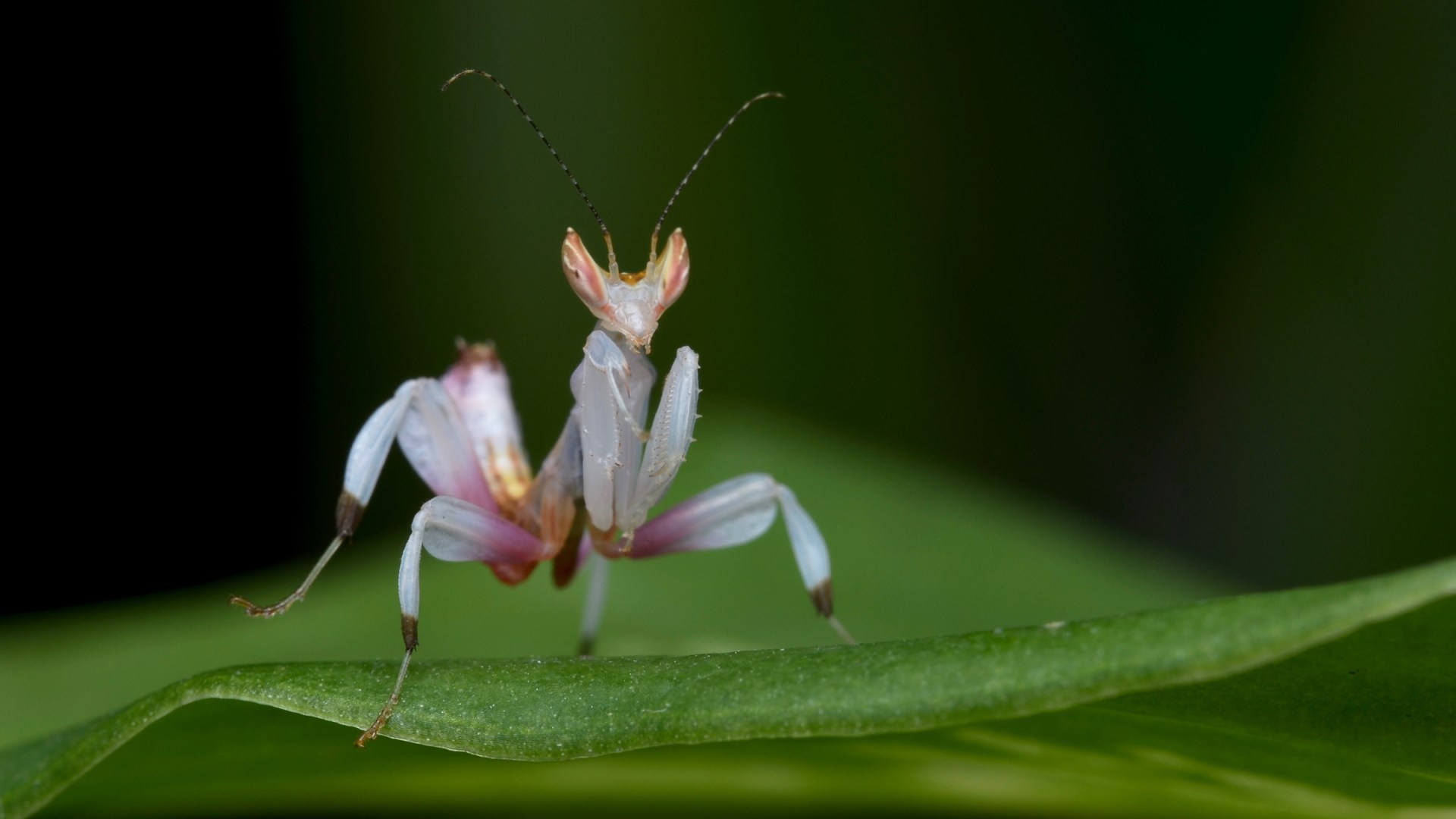

Orchid Mantis
This kind of mantis favors haute couture over neutral garb. The elaborate disguise would seem to be a form of “cryptic mimicry”: unsuspecting prey insects land in a cluster of flowers, only to be snatched up by the mantis lurking there, unnoticed. This ruse apparently fooled the 19th-century travel writer James Hingston, who wrote of visiting an Indonesian garden harboring a certain carnivorous orchid, which “enclosed [a butterfly] in its pretty but deadly leaves, as a spider would have enveloped it in network.” But the real motive for the orchid mantis’s fancy costume is a bit more complex. In the wild, orchid mantises aren’t trying to hide at all. When researchers observed them in the field, they found that the mantises “were not hiding amongst flowers, but were sitting on their own against a backdrop of green vegetation.” Orchid you not.
Danish Crucifix
This little filigreed crucifix—unearthed from a field via metal detector—has been called “an absolutely sensational discovery” by a museum curator. Why so sensational? Because the pendant has been dated to the early 900s, which predates even the Jelling Stones. The inscriptions on the Jelling Stones document the conversion of Denmark’s rulers to Christianity, and were previously considered the oldest representation of Jesus in Denmark. So the discovery of this crucifix is strong evidence that the Danes broadly embraced Christianity earlier than we thought. Looks like Denmark’s historical record might be needing some adjustments … and it’s all because Dennis Fabricius Holm got off work early on a Friday afternoon and decided to scope around a nearby field for fun. (All that said, we’ve known for a while that Christianity came to Denmark long before the 990s—Irish missionary Willibrord, for example, went there in the early 700s. For more of the story, see J. R. Christianson’s article from Christian History.)
Work, Wonder, and Worship
We’d love to see every church celebrate the awe and wonder of science the way Ruth Bancewicz’s has. The congregation recently set aside an area of the church building as a “science-faith gallery exhibition,” where members who are scientists can showcase the beauty of creation as they encounter it in their work: through the lenses of an electron microscopes, the arrangement of the periodic table, the graceful functionality of chalk cliffs. Here’s an excerpt from the entry by biochemist Phil Balding, who works on DNA sequencing:
When I think about how everything that makes a human can be boiled down to DNA, it makes me stand in awe of the infinite God who breathed life into this bag of molecules, wants to have a relationship with me, and even came down to earth and dwelt among us.
May we all be inspired to wonder at this mystery, and to worship God through our work!