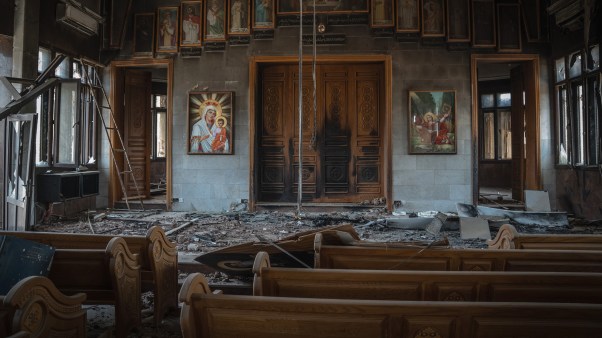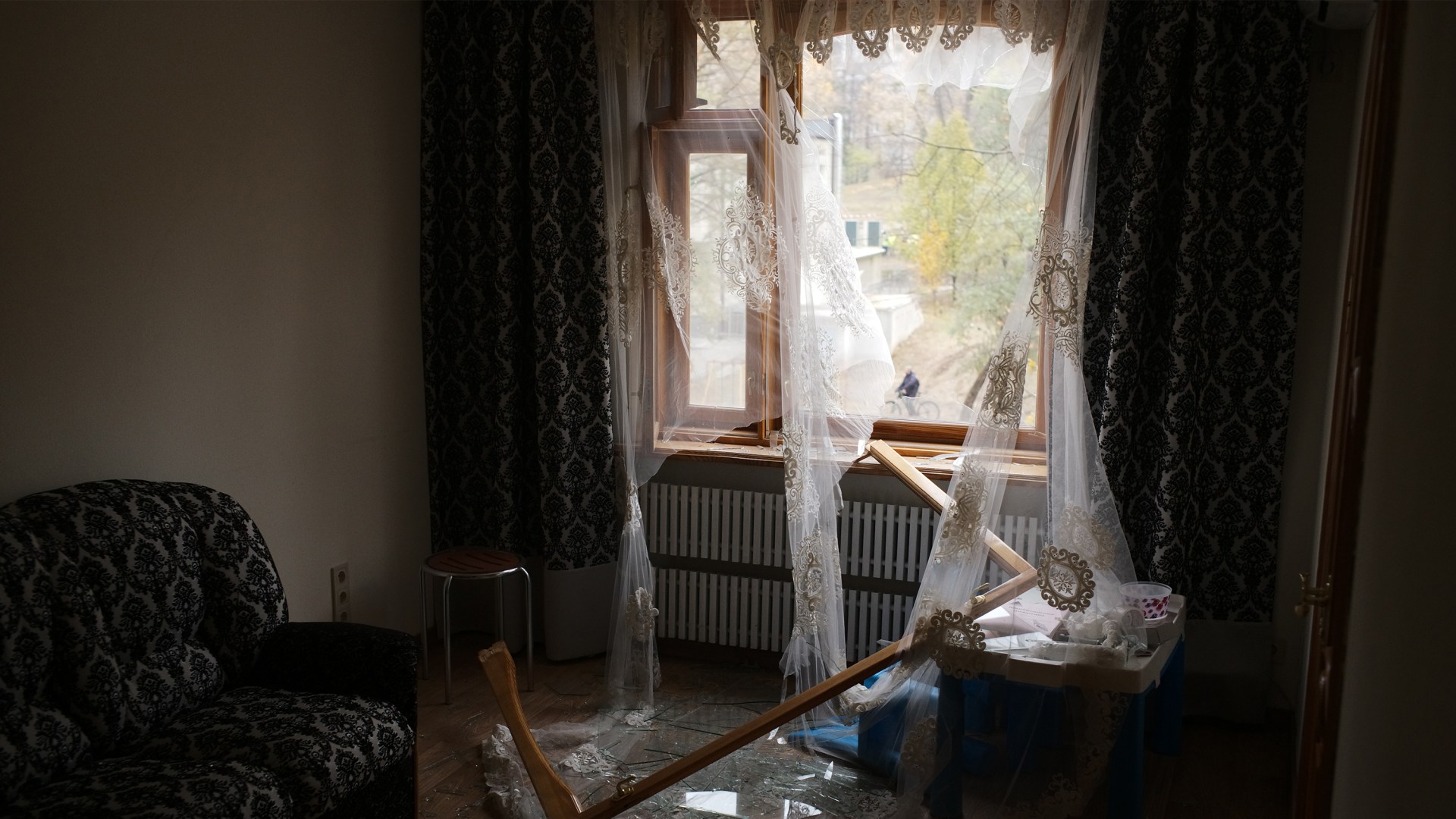
The once-thriving neighborhood of Northern Saltivka in the Ukrainian city of Kharkiv, 20 miles from the Russian border, is now mostly a ghost town. It took the brunt of Russia’s early offensive into Kharkiv in 2022.
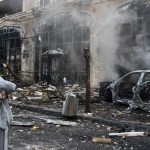
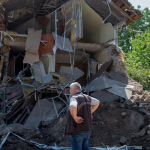
Saltivka’s apartments were built during the Soviet Brezhnev era, mid-1960s to mid-1980s, known for the cold, gray architecture that many Americans have seen in movies and documentaries. Now, almost all the buildings are skeletons, with many bones broken. Nearly every window is shattered. Many are boarded up. Others remain as frames, either totally empty or with shards of glass.
This residential area included a school building, the remains of which are now fenced off—but a large hole in the ceiling shows where bombs fell. Abandoned, dirty swings and children’s playthings in small fields between the buildings make the cold reality of what happened here more haunting.
That I was able to view the devastation is the result of the stunning counteroffensive culminating in November 2022 that restored Ukrainian control of the city. In Kharkiv, only four days into the invasion, a mix of Ukrainian troops, police officers, and local militias killed most members of an elite Russian unit. Residents at that time saw it as a community victory, with the complete liberation of Kharkiv still months away.
Less than a mile from the apartment buildings, Russian bombs in 2024 destroyed the Ukrainian equivalent of a Home Depot and killed at least 16 people. Russian propagandists claimed the hardware store had been used to repair tanks. Bombardment continues: In virtually every Kharkiv neighborhood, damage to buildings, blown-out windows, holes in the sidewalk, and bullet holes in fences are common.
And yet life goes on. The hardware store was in the same parking lot complex as a modern mall that looks like an American one—and when I was there earlier this month, it was very much open for business. Another mall, only a block away from a municipal building badly damaged by Russian bombardment, was packed with people.
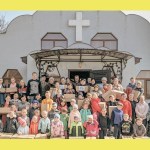
Religious life also goes on. On a cold and wet Sunday, I visited Anunciation, a stunningly ornate red and white building with gold trim and icons inside, which remains under the theological authority of Orthodox patriarchs from Moscow. Attendance was 150–200 despite physical dangers and the politically fraught split between Moscow-oriented churches, widely thought to be compromised by Putin’s government, and the Orthodox Church of Ukraine, recognized by the bishop of Constantinople and now followed by a majority of Ukrainians.
Parishioners at this church, though, didn’t seem to be thinking about church division. One young woman, Tanya, said, “I go because the choir is mesmerizing.” Nobody mentioned church politics. From a different denomination, evangelical pastor Ivan Rusyn told me he read the work of Holocaust chronicler Elie Wiesel, who questioned where God was during the killing of 6 million Jews. Ideas that God was there alongside the innocent, Rusyn said, “were very helpful to me, personally.”
As I left Kharkiv, an air-raid siren went off. Residents didn’t take much notice of it. Some seem numb to the constant threat. Others are indignant about Russian leaders and consider them or their apologists in the same way Jeremiah prophetically viewed adversaries in his day: “They dress the wound of my people as though it were not serious. ‘Peace, peace,’ they say, when there is no peace. Are they ashamed of their detestable conduct? No, they have no shame at all; they do not even know how to blush” (6:14–15).