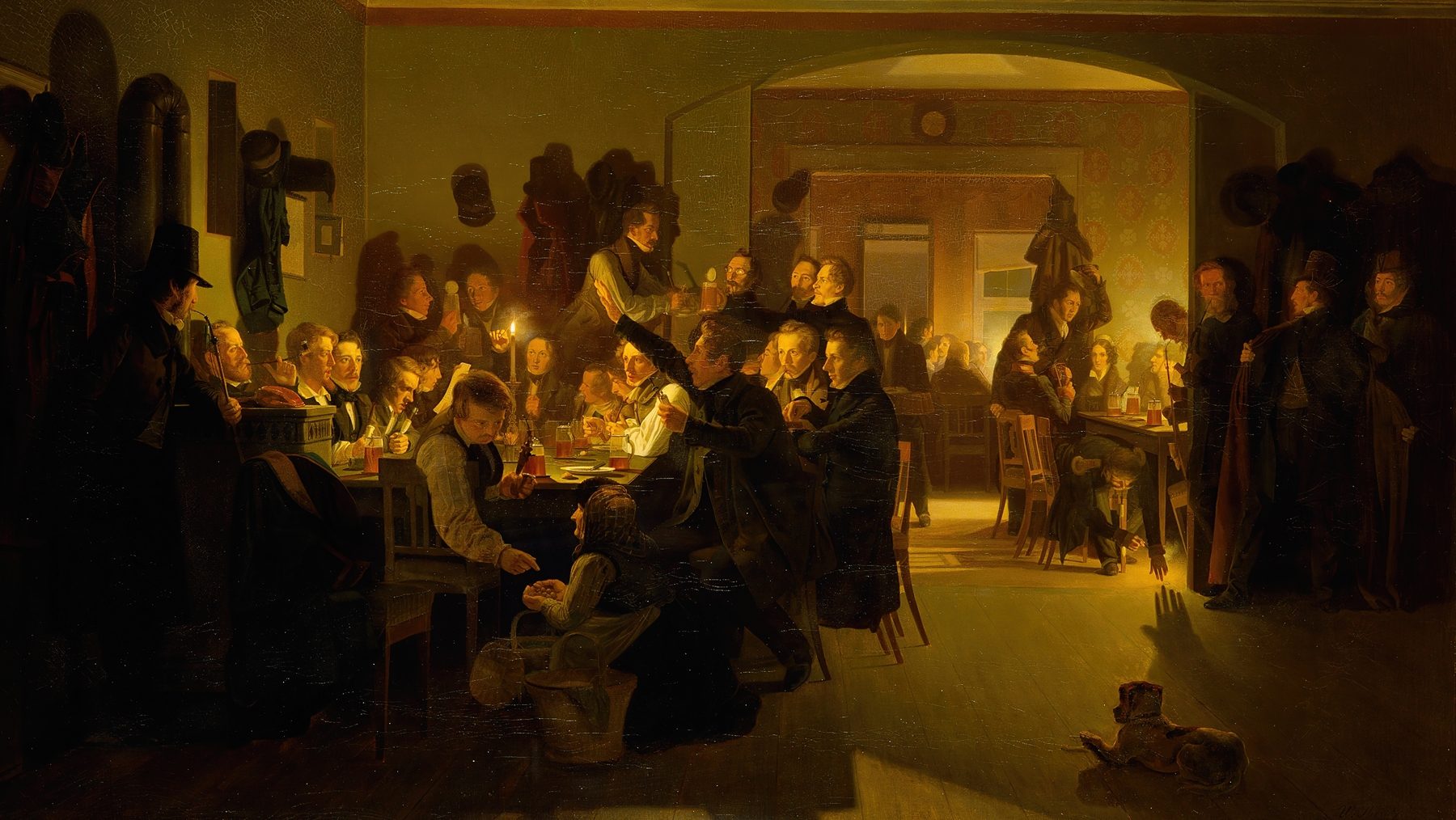
Have you ever walked into a coffee shop—you know the type—filled with carefully curated furniture and wire-rimmed glasses and copies of Infinite Jest, and left with an essay, or an idea, or a method for making homemade cold brew that you never would have had if you’d stayed home?
Have you ever settled into the cozy haze of a British pub and had one of those conversations with your friends that takes on a life of its own, pulling in bartenders and neighboring booths, forming new bonds and strengthening old ones, turning all who partake into beautiful caricatures of themselves?
Have you ever sat among a strange yet sublime combination of midnight truckers, wits-end strung-outs, and broke college students at varying levels of sobriety and observed that, between the hours of midnight and 5 a.m., this is not, in fact, a Waffle House but a Waffle Home?
Have you ever joined the 6-a.m.-ers at the donut shop and realized, as the old regulars swapped bantering stories, that maybe the boomers weren’t being boomers when they said the internet could never replicate this?
If any of these sound familiar, you have been the recipient of the inherent magic of a third place.
The term third place is nearly ubiquitous now, but it was first coined by sociologist Ray Oldenburg in his book The Great Good Place, which documents the phenomenon of third places and considers their value in larger society.
The term describes the idea that, while most of our lives are spent between our homes (“first places”) and our work (“second places”), a third set of places—cafés, pubs, barbershops, salons, bowling alleys, churches, and the like—give us another space to rest, create, play, and commune, a space to be human.
As Oldenburg explains in a 1997 article on the same topic, “What suburbia cries for are the means for people to gather easily, inexpensively, regularly, and pleasurably—a ‘place on the corner,’ real life alternatives to television, easy escapes from the cabin fever of marriage and family life that do not necessitate getting into an automobile.”
But such spaces have experienced a loss in recent decades, as Robert D. Putnam’s sociological tour de force, Bowling Alone (2000), laments. Using bowling as his guiding image, Putnam describes how the sharp decline of enrollment in bowling leagues is an example of the loss of the social capital such spaces have long provided to American communities. This spells trouble for society and culture.
The COVID-19 pandemic showed us just how bleak our individual and communal lives can look when left entirely without these hubs of social capital. Perhaps I’m an optimist, but I have sensed, since then, an uptick in our collective concern for cultivating third spaces. As G. K. Chesterton reminds us, “the way to love anything is to realize that it might be lost.”
The thing about third places—wide-ranging as they are in character—is that they breed culture in a way that would be impossible without them.
Coffee houses in Paris, London, and New England have served consistently as cradles of intellectual discourse from the early Enlightenment period to the American and French Revolutions and up through the literary circles of Eliot and Hemingway, earning such cafés the title “penny universities.”
The Eagle and Child pub, famed Oxford meeting place of the Inklings, spun from its cozy, wood-paneled walls and leather seats some of the most influential works of fiction and theology of the 20th century. There is a real sense in which Tolkien, Lewis, Williams, Barfield, and the rest were as much products of their time together at “The Bird and the Baby,” as the pub was familiarly known, as they were products of their individual reading lists.
And that famed rendition of Creed’s “Higher” by your buddy Brian that has become the stuff of legend in the friend group would certainly never have happened without the help of your local karaoke joint.
Third places produce culture. But how do they do it?
In The Four Loves, C. S. Lewis describes friendship as postured “shoulder to shoulder”:
Friendship arises … when two or more of the companions discover that they have in common some insight or interest or even taste which the others do not share and which, till that moment, each believed to be his own unique treasure (or burden). The typical expression of opening Friendship would be something like, “What? You too? I thought I was the only one.”
Friendship, then, develops out of a love between two people for a third thing. Lewis theorizes that this would have been true even in the earliest days of humanity:
We can imagine that among those early hunters and warriors single individuals … saw what others did not; saw that the deer was beautiful as well as edible, that hunting was fun as well as necessary, dreamed that his gods might be not only powerful but holy. But as long as each of these percipient persons dies without finding a kindred soul, nothing (I suspect) will come of it; art or sport or spiritual religion will not be born. It is when two such persons discover one another, when, whether with immense difficulties and semi-articulate rumblings or with what would seem to us amazing and elliptical speed, they share their vision—it is then that Friendship is born.
We see here, by inversion, the innately human progression that happens in third places. Kindred souls meet, and from their union flows art, literature, sport—the stuff of shared time, shared experience, and shared soul. Third places conceive friendship, and friendship gives birth to culture. This is only possible because third places are places of hospitality, providing time and space where such connections can flourish.
While I cannot, for the purposes of this essay, fully parse out what produces this effect, I would argue that it often has to do with cultivating a space that invites continued presence—comfortable furniture, aesthetically pleasing decor, rounded surfaces, and mugs (as opposed to to-go cups). Starbucks is hardly a third place. A drive-thru is the antithesis of one. But from a wider view, third places create culture because they are places that exist for the love of things, whether those things be good coffee, food, beer, sports, comedy, you name it.
This is why you have Philadelphia Eagles bars in Portland and why every flannel-donning espresso “granolite” in the Northwest Arkansas tri-state area finds themselves pulled, magnetically, into Onyx Coffee. The best third places convene lovers of particular things.
In the education world, I have often heard it said that great teaching boils down to a simple definition: loving the students and loving the material in the same room. Something similar could be said of true friendship. A true friend genuinely loves the other person in the room and genuinely loves the other thing in the room that unites them. A great third place provides all the necessary material for this process: the other person, the thing, and the physical room.
Without crossing into the dangerous waters of the precarious church–coffee-shop distinction, I must observe that churches too display a similar tendency. The church gathers its people with the express purpose of allowing them to love something outside of themselves—namely, God. When they do so, culture—fellowship, friendship, music, art, cathedrals—are birthed from the communion between them.
In the introductory chapter of Orthodoxy, G. K. Chesterton describes a hypothetical, whimsical fable, “a romance about an English yachtsman who slightly miscalculated his course and discovered England under the impression that it was a new island in the South Seas.”
Chesterton contends that such a sailor, once he had overcome his initial wave of embarrassment, would feel a peculiar mix of emotions—for “what could be more delightful than to have in the same few minutes all the fascinating terrors of going abroad combined with all the humane security of coming home again?”
He muses that the predicament of the sailor is really, in many ways, the predicament of the human race: “This at least seems to me the main problem for philosophers. … How can we contrive to be at once astonished at the world and yet at home in it?”
In this “mixture of the familiar and the unfamiliar which Christendom has rightly named romance,” Chesterton sees an essential human need:
But nearly all people I have ever met in this western society in which I live would agree to the general proposition that we need this life of practical romance; the combination of something that is strange with something that is secure. We need so to view the world as to combine an idea of wonder and an idea of welcome. We need to be happy in this wonderland without once being merely comfortable.
Chesterton asserts that the Christian faith is the best answer to this double spiritual need. And I would contend that he makes a solid case (you should read the book).
Consider how this paradox of wonder and welcome comes to bear in our third places. If Chesterton is right, it is unsurprising that we gravitate toward places that get at this deep human need for “practical romance.” Ultimately, the magic of third places lies in their ability to be places of both wonder and welcome.
We all know the experience of walking into a local haunt. You step in the door and feel as if you are home. You say, “I’ll have the usual” or, “Put it on my tab.” Sometimes you want to go where everybody knows your name. Yet we also know that part of the allure of these places is that they are decidedly not our homes.
You never know when a friend might walk in. Or a literary agent. Or a cute girl who happens to be reading The Brothers Karamazov. And of course, she wants to be in the book club you are starting up. The rest, as they say, will be history—and you’ll be off on the adventure of a lifetime.
Wendell Berry, Paul Kingsnorth, and others have lamented the disappearance of the front porch as a loss of a fundamental part of American society. I join them, and I would be the first to celebrate a revival of the porch.
The third place is made of similar spiritual “stuff” as the front porch is. The third place is the best front porch we still have readily available in most of American culture. For third places, like front porches, are liminal spaces, in between. They are in our comfort zone and yet out of it. They are our home and yet not our home. They are wonder and welcome.
Charles Dickens tells of an episode in a café that awakened him to this reality:
One [coffee shop] in St. Martin’s Lane, of which I only recollect that it stood near the church, and that in the door there was an oval glass plate with “COFFEE ROOM” painted on it, addressed towards the street. If I ever find myself in a very different kind of coffee-room now, but where there is such an inscription on glass, and read it backwards on the wrong side, MOOR EEFFOC (as I often used to do then in a dismal reverie), a shock goes through my blood.
As biographers note, this scene constituted a profound awakening of Dickens’s imagination to the fantasy of the everyday, and he went on to paint his own fictional world with all the elvish realism of the “Moor Eeffoc.” It is no surprise that this awakening took place in a coffee room. He was not the first (and far from the last) to walk into a third space and leave with a transfigured vision of the world.
In some ways, these places function like large-scale icons. They awaken us, for a second, to the way things are all around us. We overhear a conversation at the table next to us and realize just what the main character should do in the last chapter of our novel. We hear a side-splitting new stand-up bit and are awakened to the gratuitous absurdity of existence. We see MOOR EEFFOC through the window and realize we are sitting in Fairyland.
And this brings me to the relationship between the coffee room and the cathedral.
The church, to state the obvious, is home. It is the place where we know and the place where we are known. Where—if it’s done right—we feel safe to be our most vulnerable. It is the place where the clamor of our masks and impressions should give way to our truest selves in communion with one another.
But it is also the place where we encounter the incomprehensible. The place where we go to meet with the living God who holds the universe in the palm of his hand, upholding stars and planets by the word of his power.
It is wonder and welcome. It is bread and wine—the most human and homely of things. It is the body and blood of the resurrected Christ—a thing more full of wonder and mystery than we could possibly imagine. And I dare not systematize what even the prophets could barely put pen to paper in describing, resorting as they do to the language of silver and gold and horses and cups and swords and eyes and stammering uses of “as it were.”
But I do have just an inkling as to why great third places speak so deeply to our souls. They do so because they give us a glimpse of something that we were made for.
Throughout the story of Scripture, there are two spaces which (though at times permeable) remain largely distinct. There is heaven—the place of wonder and adventure and perfection, where the Lord dwells. And there is earth—home—a place that is, through God’s creative mandate, truly ours.
Yet the whole arc of Scripture seems a dogged attempt at finding a third space where the two can somehow dwell together at last: A garden where God walks with man. A tabernacle where heaven moves upon the earth. A temple where the Holy of Holies is made accessible. A person in whom Word becomes flesh. A meal that is the bread come down from heaven, given for the life of the world. A Presence that places the good law of heaven directly on the hearts of humankind.
And we move at last toward a great Third Place, where heaven will come down to earth and wonder and welcome will finally, fully be one—and more than just the fresh batch of coffee will be made new.
Coby Dolloff writes and teaches at Pepperdine University in Malibu, California. His deepest interests lie at the intersection of theology and comedy. You can follow his work (if you’re not averse to a few memes) on his Substack.