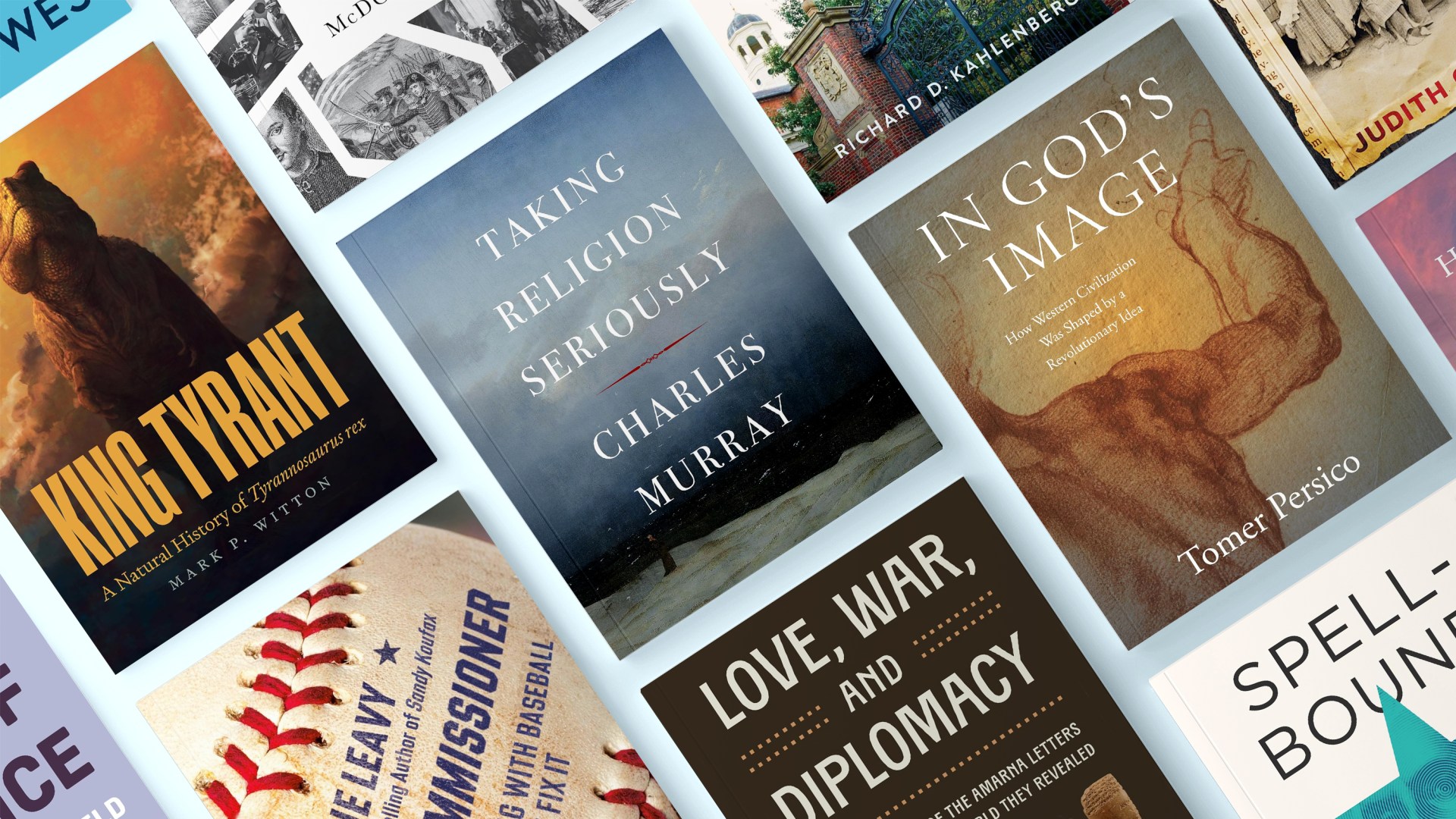
Today CT celebrates great Christian books—and we can also learn from others. Here, two-by-two, are capsule comments on 20 books published by non-Christian houses in 2025 that educated me.
Historic Figures
Molly Worthen’s Spellbound: How Charisma Shaped American History from the Puritans to Donald Trump (Forum) walks us through four centuries of mystery history: Some leaders gain followers by charm, but charisma is more powerful—and sometimes rational explanations for success fall short. | Listen to Worthen’s conversation with Russell Moore, and read an original essay she wrote for CT this year.
Gems of American History (Encounter) by Walter McDougall affectionally profiles pioneers from William Penn and Benjamin Franklin to the Wright brothers.
Society and Religion
In Broken Altars: Secularist Violence in Modern History (Yale University Press), Thomas Albert Howard contrasts the “passive secularism” of the First Amendment, which worked well in the United States for two centuries, with antireligious “combative secularism” and murderous “eliminationist secularism.” | Read CT’s review.
Cross Purposes: Christianity’s Broken Bargain with Democracy (Yale) by Jonathan Rauch analyzes “thin Christianity,” 20th-century modernism ashamed of its core, and “sharp Christianity,” 21st-century Christianity in which politics edges out theology. | Read CT’s review and listen to Rauch’s conversation with Russell Moore.
Thinking About Individuality
Tomer Persico’s In God’s Image (NYU Press) traces the revolutionary idea that arose from the Bible and shaped Western civilization: Each human life is significant, and we are not just part of a clan. | Read CT’s review.
In The Age of Choice: A History of Freedom in Modern Life (Princeton University Press), Sophia Rosenfeld urges us to rethink both the promises and limitations of choice in a culture becoming cancerous. | Read a CT essay that draws on Rosenfeld’s work.


Wrestling with God
Eminent Jews (Henry Holt) by David Denby tells of the aggressive comedy of Mel Brooks, the torment of Leonard Bernstein, and the angst of Betty Friedan and Norman Mailer.
In Taking Religion Seriously (Encounter), formerly agnostic scholar Charles Murray explains how he came to believe in God. | Read CT’s review.
Rich and Poor
Kim Bowes in Surviving Rome: The Economic Lives of the Ninety Percent (Princeton) Iiterally digs deep into artifacts to tell the stories of day laborers, slaves, farmers, and even pimps working the gig economy two millennia ago.
Class Matters (PublicAffairs) by Richard D. Kahlenberg shows how we can have diversity at universities while reducing discrimination and recrimination.
Proclaiming Liberty
Bennett Parten’s Somewhere Toward Freedom (Simon & Schuster) reveals how the Union Army’s 1864 march from Atlanta to Savannah “evolved into a profound religious experience” as 20,000 former slaves followed the soldiers.
In Last Seen: The Enduring Search by Formerly Enslaved People to Find Their Lost Families (Simon & Schuster), Judith Giesberg details how couples separated by slave sales strove to reunite.
War and Tragedy
Iain MacGregor’s The Hiroshima Men (Scribner) describes the making and use of the first atomic bombs, the cost in lives for both Japan and the United States, and the way Japan’s leaders finally stopped sacrificing their people.
Rafael Medoff in The Road to October 7: Hamas, the Holocaust, and the Eternal War Against the Jews (Jewish Publication Society) lays out the long sorrow.

Baseball and Life
Jane Leavy offers ways to increase baseball action in Make Me Commissioner (Grand Central), such as by topping off outfield walls with 18-foot-high Plexiglas, NHL arena style.
Will Bardenwerper’s Homestand: Small Town Baseball and the Fight for the Soul of America (Doubleday) argues that minor league ballparks are still places where community grows, with “evening shadows advancing toward the infield as that familiar feeling of serenity slowly swept over us.”
Please, Mr. Postman
Stephen Starring Grant’s Mailman: My Wild Ride Delivering the Mail in Appalachia and Finally Finding Home (Simon & Schuster) reports with humor and compassion his time as a rural letter carrier.
In Love, War, and Diplomacy: The Discovery of the Amarna Letters and the Bronze Age World They Revealed (Princeton), Eric H. Cline explores the mail some pharaohs received from 1360 to 1334 BC.
Dinosaurs and Birds
King Tyrant (Princeton) by Mark P. Witton is an authoritative book for adults about Tyrannosaurus rex—and its pictures of dinosaurs in combat can fascinate children as adults read to them at bedtime about the bad old days.
Roger Pasquier’s Birds at Rest: The Behavior and Ecology of Avian Sleep (Princeton) is far more peaceful.
Marvin Olasky is editor in chief of Christianity Today. Since 2022, he has reviewed both general and Christian books in a monthly free newsletter, OlaskyBooks. You can sign up here.