CT started 1966 with a review of one church’s attempt to jazz up evangelism.
Protestants have tinkered with jazz in worship for years. Now some see it as an evangelistic wedge. … [Presbyterian] pastor Bryant Kirkland said the [Duke] Ellington concerts were “an attempt to establish contact with people normally outside the church” and “churchgoers who are not ministered to by the usual presentations.”
Ellington hoped his concerts would “help to bring people into the fold.” One of his favorite words is “communication,” and he contends that informal words and jazz music can put across spiritual truths to many people when “good English would fly by them like a kite.”
So in New York he permitted publicity, an RCA recording, and a CBS-TV taping for broadcast January 16. … The choirs chanted the books of the Old Testament (nearly inaudible to concert-goers) while tenor sax man Paul Gonsalves screwed up his face with a hard rock solo in his famous Newport Jazz Festival idiom. After a screech solo by trumpeter “Cat” Anderson, Ellington quipped, “That’s as high as we go.” …
The whole bit was more of a maybe than a yes.
Many Protestants had turned against the idea of evangelism and personal confessions of faith in Christ. CT reported the development with concern, surveying the positions of a wide variety of church leaders, starting with Methodists:
Evangelism is the lifeline of Christianity. Since apostolic times it has been hard, controversial work. And it has always produced opposition outside the Church.
Today, however, there is a struggle over evangelism within the Church. Methodists were informed at a recent evangelism conference that revival services are now ill advised, in fact unchristian. The speaker, the Rev. Dr. Edmund Perry, a religious historian at Methodist-rooted Northwestern University, told the Miami Herald’s Adon Taft, “I abhor the notion of individual salvation.”
Traditional methods for proclaiming the good news of the gospel seemed to be fading fast in the late 1960s. CT reported that “there are fewer tent meetings and sawdust trails” and “altar calls in evangelical churches are probably hitting a new low this year.” But other new approaches were emerging.
Traditional evangelistic methods based on hit-or-miss, take-it-or-leave-it proclamation of the Gospel are seen to be giving way to more specialized, in-depth approaches. Evangelicals in North America and abroad are realizing anew that deeds are fully as important as words, that positive dialogue is more effective than legalistic argumentation, and that winning converts is not primarily the task of paid clergymen. …
At Daytona Beach, Florida, two Bob Jones University-trained folk singers roamed the sands with an inter-religious entertainment and evangelism team during Easter week. Many hundreds of the 75,000 vacationing college students were counseled, and some (including at least one Hebrew) professed initial commitment to Christ. At Fort Lauderdale, some 250 miles south, where thousands of other students were soaking in the sun, an Inter-Varsity Christian Fellowship team set up an evangelistic effort.
In New York, Pentecostalist youth worker David Wilkerson planned to open a new training program for converts this week. His Teen Challenge organization, meanwhile, has begun holding Saturday night rallies at a theater on Manhattan’s Lower East Side.
In Colorado, evangelist Jack Wyrtzen conducted a three-day camp retreat attended by cadets of the Air Force Academy. A spokesman for Wyrtzen said “many cadets responded to the gospel invitation to receive Jesus Christ as their Lord and Saviour.”
The magazine published a special issue on evangelism and a second on the presentation of the gospel in the inner city—the first issue with a cover printed in color. CT profiled an urban church in Pittsburgh, talked to a Young Life leader reaching out to gang members, and caught up with a Christian college training social workers.
At Philadelphia College of Bible, a new prong has been added to the long-established ministry to the city. In the new social-work undergraduate curriculum, the college is acknowledging and dealing with today’s inner-city crises.
Concern in this area is not new at the college. It saw extreme inner-city conditions in the second decade of this century, when it began. Since then, through days of prosperity and days of depression, it has consistently ministered to the poor, even before the word “poverty” was rediscovered. This ministry was carried on through the practical-work departments of the two Bible institutes that later merged to form the present college, and it is continuing through the present Department of Christian Service. The “new prong”—the Department of Social Work—will augment the general thrust by training workers for urban areas. …
Christian social agencies very much need born-again workers, especially those who go on to graduate school and qualify to become administrators. State laws more and more are requiring executives to have the master’s degree in social work. Lack of administrators with this level of training often jeopardizes the start or continuation of new agencies and services.
Throughout the year, CT reminded readers that every Christian was called to evangelize, with evangelism being “The Order of the Day.”
The Church has ever been under orders to evangelize. Are the orders less urgent in this time of apocalyptic siftings and transitions? We claim to see in our domestic and international upheavals, in our plunge toward the abyss of unbelief, an inexorable movement toward the great denouement of the human story; it would thus be tragic if we were to soften the thrust of evangelism in this fateful hour.
Choruses of despair sound from all sides. And why not? One need not be a prophet to discern the signs of the times. …
But why, as evangelicals, should we be surprised at all this? … This is no time to be beguiled by unbelieving scholars who disown God’s Word and dishonor his Son; it is rather a time for men to match the mission of evangelism. In a day of incredible unbelief, those who still believe must fill a vast vacuum.
One sign of the times was the increasing popularity of psychedelic drugs. CT reported on “The LSD Cult.”
A new cult is making its appearance across North America. The rationale, if it is to be taken seriously, is the bizarre theory of what its proponents call “expanding consciousness.” Principal promotion comes from the attention currently being given to lysergic acid diethylamide, better known as LSD, and other drugs that, taken internally, produce outlandish mental images.
High priest of the LSD cult is ex-Roman Catholic Timothy Leary, 45-year-old psychologist who in 1963 was fired from Harvard University for using students in LSD experiments. He then went on to become the world’s leading exponent of “mind-opening substances.”
“We regard him with the same special love and respect as was reserved by the early Christians for Jesus, by the Moslems for Mohammed, or the Buddhists for Gautama,” said Arthur Kleps in testimony last month before a United States Senate subcommittee. Kleps is identified as director of the “Neo-American Church,” which is supposed to have 500 members and churches in the Northeast, Florida, and California and is spreading.
CT noted the growth of the anti-war movement in the US. Unlike in previous military conflicts, the pacifists weren’t led by Christians.
Some have supposed that the protest marches about the war in South Viet Nam were chiefly an evidence of Christian opposition to war. This, however, is a really erroneous judgment. A great many of those who are protesters against the war are openly atheistic, and some are frankly Communists. For example, the leadership of the protest at Berkeley, California, is now known to be admittedly Communist, with no reference to the Christian faith whatever.
CT asked a retired general to explain the US military tactics and make the case that American evangelicals should support the bombing of North Vietnam.
The United States is faced with the alternatives of defeating the aggressor by military effort or of failing to do so. The latter would entail national humiliation, loss of prestige and influence in the world, and desertion of the South Vietnamese, who have every right to expect our full support and will be lost without it. It is probable that all of Southeast Asia would then fall to Communist military control. The worst effect, however, would very likely be the effect on the American people. This weakening of the moral fiber would bode ill for the future.
Wars are fought by men with weapons that can destroy life and property. Victory comes when one side destroys the other’s weapons and men faster than it loses its own, thus assuring the ultimate total destruction of its enemy’s forces if the conflict is continued. The greater the applied superiority, the quicker and cheaper the victory.
The prime minister of South Africa was assassinated in 1966. CT reported on his Christian faith and racist policies.
The son of a Dutch Reformed missionary who worshipped regularly at a Reformed church in Rondebosch, a suburb of the parliamentary city of Cape Town … [Hendrik] Verwoerd himself first achieved prominence as editor of Die Transvaler, organ of the then-minority Nationalists, as he backed Hitler to a degree and opposed South Africa’s participation in World War II. …
The succeeding years made Verwoerd a symbol of political success through racism. … In an August 26 cover story, Time characterized Verwoerd as “one of the ablest white leaders that Africa has ever produced. He has a photographic memory, an analytical mind and an endless capacity for work. He is a brilliant diplomat and an inventive politician.”
The full results of such abilities invested in the anachronistic cause of racial separation will only be known at the end of the current worldwide racial revolution.
The Roman Catholic Church entered a period of reform in the late 1960s, following the conclusion of Vatican II. CT editors noted that the church had not changed its position on the authority of the pope but that some Catholics were having “born again” experiences.
From scores of sources around the world reports filter in of priests, nuns, and laymen who have experienced the same kind of religious experience as their counterparts of Reformation and pre-Reformation days. Unlike the Reformers, who were forced out of the church, these modern disciples remain within the fold. Yet they have come to know Jesus Christ in an intimacy that sometimes surpasses the devotion of many Protestants. The reality of their experience we cannot question; the depth of their commitment and the open expression of joy in their newfound faith are good to behold. …
In the midst of change and renewal, evangelicals should reach out with heart and hand to those who, though they are in the church of Rome, are our spiritual brothers and sisters in Christ.
CT reported on Protestant leaders, including an Episcopal bishop who was “full of surprises.” That fall, he demanded the church try him for heresy.
The Episcopal House of Bishops attempted to head off heresy proceedings against Resigned Bishop James A. Pike last month by adopting, 103 to 36, a statement denouncing Pike’s conduct and doctrinal statements. The attempt failed, for though Pike’s accusers seemed satisfied, the statement was so abhorrent to Pike that he moved to put trial machinery in motion “to clear my name” …
The committee’s 1200-word statement, which was adopted by the house, rejected Pike’s “irresponsible” utterances, and said “his writing and speaking on profound realities with which Christian faith and worship are concerned are too often marred by caricatures of precious symbols and at the worst, by cheap vulgarizations of great expressions of faith” …
Pike charged that “this House is not interested in theology, but only public relations.” When he raised a theological point he was ruled out of order.
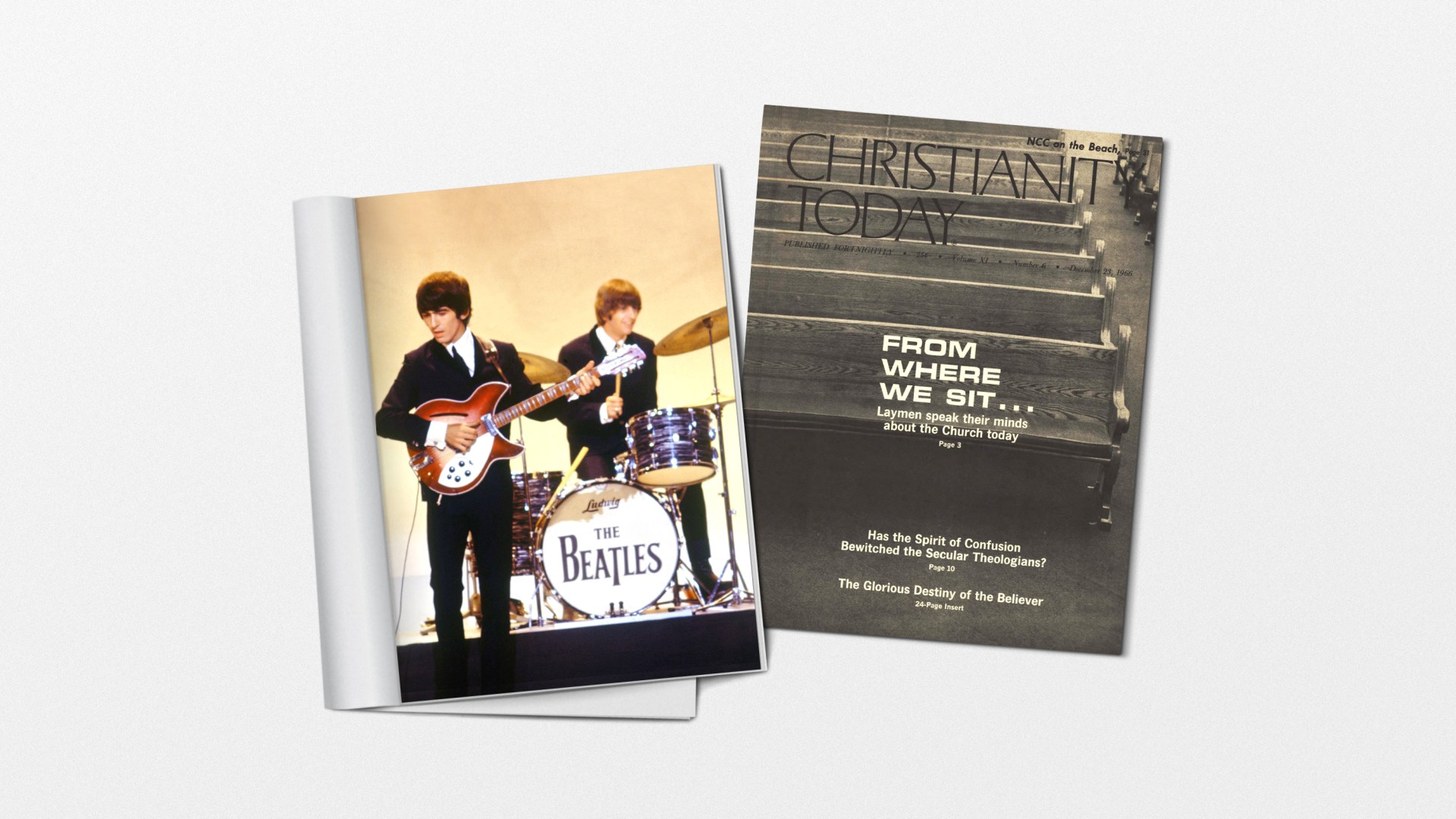
CT also encouraged readers to pay attention to a British pop band named The Beatles. The founding editor of the Methodist Good News magazine reported his experience listening to “the Fab Four”:
The real contribution of the Beatles and of other popular singers to theological dialogue is their songs. Listen to the words. Listen and you will learn how lots of people look at life.
As the father of five children, I have become, perforce, a student of popular music. At latest count, five radios are to be found from the basement to the attic of our parsonage. At almost any time of the day or night, “pop” music (or so they call it) pours from one if not all of these radios.
For a long time I tried to shut my ears to the caterwauling and the frenetic beat, beat, beat. But after a while my middle-aged eardrums capitulated, and I began to listen. What I heard caused me to listen seriously. For the “go-go” music that blares from millions of radios proclaims a popular philosophy of life—and sometimes a theology as well.
Evangelical Christians need to be listening, painful as this suggestion may seem, because pop music reveals what many, many people are thinking; what sort of values they admire; what idols are worshiped by the pagans in our midst. Pop music gives us an important clue to where the action really is—or should be—in our apologetics these days.