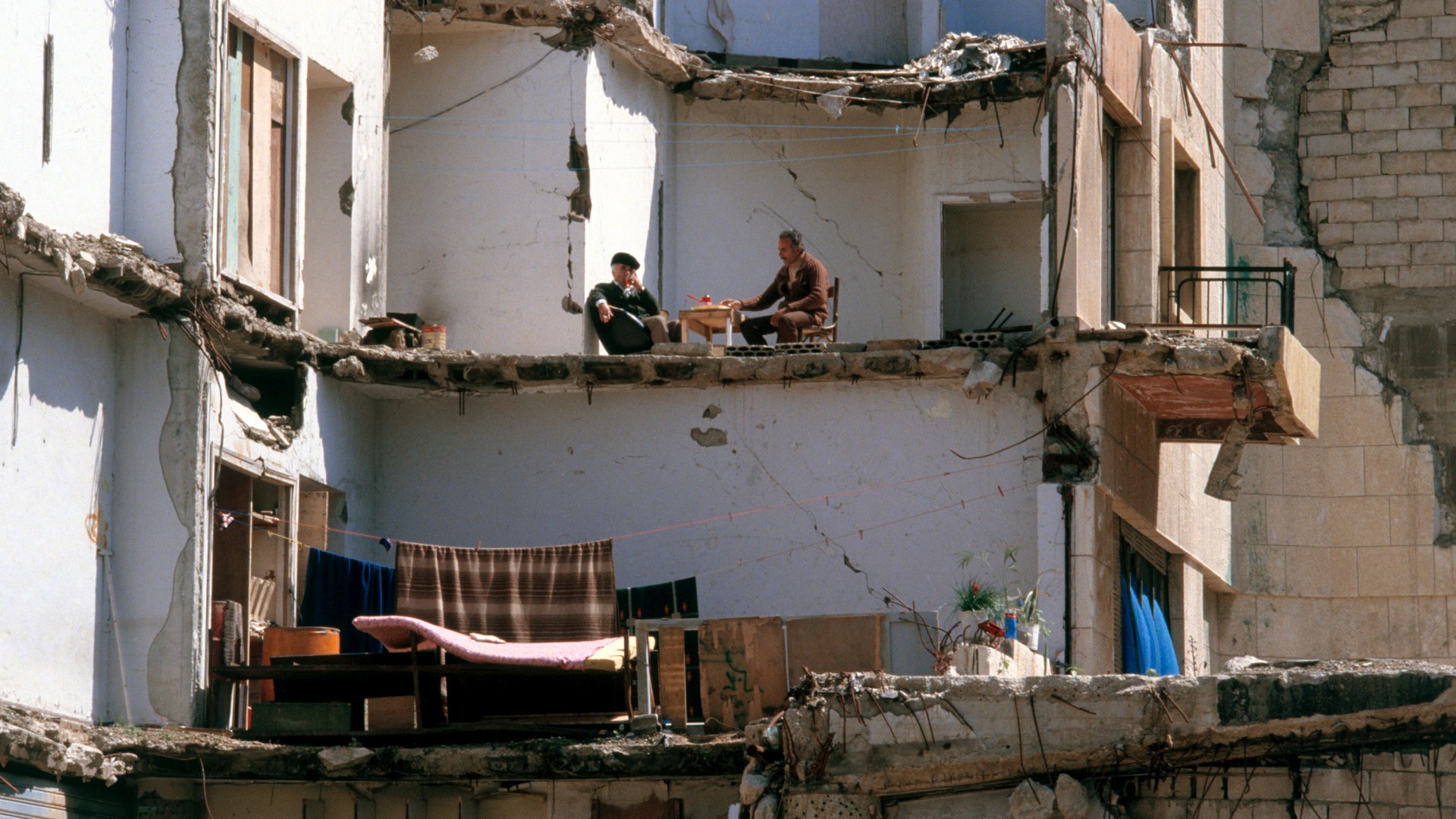
Eight somber Muslims sat around white plastic tables on the gold-tinged red carpet of Sayyida Aisha Mosque in Sidon, Lebanon. Arabic sweets beckoned, but few partook. The seriousness of the occasion—reviewing their memories of Lebanon’s 15-year civil war that ended in 1990—seemed to make several uneasy. They did sip their tea.
Four were Lebanese native to Sidon. Four were Palestinian refugees. Several wore beards, some long and scraggly, others short and trimmed. One was a former fighter in the war. Another lost family members when a Christian militia massacred inhabitants in Tel al-Zaatar.
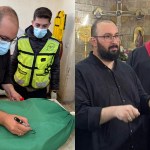
Beginning in 1975, Christians, Muslims, and Palestinians plunged Lebanon into a regional conflict that included Israel and Syria, leaving 150,000 dead. Those convening the meeting, a Lebanese evangelical and a Druze follower of Jesus, hoped to unravel the reasons behind the highly contested conflict. Their host, chief judge for the Sunni Muslim court in Sidon and imam of the mosque, lent his legitimacy to the sensitive proceedings.
As participants received a 12-page document presenting Lebanese history that preceded the war, they were taken aback by reading a fully Christian perspective. But then the story shifted to Muslim perspectives, divided between Lebanese and Palestinian views. Three versions of history, none legitimized over the other.
Many Christians do not call Lebanon’s tragedy a civil war. They emphasize how Palestinian refugees brought local destruction in their fight against Israel. Meanwhile, Palestinians emphasize displacement from their homeland and their need for a base from which to fight Israel. Lebanese Muslims sympathized with Palestine but aimed to change a sectarian political order that disproportionately favored Christians.
When the group finished reading the document, the evangelical stood up.
“Which narrative do you sympathize with the most?” he asked.
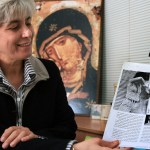
Martin Accad, president of the Beirut-based Near East School of Theology, spoke in his capacity as founder of Action Research Associates (ARA), which is working on a project that presents civil war history through multiple narratives. Cofounder Chaden Hani took notes. Their project is unique because, in schools, history books end shortly after the country’s independence in 1943 and avoid discussion of the sectarian struggles that followed.
A few participants dominated the mosque conversation with their viewpoints. An elderly Palestinian former fighter mostly sat silent. Accad asked about their emotions, which prompted different responses. “Sadness at what happened,” said one. “Fear it might happen again,” said another. A third noted, “I am happy we are finally trying to talk objectively about what took place.”
To move on from the conflict, Parliament passed a general amnesty law in 1991 that pardoned all political and civil war–related crimes. Former militia leaders became politicians and ignored the peace accord to write a unified history textbook as each sect clung to its narrative.
In 1997, Lebanon mandated a new educational approach. After three years of work, the cabinet formally adopted the history curriculum. But it was never implemented due to political interference behind the scenes.
“History is written by the winners,” said Accad. “But there was no winner in Lebanon.”
Christians and Muslims fought each other, and as allegiances shifted, each religion split into rival factions that clashed as well. Accad said history became too sensitive a subject for postwar leaders, as each feared being cast as a villain. A multinarrative approach sidesteps this issue, Accad believes, as every religious community can voice its own perspective.
Accad noted that this historical retelling should not gloss over criminality, which he personally lived through. While many people left the country during the war, his father, an evangelical leader, insisted they remain and serve in their Muslim-majority neighborhood. When Accad was 13, his parents allowed a displaced family to stay in their home during a summer trip abroad—but when they returned, the family refused to leave. They became displaced in turn, forced to relocate to Christian-majority East Beirut.
Accad later became a leader as well, serving as academic dean of Arab Baptist Theological Seminary. During that time, he discovered the power of empathetic listening as he pioneered evangelical interfaith work. He learned that by genuinely listening to another person’s story, participants win the right for their stories to be heard. As Lebanon again spiraled into political and economic chaos in 2019, Accad resigned his position and founded ARA to heal the wounds left by the civil war.
ARA’s initial work was archival. After collecting facts, images, and conflicting versions of events from the sectarian press, ARA presented its findings to leaders of the different factions in the civil war. Accad focused on Christians, while Hani won the trust of Muslim groups with her Druze background and similar history of displacement. After recording responses and crosschecking perspectives, they carefully crafted each side’s narrative.
Then the hard work began. For each of the project’s four modules, ARA convened about a dozen focus groups with a maximum of 10 people and a mix of age brackets, religions, and political orientations. Accad and Hani then read—and, as necessary, explained—the narrative of the sect opposite their own, modeling empathy for the other.
Younger groups born after the war confessed they knew only the narratives of their families and sects. Those who lived through it as youth were more familiar with other narratives, as they had lived in mixed Lebanese society, but they had no idea what had really happened. After hearing facts and testimonies that clashed with what they had been taught, they often concluded, If we cannot trust our leaders about our history, why do we trust them with our politics today?
Older groups, meanwhile, recounted emotionally charged stories of victimhood alongside more muted tales of wartime combat. When a Muslim recalled the horrors of crossing a checkpoint—where militants killed civilians from both faiths simply for the religion printed on their ID cards—it matched Christian terror evading sniper fire. For the first time, many heard directly how the actions of their community hurt others. But their conclusions were personal: What did we get out of this war?
“Seeing themselves as both victims and perpetrators created empathy,” said Hani. “This is necessary to help our many sects live together as one people.”
One Druze participant, Arij Koukash, a 23-year-old independent journalist from Aley, Lebanon, said that growing up, he heard from his grandfather that Christians wanted to drive the Druze from their homes in the mountains. His grandfather was a simple man, a lifelong fighter for the Druze militia, and Koukash’s role model. In return for his grandfather’s service, the primary political party of his sect took care of family needs and would eventually ensure Koukash’s employment as well.
Koukash first began to doubt the Druze version of history in 2019 during an ultimately unsuccessful nonsectarian protest movement as he met members of different sects who similarly wished to address Lebanese corruption. A few years later, he met Hani, who invited him to an ARA focus group exploring the Palestinian massacre of Christians in the village of Damour.
Impressed by ARA’s academic professionalism and fairness in listening to all sides, Koukash shared at home what he had learned. You didn’t live the war, his grandfather said, rebuking him. But when a relative demanded Koukash remove a Facebook post criticizing a Druze leader accused of corruption, his father defended him. The family lost its life savings during the banking crisis that followed the 2019 uprising, and his parents, he said, now understand that the country must change.
“I love my grandfather,” Koukash said. “But what I learned was propaganda.”
Last April, ARA invited Koukash to speak at a commemoration of the 50th anniversary of the civil war, which featured Lebanese prime minister Nawaf Salam as well as a discussion moderated by Accad on the multiple-narratives approach to dealing with the past.
Salam and President Joseph Aoun assumed their positions early this year. Outsiders of the traditional political elite, they promised reform. Accad and Hani hope the reform will include education.
In 2022, the Ministry of Education and Higher Education announced an overhaul of the entire curriculum beginning in 2026. The effort involves the Lebanese Association for History (LAH), which hopes to shift education from rote learning to critical thinking, said its president, Leila Zahoui. LAH also supports multiple-narrative approaches to teaching about the civil war, and it created a less-controversial module on the daily life of women.
The newly appointed minister of education asked all public schools to include it and similar LAH lesson plans during the 50th anniversary week, Zahoui said, the first time the government ever authorized the teaching of civil-war material. She hopes this will lay the groundwork for future efforts to tackle the highly sensitive conflict.
“The multiple-narrative approach is gaining traction,” Hani said.
But while it may attract the attention of the philosophically minded who can place their national identity above the sectarian, Hani emphasized that the Lebanese have yet to become one people. Latent hostility still divides many. During the focus groups, one Muslim redirected Lebanon’s problems to the colonial divisions imposed on the Middle East. One Christian could only repeat his party’s political verdict about the war. Even the participant who most clearly articulated why the Lebanese could not trust their leaders then immediately walked out of the focus group, frustrated.
Many felt such frustration during the discussions.
Saeed Tuhami, the elderly Palestinian fighter in the Sayyida Aisha mosque, maintained his quiet posture at home, while his wife, Bader, spoke with animation about their family history. Tuhami was born in 1946 before the creation of Israel. His family became refugees who settled in the Mieh Mieh Palestinian camp outside Sidon. A building contractor, he married Bader, a Muslim Palestinian born in the Christian village of Mieh Mieh. Residents invited her father to live there in 1958 to escape sectarian tension.
Once married, Tuhami lived with his wife and six children in the camp and maintained good relations with Christians. Even after a Christian militia bombed the camp and displaced Palestinians during the war, he rented a Christian-owned second-floor apartment down a narrow alley in Sidon’s old city center.
But Tuhami was already a militant before the civil war started, clashing with Lebanese police he viewed as oppressive and discriminatory against Palestinian refugees. His faction smuggled rifles in a vegetable cart. During the war, he served in military intelligence, scouting the geography of southern Lebanon for fighting against Israelis, Shiites, or Christians as shifting militia alliances dictated.
“We and our neighbors shared the same water and bread,” said Bader, recalling her prewar friendships. “Those were good days, but the politicians divided us.”
She was adamantly in favor of the multiple-narratives approach, believing global media is biased against Palestinian voices. Tuhami was less sure. Why should we bother teaching our children about who killed whom 50 years ago, he said, when Gazans are being killed today?
If Christians had participated in the Sayyida Aisha discussion, Tuhami would have told them they are good people—but their leaders weren’t. He was always a faithful Muslim. But as he and Bader went back and forth about history, he noted the conflict’s many layers of complexity. Some of his own faction’s leaders were Christian, while many of his colleagues took drugs and drank alcohol. Others were motivated by Marxist ideology.
Tuhami and his fellow militants fought for their people. But as the war became increasingly sectarian, he watched Palestinian and Lebanese Muslims become more religious, believing they were fighting for Allah. Tuhami’s son thought that finding faith, at least, was positive. Yet his father remembered the horror of checkpoints where innocent people were killed for their religious identity. And on one occasion, he pleaded with fellow fighters not to take revenge against the Mieh Mieh family of an officer accused of massacring Muslims. They didn’t listen.
He lamented that if the conflict is not taught in its complexity, 70 years of history will be lost.
“Students today have to read all three perspectives,” Tuhami concluded. “If you want to have a future, you have to know your past.”