This has been quite the year for animated Bible stories, from The King of Kings and Light of the World on the big screen to The Chosen Adventures on Prime Video. Now comes the most ambitious animated biblical production of them all: a rousing, epic, family-friendly musical about David called simply David.
The look and feel of the film—at least in its early scenes—will be familiar to anyone who has seen Young David, the prequel series that has been streaming on Angel and Minno for the past two years. David begins with the young shepherd (voiced by Brandon Engman) hanging out with his sheep in the fields and singing of the joy he feels just being with them in nature. He even saves them from a lion, just as he does in the prequel’s first episode.
But Young David stayed out to pasture for the most part and didn’t do all that much with David’s hometown of Bethlehem, aside from one memorable musical number. The film, on the other hand, ranges all over Israel and beyond, and it boasts some massive set pieces, from armies massed for battle in the Valley of Elah to singing and cheering crowds in the streets of Gibeah.
It’s not just the size of the storytelling that’s impressive; there’s also the way the film pays attention to smaller, more intimate details, like when Samuel (Brian Stivale) anoints David in the presence of his family. The prophet sings a blessing in Hebrew as he holds his horn of oil above the boy’s head. A hush comes over the film as leaves stir in the wind, a flame flickers in a lamp, and birds perch in the beams of Jesse’s house, keen to get a look at what’s happening.
The images in scenes like this have a depth and texture that is simply unparalleled in faith-based animation—and if Angel Studios has been surprisingly generous in releasing clips from the film online, it could be because they’re counting on viewers to be so impressed by what they see that they’ll head to the theater to see them all over again in even greater detail.
related


The story, of course, is a familiar one: the rise of David from simple shepherd to king of Israel, and his complicated relationship with the previous king, Saul (Adam Michael Gold), along the way.
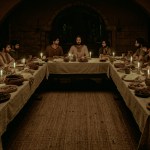
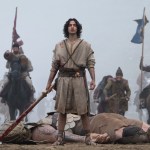
We’ve seen part of this story already this year in Prime Video and Wonder Project’s House of David. But where that series leaned into the darker, grittier aspects of the narrative, full of battlefield violence and hints (just hints!) of sexual misdeeds, the animated David keeps things Sunday-school friendly.
For one thing, there is very little violence onscreen. The film can’t avoid the killing of Goliath (Kamran Nikhad) entirely, of course—it does omit the beheading—but it manages to suggest the darker parts of the story without quite showing them. Armies chase each other, but we don’t see what happens when one army catches up to the other. And when someone holds up a weapon to someone else, the camera cuts away before we see how the weapon is used.
The film tones things down in other, more unexpected ways too. After saving his sheep from the lion—by knocking the beast off a cliff, as he did in Young David—David then saves the lion itself, which is pinned against a rock. And when the adult David (now voiced by Phil Wickham) confronts the Amalekites who have captured his family (1 Sam. 30) … well, no spoilers, but suffice it to say he leads with nonviolence in a way that directly parallels his rejection of Saul’s armor before he fights Goliath. The Amalekites, incidentally, are wonderfully dark and ominous, and wear masks of bone and antler like something out of a Terry Gilliam movie.


The film also completely avoids any hint of David’s love life. King Saul has no daughters to offer as a prize for killing Goliath, and David’s closest female relationships are with his kid sister Zeruiah (Sloan Lucas Muldown and Ashley Boettcher) and especially his mother Nitzevet (Israeli singer Miri Mesika). It’s particularly gratifying to see how big a role Nitzevet plays in this film. House of David and Of Kings and Prophets killed her off before they even began, contrary to the biblical narrative.
David makes its protagonist more heroic in other ways too. The biblical David and his men hid from King Saul by forging an uneasy alliance with the Philistines—one that entailed a fair bit of lying and killing on David’s part (1 Sam. 27; 29)—but the David of the movie plans to infiltrate the Philistines to save the Israelite army, until events conspire to draw him away.
Strikingly, a lot of these twists work. The film makes perfect dramatic sense on its own terms, and you can marvel at how cleverly it rearranges the narrative pieces of the biblical story. It just isn’t as morally complex as the original.
Bible nerds might get a kick out of some of the more obscure details that make their way into the script. One of David’s men is named Elhanan (Doron Rechlis), and when David’s men put on a skit celebrating David’s victory over Goliath, Elhanan plays the giant. (The biblical Elhanan had a history of his own with Goliath’s brother; see 2 Sam. 21:19 and 1 Chron. 20:5.)
The film also has some interesting parallels with another animated Bible movie, The Prince of Egypt. Like that film, this one emphasizes the hero’s closeness to his female relatives, and it casts an Israeli singer as his mother. It also features a scene in which a giant stone image of the king is defaced or destroyed. And in a song called “Tapestry,” David’s mother teaches him about trying to see the big picture, just as Jethro taught Moses in “Through Heaven’s Eyes”—a song that begins with the line “a single thread in a tapestry.”
For all its visual and artistic ambition, though, David isn’t as grown-up (for lack of a better word) as The Prince of Egypt. David has its serious moments, but it frequently goes for the joke in a way that the Moses movie didn’t—by finding humor in the cowardice of the Israelite soldiers, for example.
related


David is also arguably weakest when it should be most iconic—that is, when David fights Goliath. The confrontation between the Israelites and the Philistines plays like something out of a pantomime, as the Philistine king Achish (Asim Chaudhry) and the giant himself come across as campy, cartoonish villains. (Goliath is also super pale, which unfortunately plays into the “evil albino” stereotype.)
But there’s still a lot of movie to go after that, as David grows up and finds himself running from King Saul. And there’s plenty to enjoy, from the gorgeous visuals to the stirring music and the clearly articulated lessons about faith and courage. David may be a children’s film at heart, but it’s one that raises the bar for faith-based animation as a whole: thematically resonant for kids but artistically inspiring for viewers of all ages.
Peter T. Chattaway is a film critic with a special interest in Bible movies.
Related