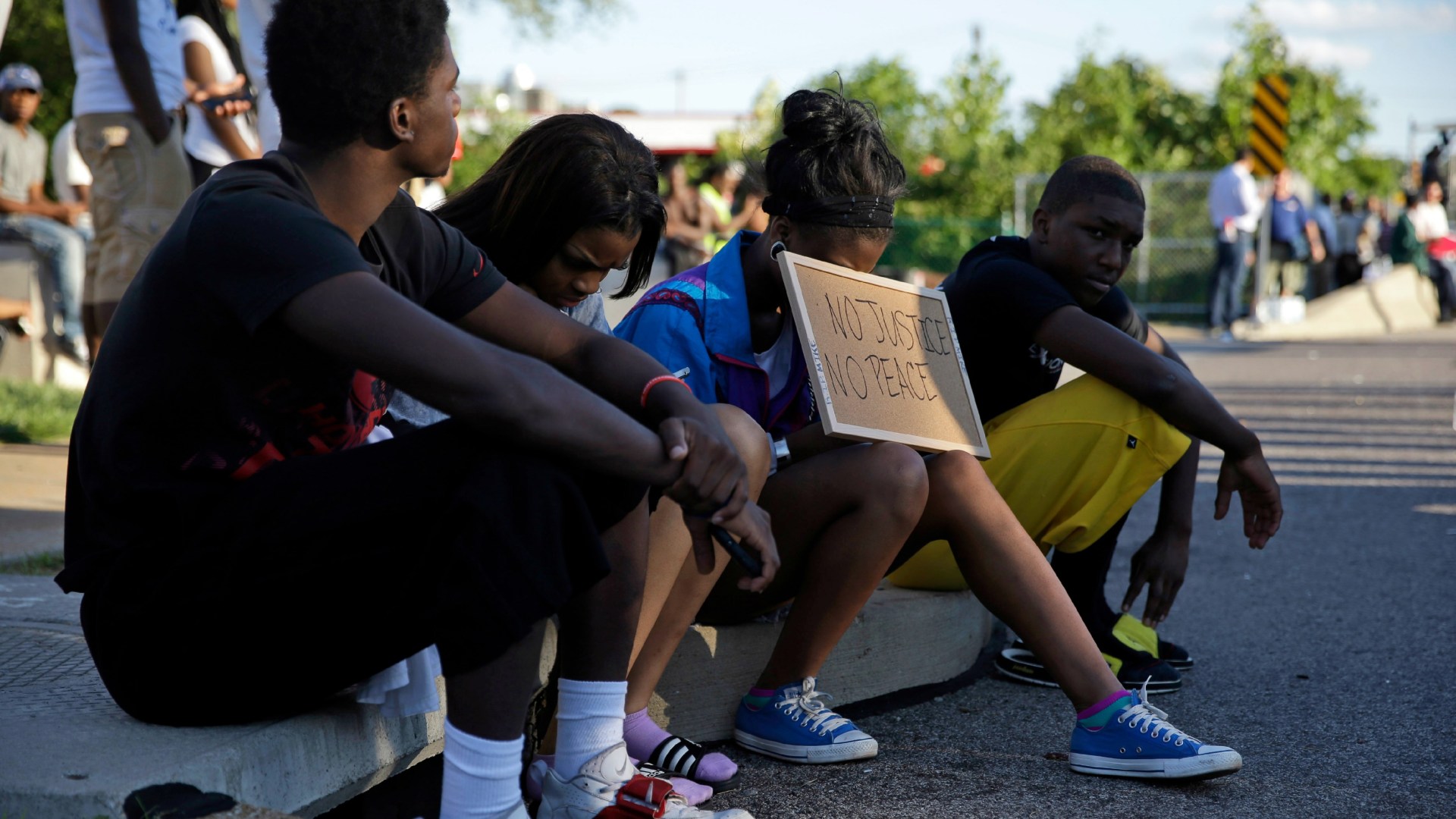
By some measures, every 28 hours, a black man is killed in America.
This statistic rang true as I turned on my computer Saturday evening, scrolled through my Twitter feed, and saw #Ferguson, #MikeBrown, and other references to a police shooting where an unarmed teenager was killed in suburban St. Louis. I opened another browser window to search, and my worst fears were confirmed: another black teenager lost his life as a result of racial profiling. Another son, another brother, another friend lost due to police violence. #MikeBrown is the latest victim of racial profiling in America. Days before him, there was #JohnCrawford, and before Crawford, there was #EricGarner, #RenishaMcBride, #JordanDavis, #TrayvonMartin, and #OscarGrant. In 2012 alone, at least 313 men died as a result of the extreme targeting. Lynching may be outlawed, but Jim Crow still exists.
Decades ago, or even years ago, names like #MikeBrown would have been buried in news briefs and death notices, if even mentioned at all. But as the result of Twitter, blacks have been able to create awareness, raise support and push the conversation forward around the issues that most resonate with our experience.
In fact, blacks use Twitter at rates higher than that of whites. This is the case because Twitter, more than any other social media platform, has given us the power to challenge the behavior of law enforcement and self-appointed vigilantes in a way that traditional forms of media do not.
Such was the case following #MikeBrown’s death. After the media posted a photo that showed Brown in a negative light, black twitter users started the hashtag, #Iftheygunnedmedown. The tweets have grown into a campaign, with users sharing pairs of photos of themselves and questioning the way that people of color are often vilified in the news.
But while these conversations trend and develop among blacks, others are often oblivious to the news or what the trending hashtags mean. It’s a result of the “filter bubble,” our tendency to isolate ourselves online from views that oppose our own. On social media, we tend to follow people who are like us – people who look like us, think like us, and believe like us.
That’s why even well-connected Internet users can miss out on a whole dimension of the news, while certain groups continue to discuss issues among themselves. The conversations among people of color can be so far removed from the overall Twitter chatter that the term #BlackTwitter emerged to describe the “cultural force” of young blacks online.
Those who aren’t paying attention to #BlackTwitter but happen upon the latest incident, may miss the nuance and importance of these news stories, activists campaigns, and hashtags. They ask, Why do these deaths matter? Why do black people pay more attention to this than to black on black violence? What are these people doing wrong that they are getting shot in the first place?
These are the wrong questions. Questions like these trivialize the daily struggle against systemic racism (which #BlackTwitter readily calls out and rallies against). Questions like these ignore this country’s history of violence against black people and even further perpetuates it because they fail to recognize our humanity and self-worth. Every 28 hours a black man is killed in America. But things can change.
While we have been dealing with hundreds of years of racial tension and oppression in this country, my hope in Jesus and the kingdom of God among us in the here and now, leads me to believe that we can create a different reality. As a mother of a black son, this is my hope for my child and every other black child.
But hashtag activism can’t foster the change alone. #MikeBrown raises awareness but it doesn’t change systems. #IfTheyGunnedMeDown provokes critical thinking, but it doesn’t shift worldviews. Change isn’t going to happen just through these essential tools but through Jesus. As a result of the reconciling nature of the cross which tears down walls between blacks and whites, I know that this pattern of racial profiling can come to an absolute end. This is what my faith tells me, this is what the Spirit of God inspires me to believe and to imagine.
I believe that Christians can play a very significant role in shifting this paradigm. As people of God, we can study the history of racism in this country and get a better understanding about how it relates to current practices and policies. Whites and other groups of color, can recognize and repent of their own racial bias and teach their peers to do the same.
After developing a racial justice lens in which to approach these issues, we can collectively lift our voices and prophesy against the entities in our society that devalue black lives, and that see us as criminals instead of fellow human beings. And we can partner with the folks on the ground who have already working on these issues – it is important that nonblack Christians join the conversation but not dominate the conversation or center the conversation on their experience.
Every 28 hours, a black man is killed in America.
This is our reality today, but I know through Christ it can be different tomorrow.
Ebony Adedayo was born in Milwaukee, Wisconsin, and moved to the Twin Cities to attend college. She earned a B.A. in Pastoral Studies from North Central University and a Master of Global and Contextual Studies from Bethel Seminary. A licensed minister, she has served in youth, young adult, and mission’s ministries and is passionate about the intersection of faith, justice, and reconciliation. She is the author of Dancing on Hot Coals and Embracing a Holistic Faith: Essays on Biblical Justice and writes at www.ebonyjohanna.com. You can find her on Twitter as @ebonyjohanna and on Facebook.