At Christmas, the Hephzibah House on the Upper West Side looks like something out of a movie. The first level of the historic brownstone has a cozy parlor with a Christmas tree, fireplace, twinkle lights, garland running up the wooden banister to the bedrooms upstairs, and warm smells of baked goods and brewing coffee coming from the kitchen.
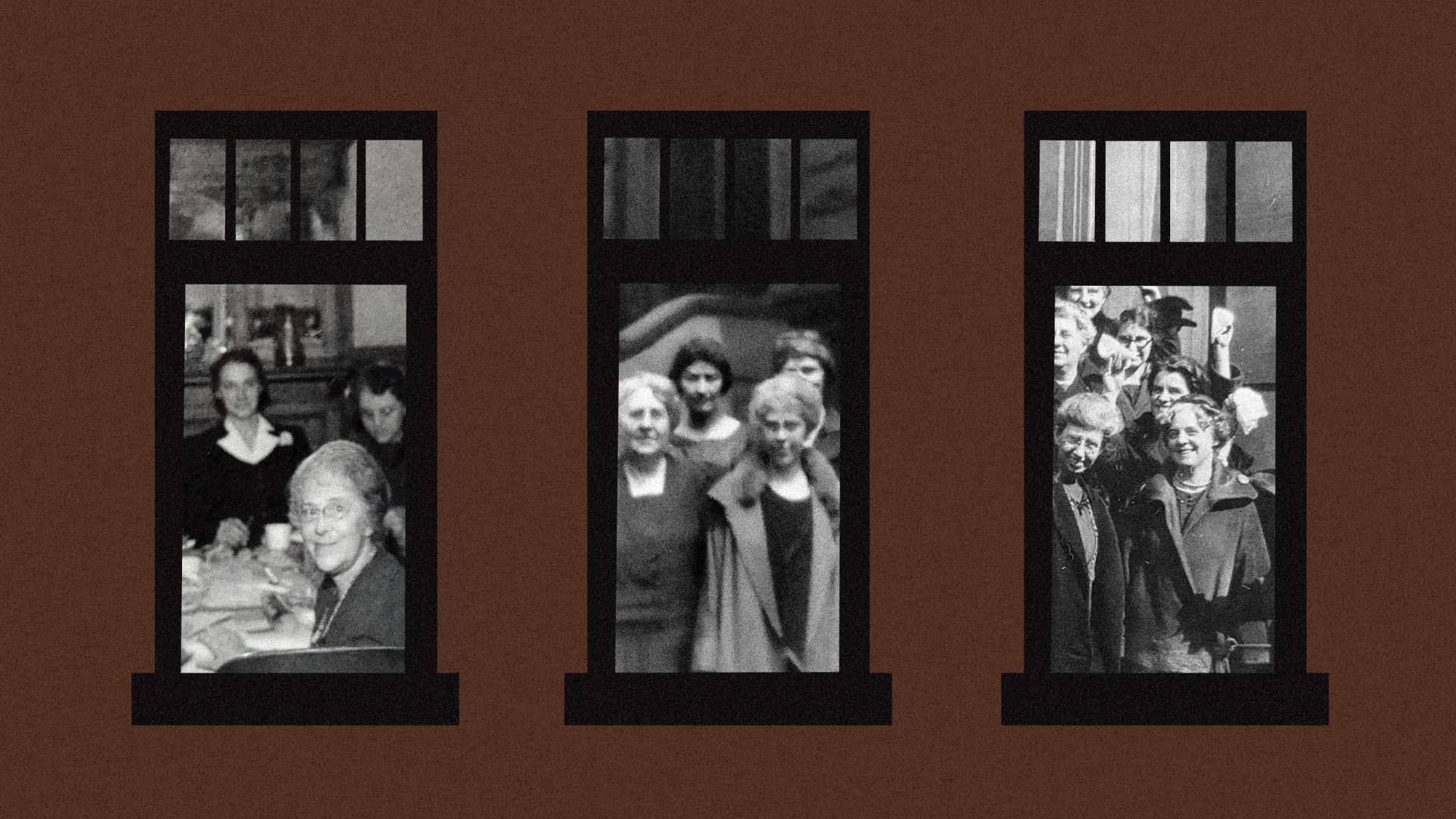
Back in the 1920s, this was a Christian boarding house for women in New York City, where the women lived, ate, and studied the Bible together. Today it’s a Christian guest house, no longer offering long-term boarding, though photos from those days still hang on the walls. It is one of the most affordable spots for visitors to the city, and while guests accept inconveniences like sharing a bathroom, they enjoy the cheaper rate, gorgeous historic molding, and etched wallpaper.
Boarding houses were once some of the lowest-cost housing in cities, providing rooms for $100 to $300 a month—in today’s dollars—a number that even those considered below the poverty line could afford. Typically, in historic boarding houses, tenants rented bedrooms and shared common spaces like parlors and kitchens.
This type of affordable lodging has all but disappeared, though a few options survive in New York. Some urban Christians and an increasing number of political leaders want to bring back this type of affordable communal living, known today as single-room occupancy (SRO).
The problem of expensive housing has hit everyone in the US, but it is acute in cities like New York, where the median rent for a Manhattan apartment is $4,625.
Penelope Morgan, who runs Hephzibah House and lives there with her family, receives requests for long-term housing all the time from Christian parents who might not know the history of religious boarding houses but who want the same institution for their children arriving to the city in 2025.
The young people may be coming to the big city for an internship or new job and are looking for an affordable, safe place to land. Morgan tells them that Hephzibah House can’t host long-term.
“There are all these Christians from around the country who could come here and be an influence in our city,” Morgan said. “It’s very hard to get here now.”
Morgan has dreamed of acquiring another brownstone and turning it into that kind of housing. She already has a name for it in mind—“Hephzibah Haven.”
Christian organizations played a big role in establishing urban boarding houses in the 1800s, some intentionally serving poor people or immigrants and others offering basic housing to working-class men and women new to the city.
Before community sports and catchy songs, this was the mission of the Young Men’s Christian Association (YMCA) as well. The YMCA was designed to “give young men moving from rural areas safe and affordable lodging in the city.” The Young Women’s Christian Association (YWCA) opened its first boarding house in New York in 1860 as more single women came to the city for work; eventually YWCAs spread like fire in other cities across the country. New Yorker Dorothy Day also started several Catholic housing initiatives for urban workers around this time.

In Chicago, most boarding houses for women in 1914 were associated with church groups, historian Jeanne Catherine Lawrence has documented. One Windy City offering was Eleanor Clubs, Christian boarding houses for women. The homes offered affordable rooms and communal living spaces, eventually housing 600 women at their peak. A form of the Eleanor Clubs existed until recently as the Eleanor Residence for Working Women and Students.
Philanthropist Ina Robertson, a devout Presbyterian who studied church history at the University of Chicago Divinity School, founded the Eleanor Clubs.
Robertson saw women who came from small towns to urban jobs “adrift,” as she said, and thought communal living would help them feel less isolated. They could also learn the Christian virtue of “love expressing itself in service,” wrote Lawrence, though Eleanor Clubs did not require attendance at worship services like the early YWCA did. Still, Robertson taught classes for Christian women at the clubs, specifically one for women training to be deacons.
The residents of Eleanor Clubs, Lawrence wrote, had a single or shared bedroom, parlors, reading rooms, sewing rooms, laundry, and big dining rooms for all the residents. Food and furnishings were simple, and the clubs had their own newspaper, the Eleanor Record.
“It truly is ministry to do that, especially for women—people who are often overlooked,” Christie Reves told CT.
Reves currently lives in one of the last remaining boarding houses in New York, Saint Agnes Residence. Saint Agnes is a Catholic institution for about 100 women on the Upper East Side. The rooms are small but affordable, and women have shared bathrooms and kitchens.
Reves’s room is spare: a twin bed with a crucifix hanging on the wall. But it suits her needs and is in a good location with a doorman. The building forbids guests, which makes Reves feel secure because she wouldn’t know who could be in her living space otherwise.
Reves ended up at Saint Agnes because she was moving to the city for work and was looking for an affordable, faith-based option. She remembered that when she was a student in Paris she had done a short-term stay at a Catholic boarding house there—and loved it—so she looked for one in New York when she arrived.
“Being completely new, I was looking at what can I find temporarily that lets me land and provides a sense of community and is maybe closer to work,” she said.
Even today, women’s wages are generally about 20 percent lower than men’s, so if they’re on their own, finding an affordable place to live is often more important, she noted.
“The times haven’t changed … if you look at why these [boarding houses] were founded,” she said. Affordable housing often has a “social stigma” and doesn’t always appeal to a woman on her own. But Saint Agnes has been a “safe and dignified situation.”
In the Saint Agnes communal kitchen, Reves has met younger and older women, including artists who might not have money for New York rents.
“I can start my job, build my relationships, figure out where I could live in the city,” said Reves. “It’s just a good place to land. It feels safe.”
Another remaining Catholic boarding house is St. Mary’s Residence on the Upper East Side, which offers rooms for women with shared bathrooms and kitchens for $1,224 a month. Regular housekeeping service is included.
Menno House, a home in Manhattan’s Gramercy Park, is not as old as other religious boarding houses in the city but has been providing low-cost communal living since 1997 for those pursuing Mennonite-related ministry or education. It has rooms for long-term residents at a steal for Manhattan: $881 a month. Residents share a kitchen and a garden out back that grows flowers and herbs for the house.
Also, a sort of boho, nonreligious boarding house model has popped up more recently, called Cohabs. The Cohabs homes have monthly house breakfasts and other events like yoga classes to help fight loneliness for the city’s newcomers. The company advertises its communal living as more carbon-neutral, with solar panels and rainwater harvesting.
New York once had 200,000 SRO units—basically boarding house rooms—in the mid-20th century. But in the 1950s and 1960s, politicians argued that SRO dwellings spread diseases like tuberculosis in shared bathrooms.
Cities also often banned the number of “unrelated” individuals who could live together, which had the effect of banning these religious dwellings. Zoning regulations, too, targeted SROs through setting minimum square footage for apartments, for example.
Now most of New York’s SRO stock is gone.
“Ironically, had SROs grown since 1960 at about the same rate as the rest of the U.S. housing stock, the nation would have roughly 2.5 million more such units—enough to house every American experiencing homelessness in a recent federal count more than three times over,” wrote Pew researchers in a brief on the issue.
Desperate for housing now, New York is considering a bill to allow the construction of SROs again. Some Western states have also passed legislation in recent years to expand the construction of these boarding home rooms. Perhaps the boarding house will return.
“Sometimes good policy is not brand new policy,” said Washington State Rep. Mia Gregerson, after the state passed a bill to expand SROs last year.
City planners think New York’s faith-based organizations could lead the way on building more communal housing.
The city’s religious groups own more than 92 million square feet of land, which is about 2.5 times the size of Central Park, according to New York University’s Furman Center. Much of that is permitted for residential use and is not built to its capacity; if it were possible to build out the maximum capacity, it would yield 98,000 homes, according to the center. But regulations are often a barrier, among other issues.
That land exists in part because of churches’ longevity and in part because they stayed when populations fled cities in the 1960s, 1970s, and 1980s, said Jonathan Keller, a longtime city planner in New York and a Christian. Churches who stayed could cheaply acquire properties in those times of urban blight.
“There’s so much need and there’s so much opportunity just from a real estate standpoint,” said Keller, who is the son of the late New York pastor Tim Keller.
He hopes to start a business one day to help churches learn how to navigate New York’s labyrinth of real estate systems and the financing for development projects on their land. Developing housing here requires lawyers, experts, and capital funds for pre-development costs before any building happens.
“Churches just don’t have that experience or institutional knowledge,” he said.
Keller is thinking specifically of New York, but there is a wider movement. Churches and other religious organizations have been pushing for zoning relief that allows churches to build affordable housing on their land. Called “Yes in God’s Backyard,” the movement was successful in California with the passage of SB 4 in 2023. The law allows churches to bypass zoning laws and build housing.

In Minnesota, churches have also started tiny home communities called “sacred settlements.” Other organizations have popped up to help faith-based organizations develop their land, including Bricks and Mortals.
Though single-bedroom rentals serve older and younger single people, they can help everyone. SROs and boarding houses simply introduced additional housing options, Keller said. More SRO housing stock for single people could free up other housing for families. “People need different options at different times in their lives,” he said.
“It’s helping the church inwardly, but it’s also an outward expression of what the gospel means for renewal of the city,” Keller said. “It would bring in a lot of Gen Zers and younger kids I think. They’re very spiritual and interested in faith but they’re very distrustful of institutions.”
A church offering housing “would be a great testimony that could get people interested in the church,” he added.