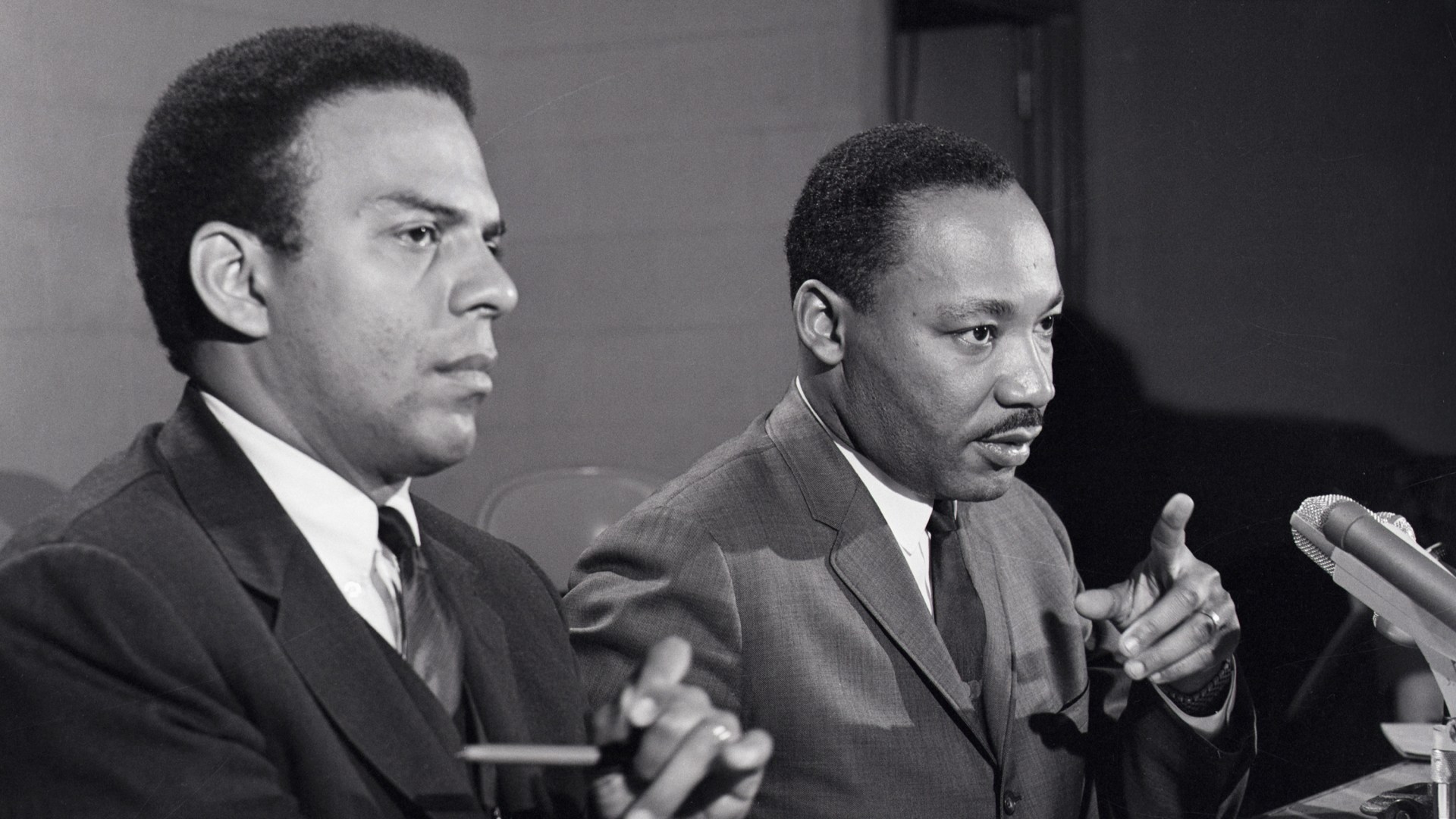
When civil rights icon Andrew Young was growing up on a diverse square in New Orleans, just 50 feet away from the Nazi Party headquarters, self-defense was a must.
But so was knowing when a physical fight wasn’t likely to lead to a good outcome. His father, a dentist, taught him how to duck and weave. He also gave Young another tip that would help in times of trouble: “Don’t get mad. Get smart.”
Staying cool under pressure would come in handy many times over for Young, a close confidant of the late civil rights leader Martin Luther King Jr. who later served as an ambassador under Jimmy Carter when he was president.
In 1964, for example, Ku Klux Klansmen beat Young and other civil rights protestors as they marched in favor of racial equality in St. Augustine, Florida. Despite the blows and taunts, the protestors didn’t physically fight back. Young recalls women marchers spontaneously broke into a song: “You can’t make me doubt him. I know too much about him. I got the love of Jesus in my heart.”
At age 93, Young is lending his name and wealth of wisdom to a new program aimed at encouraging young people to take up the mantle of King and other civil rights leaders like himself to be bridge builders in today’s divisive and polarized age.
The program—called Andrew Young Higher Education Initiative—teaches students about the formative principles of nonviolence, belief in the dignity of human life, and other formative principles of the Civil Rights Movement. It encourages students to wrestle with the central role Christianity played in the movement and challenges them to consider how nonviolent principles can inform our response to today’s challenges. The latter, facilitators note, is increasingly important amid rising political violence.
The program was rolled out last summer as a weeklong intensive for college students at Anderson University, a private Christian college in South Carolina. About 50 students from the school participated in the initial launch. This year, the facilitators are aiming to attract 500 participants as they expand their work to other colleges and universities, with a focus on reaching Christian campuses and historically Black colleges and universities (HBCUs).
“This is a moment where God’s people absolutely have to be an example, because we’re the only ones with an answer,” said Matthew Daniels, a professor of law and human rights at Anderson University and co-creator of the program named after Young. The initiative was also developed by Anthony Jones, the chair of the HBCU Committee of the College Board, which creates and administers standardized tests.
Daniels and Jones initially developed a guide that is being used by the South Carolina Department of Education to help teachers provide similar lessons. Other states, including Texas and Tennessee, have used South Carolina’s curriculum.
That success led Young to create a Bible Study for K-12 students and published by HarperChristian Resources and Urban Ministries, Inc. Christian rapper Lecrae; United States Senate chaplain Barry Black, who is Seventh-day Adventist; and other Christian public figures are featured as teachers in the program’s curriculum. The Bible study material became the basis for the Ambassador Young Fellowship.
Last year, the Anderson students used the curriculum to learn about the history of the Civil Rights Movement. They also visited King’s house in Atlanta, and, for one of their assignments, authored a version of King’s “I Have a Dream” speech focused on current events.
It’s no secret that biblical principles powered much of the Civil Rights Movement. Young recalls that whenever he wasn’t in some kind of demonstration, everyone “was going to church every day” to learn about nonviolence, listen to preaching, and sing hymns.
Young still believes the church holds the key for addressing many of the challenges America faces, including a renewal of vitriol he’s seen toward racial minorities in recent years: “It’s really the only force we got,” he told CT. Daniels agrees.
“Students, including those in this program, are understandably and rightly deeply concerned about the world they’re inheriting,” Daniels said. Adults scream at each other on cable news, fight at school board meetings, or shoot up political rallies. Meanwhile, social media embeds divisions even deeper, and the news cycle often trends negative.
“No one is giving [students] a road map for how to fix the problem,” Daniels added. “Our secular cultural institutions are out of answers at best. At worst, they’re pouring gas on the flames.”
Of particular concern is a tide of political violence. In September, Americans witnessed the assassination of conservative political activist Charlie Kirk. Just a few months prior, a Democratic Minnesota lawmaker and her husband were gunned down at their home in a northern Minneapolis suburb. President Donald Trump was also the target of assassination attempts during the 2024 presidential campaign.
Americans are concerned about the trend. Pew Research Center found in October that 85 percent of Americans thought politically motivated violence was on the rise. But it also found that majorities of left-leaning and right-leaning Americans saw the other side as “major problems.”

Daniels said teachings that are focused on human dignity and worth “inoculate” people against ideas that stoke violence and extremism, something he’s seen firsthand in his work as a human rights advocate in the US and abroad.
“One of the criticisms of us has been ‘Oh, you know, Dr. King, that’s so passé, right?’ That’s kind of like saying, ‘Oh, penicillin, that’s so passé,’” Daniels said. “Yeah, it was invented 100 years ago, but boy do you need it when you’re sick.”
His hope is Christians will be central to these inoculation efforts.
“This is exactly the kind of moment where God’s people are called to greatness,” he said. “That’s what we teach. It’s a call to them to save the nation, nothing less.”