This piece was adapted from Russell Moore’s newsletter. Subscribe here.
Whenever some terrible atrocity comes to light in the news cycle these days (in other words, about every 15 minutes), I hear the question “But what can we do?” I usually urge prayer and patience. The first part I have no doubts about, but I’m starting to realize the second one needs more context. That’s because, just like faith or hope or love or grace, the word patience often stands in for a cheap imitation. The right kind of patience can save us; the wrong kind will destroy us.
Last year, Leon Wieseltier wrote in his journal Liberties a kind of jeremiad against patience. It is, he wrote, the virtue those of us who believe in democracy often commend against all kinds of revolutionaries and enthusiasts, and rightly so. Still, Wieseltier wrote, patience can also be paralyzing when we don’t know where the line is between wise acceptance and unwise resignation. As he put it, “Sometimes patience has the lamentable effect of turning a player into an umpire, and umpires have no sides.”
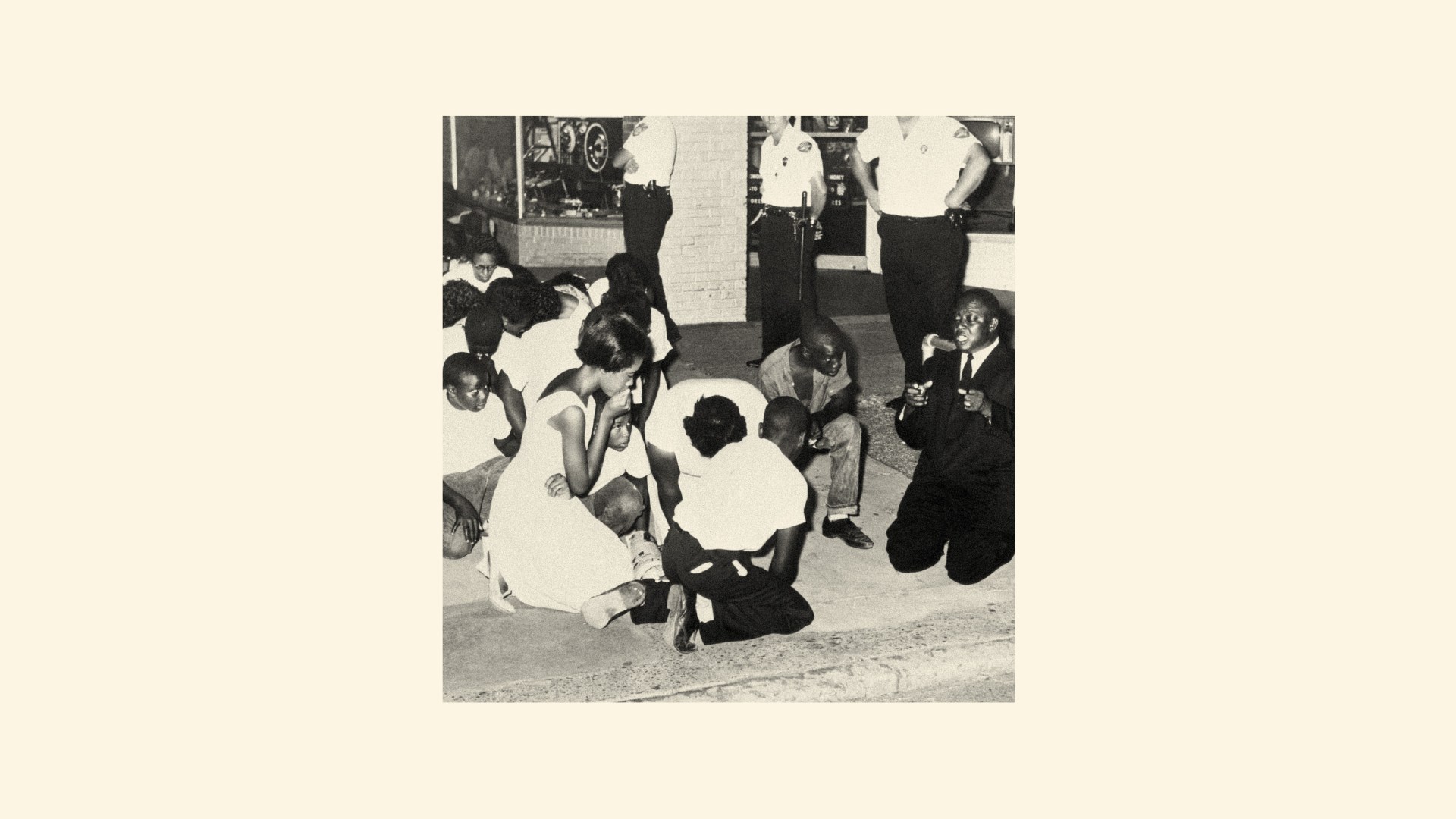
Those words made me wince because they called to mind Martin Luther King Jr.’s “Letter from Birmingham Jail” to the “white moderate” pastors who told him they agreed with his goals but he should wait patiently for justice. Noting his own consistent commitment to nonviolence and persuasive witness, King wrote, “I have tried to make clear that it is wrong to use immoral means to attain moral ends. But now I must affirm that it is just as wrong, or perhaps even more so, to use moral means to preserve immoral ends.”
King wrote and spoke very differently when addressing a different audience than those who remained silent “behind the anesthetizing security of stained glass windows.” Many, after all, concluded King’s movement was too patient, too slow. Some decided his patience just wasn’t working. We can see why someone would come to that conclusion a full decade after the Supreme Court’s desegregation decision with Jim Crow still in effect all across the South. To those, King counseled patience. This difference wasn’t inconsistency.
If someone thinks he or she has sinned too much to be forgiven, I am not going to say “Obey God” and walk away—not because obedience is unimportant but because what that person will hear, with an already-faulty view of obedience, is “Work harder.” But if another friend tells me he’s been caught embezzling money but it really wasn’t that much, and if the company wanted him not to do it, they should have paid him more, I am not going to say simply, “Rest in God’s grace.” Again, that’s not because he shouldn’t rest in God’s grace but because he has a wrong definition of grace.
Patience is indeed what’s called for in this time and in all times. Patience is worked in us by the Spirit. But the efficacy of this virtue requires that we know what it is and isn’t. Let’s look at some common views of patience.

First, think about cynical patience. This is what King called out in the Birmingham pastors. This kind of patience says, “You’ve got to be realistic” or “Idealism is for losers.” It acts as a moral sedative against doing what is right and accepts the Devil’s account of reality—that force is ultimate, that cruelty is power.
Second is demoralized patience. Those with this kind of patience wait not because they trust but because they have given up. Demoralized patience is waiting without hope. Over time, it loses the ability even to imagine a different kind of future.
In reality, the first kind of fake patience feeds on the second. Most people aren’t calculating and opportunistic. But for those who are—the cynics—nothing is more of an obstacle than people who actually hope—who aspire to something better. The cynics often tell people to be patient when what they really want is for the demoralized to shrug and say, “Well, it is what it is.”
Sometimes what feels realistic or reasonable or mature is just a way of saying to oneself, “Nothing meaningful is coming. Adjust yourself accordingly.”
In the days of the prophet Ezekiel, the problem was not just with exiles who feared God had forgotten them but also with those who were left behind in their homeland. They concluded that injustice and violence would continue: “The Lord has forsaken the land, and the Lord does not see” (Ezek. 9:9, ESV throughout).
This pattern of thinking ends with the cynics leading the demoralized to hopelessness—right where the cynics want it. And God denounced the cynics, who had “disheartened the righteous falsely, although I have not grieved him, and you have encouraged the wicked, that he should not turn from his evil way to save his life” (13:22).
But neither of these false views is what the Bible means by patience. Paul wrote of endurance, a patient bearing-up under suffering, this way: “We rejoice in our sufferings, knowing that suffering produces endurance, and endurance produces character, and character produces hope, and hope does not put us to shame” (Rom. 5:3–5). He then wrote that “if we hope for what we do not see, we wait for it with patience” (8:25).
This is hopeful patience. It recognizes delayed outcomes but does not decay expectations.
In fact, Paul wrote that waiting with hope is not passive but active, even when we don’t know what to do. The Spirit prompts us, after all, to “groan inwardly as we wait eagerly for adoption as sons, the redemption of our bodies. For in this hope we were saved” (vv. 23–24). That’s full of lament but not despair.

If what we define as patience makes us less able to determine what is wrong, it is not patience of the Spirit. Patience instead lets go of the need to control timetables or to have hopes that are immediately measurable.
Hopeful patience does not refuse to bear witness. Often this kind of patience cannot see the next steps to take, but not because it no longer believes there’s a way forward. Sometimes hopeful patience doesn’t know how to achieve justice, but not because it has concluded that injustice is inevitable or that good and evil are the same.
Impatience, on the other hand, leads first to frenzy and then compliance. When we expect everything to be immediately made right, we become frantic when it is not. For some people, that then means forcing change to happen—even if it mimics the ways and means of the unjust. If Martin Luther King Jr. had decided to fight Bull Connor with fire hoses and attack dogs of his own, he would have lost regardless of who won—it would just create a contest to find which Bull Connor was bigger.
Even for those who retain moral integrity and authority, a waiting that isn’t energized by both hope and lament will lose heart—and give up. Eventually, the impatient look around for what does seem to work, and often they find the same thing the cynical propose and the demoralized accept.
The patience of the Spirit is different because it conforms us to the patience of God himself. If we misunderstand that, we miss it all. In The Perilous Deep: A Supernatural History of the Atlantic, author Karl Bell explores how the chaos of the oceans led to the genre of “cosmic horror” by such writers as H. P. Lovecraft. Lovecraft’s Cthulhu and other monsters are terrifying because they are, in a sense, patient. They slumber in waiting because they do not care about human beings at all. They represent a meaningless, unfeeling universe. But that is not the patience of the God and Father of Jesus Christ.
The impatient look at the injustice and suffering of the world, and they conclude, as do the cynical and demoralized patient, that everything will be this way forever (2 Pet. 3:4). They cannot see that the patience of God is active: “The Lord is not slow to fulfill his promise as some count slowness, but is patient toward you, not wishing that any should perish, but that all should reach repentance” (v. 9). Patience with hope keeps checking in, even if that means asking, “How long, O Lord?” or sighing in utterance too deep for words.
Patience is not Zen-like detachment. That’s why some of the most patient people I know feel as if they’re impatient. And some of the people who think they are patient are just procrastinating or scared or numb. If you are anguished and unsure of what to do, pray—stop and just say that in the presence of God. You will find that you are either appealing for God to intervene or praying for him to bring to mind what he is calling you to do.
Patience endures suffering, but it doesn’t cause it. Patience endures evil, but it doesn’t endorse it. Let’s wait, but not as those who have no hope.
Russell Moore is editor at large and columnist at Christianity Today and leads its Public Theology Project.