The story is told of how the Armenian king Trdat (also known as Tiridates III) was physically transformed into a wild boar as a form of divine punishment for persecuting Christians. He reportedly developed claws, a snout, fangs, and bristly hair, symbolizing his descent into a beastlike state.
Ancient church historian Agathangelos tells how Trdat suffered from this strange affliction until divine aid provided a cure. The king’s sister had a vision of a man who could heal him—the same man Trdat had years earlier thrown into the aptly named Pit of Oblivion for refusing to sacrifice to an Armenian ancestral goddess.
The man’s name was Grigor (we know him as Gregory the Illuminator), and he should have died there. But when the Pit of Oblivion was opened, Grigor was found alive thanks to the generosity of a woman who had furtively tossed bread into the pit each day for years.
Grigor was brought forth to heal King Trdat, who immediately repented and converted, dedicating the rest of his long reign to tirelessly building up the Armenian Church with Grigor’s help.

How should we approach inspiring (and often entertaining) stories like this one, which many cautious historians of Christianity introduce with phrases such as “According to tradition …” or “Legend has it that …”? The history of the Armenian Church is full of such accounts, yet historians remain divided on whether or how to incorporate them into serious historical narratives.
Even the date of Trdat’s conversion is deeply controversial, with scholars arguing for either 301 or 314 or somewhere in between. Such challenges are intricately enmeshed with the Armenian national story. Well before Trdat’s conversion, Christianity had been growing steadily in Armenia, as it was elsewhere. Early church traditions declare that Bartholemew and Thaddeus, 2 of the 72 disciples mentioned in Luke 10:1, were the original apostles to the Armenians. Perhaps.
Several important trade routes cut through Armenia, and merchants and missionaries shared their faith in the major cities. Over the course of the second and third centuries, Christianity came to Armenia primarily from Edessa in Mesopotamia, which was home to a vibrant Syriac Christianity, and from Cappadocia, which was predominantly Greek. The first recorded Armenian bishop was Meruzanes, who we know corresponded with Dionysius, bishop of Alexandria, around the year 250.
By the late third century, some powerful Armenian nobles embraced Christianity as well. The political situation of Armenia was vital to Christianity’s rise there. Armenia was located between two warring superpowers—the Romans to the west and the Sassanian Persians to the east.
Even at moments of relative independence, Armenia was almost never centrally unified and was usually only superficially autonomous. At one such moment, in 298, the Roman and Sassanian empires signed a peace treaty that recognized Armenian autonomy and acknowledged the Arsacid royal house, which had a strong connection to the Roman Empire.
Trdat came to power as part of that treaty but soon faced strong religious and political pressures from all sides. From the east, “the Sassanian Persians were increasing pressure on the Armenians to accept the official Zoroastrian religion of [their] empire” in something akin to forced conversion.
From the west, Roman leaders called on Trdat to suppress Christianity and to punish any Christians fleeing to Armenia to escape Roman persecution. Trdat bowed to Roman wishes, reversed a history of religious toleration in Armenia, and began persecuting Christians, declaring his intentions in a letter to Diocletian, the Roman emperor who orchestrated the Great Persecution.
But when the Roman emperor Constantine converted to Christianity in 312, Trdat dutifully reversed course, embraced Christianity, and was taught by Grigor. All along, Trdat also felt pressures from inside his own country, as a number of Armenia’s assertive and strong aristocrats had become Christians themselves.
The two central figures in the early Armenian Christian story, Trdat and Grigor, shared strikingly similar backgrounds. Both were born into noble families with roots tracing back to Parthian or Persian heritage. As young children, they narrowly escaped death during periods of intense political upheaval thanks to courageous nurses who smuggled them out of Armenia and into Roman territory after their families were murdered.
Interestingly, some accounts suggest a dramatic connection between their families: Trdat’s father was assassinated in a plot in which Grigor’s father is said to have played a role. Agathangelos tells us that, while sheltering in the Roman region of Cappadocia as a child or teenager, Grigor “was raised as a devout Christian.”
Later, in the city of Rome, Trdat befriended influential Romans, laying the groundwork for bonds of friendship. When Grigor reached adulthood, he returned to Armenia, where he and 33 Christian women, led by Hripsime and Gaiane, shared the gospel at the Armenian court. Trdat, however, demanded that Grigor and the others publicly sacrifice to the royal Armenian goddess Anahit. When they refused, they were subjected to torture, though it remains unclear if the infamous Pit of Oblivion was actually involved. Sometime later, Trdat embraced Christianity.
Scholars have proposed various reasons for his conversion, none of which, notably, involve the tale of bristly boar hair. Some point to the influence of powerful Christian nobles within his court, others to the courageous witness of Grigor, Hripsime, Gaiane, and their companions.
Another factor may have been Constantine’s Edict of Milan in 313, which granted religious toleration throughout the Roman Empire. It is likely that a combination of these factors played a role. What is clear, however, is that once Trdat converted, he immediately began reshaping Armenia in accordance with his new faith. In 313 or 314, a state assembly in Vagharshapat, Armenia, affirmed his choice of a new religion.
The first official act of the Armenian Christian state was to send Grigor back to Cappadocia for ordination as bishop of the Armenians. He received an official political mandate to the entire Armenian people. Grigor returned to continue teaching, and in 314 or 315, he baptized the Armenian king, the army, and, sources say, the Armenian people in the Euphrates River. The areas Trdat controlled most strongly in his fragmented realm and areas controlled by Christian nobility saw immediate conversions. Pockets of paganism remained, as we see Mesrop Mashtots still sharing the gospel with pagan Armenians well into the fifth century.
But the royal family and nobility ensured that Christianity would be the religion of the state from the time of Trdat onward. Toward the end of his long reign, he would even send an Armenian representative—Grigor’s son Aristaces—to the Council of Nicaea in 325.
The Roman emperor Constantine, as we will see, embraced the faith himself and extended toleration to others. Trdat went a serious step beyond this when he “established Christianity as a state religion,” the first ruler ever to do so. Whether one accepts the traditional Armenian account and dates Trdat’s conversion to 301, making him the first political leader to embrace Christianity, or the current consensus of 314, or somewhere in between, Armenia was the first state to embrace Christianity. The Roman Empire would not declare Christianity the state religion until almost a century later. The Armenians would come to view themselves as God’s chosen people.
The ancient writer Agathangelos described his home country as a place “where God’s grace has been manifested,” with assumptions of exclusivity that have been connected with national pride there ever since.

Not surprisingly, this first “Christian nationalism” bore some unpleasant fruit. Once Christianity became the state religion, “an intense—and at times violent—proselytizing campaign began to enforce the new religion on the entire population.” Non-Christians were persecuted, and pagan and Zoroastrian sites and temples were destroyed, with Christian projects often built directly on top of the ruins. Christianity had not functioned this way before, but it would do so in subsequent centuries with great regularity across many different settings.
Throughout history, we find similar examples of Christianity being consolidated with political power. Such dangers lurk whenever a people—whether Romans, Franks, Brits, or Americans—claim to be chosen by God and adopt, in effect, a Christian nationalism.
Still, it is impossible to ignore the power Christian nationalism has to sustain a people. Christianity left a unique mark on the Armenian people that has remained strong through the centuries. Despite an often politically fragmented realm, “it was Christianity that cemented the distinctiveness of Armenian identity” in this period.
That identity has long sustained our Armenian brothers and sisters through setbacks, conquests, and occupations by Persians, Byzantines, Arabs, Ottoman Turks, and Soviet Russians. They remained a people, sometimes even without any official state to speak of.
Within a century of Trdat’s conversion, the first Armenian alphabet and script were developed by Mesrop Mashtots, and Armenians now had texts—first the Scriptures, then original literature—written in their own language. Up to that point, Christian writings had only been available in Greek and Syriac.
These were powerful markers, statements, and enforcers of Armenian national faith and identity that remain so to this day.
Mark W. Graham is chair of the history department at Grove City College.
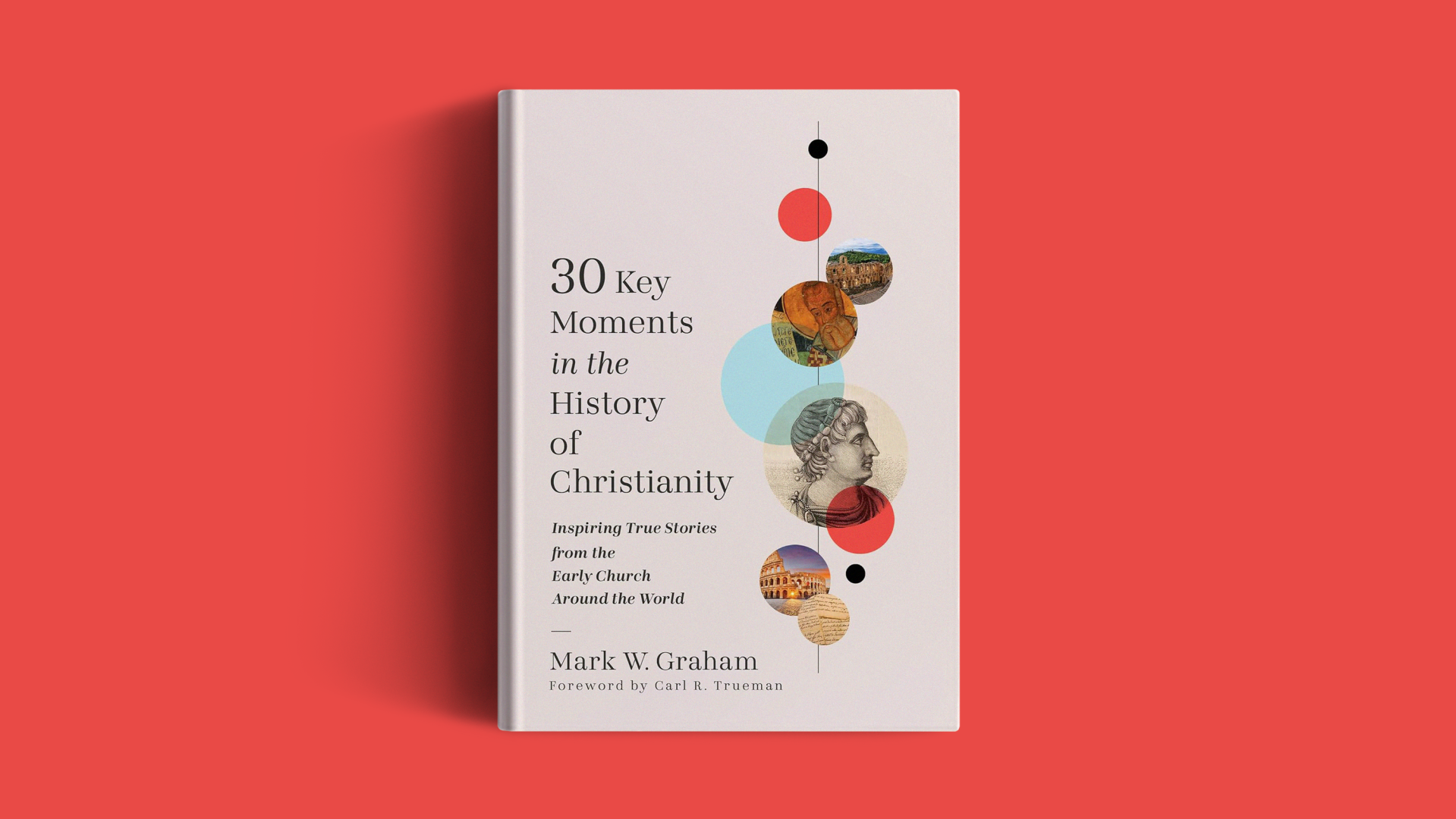
This essay is adapted from 30 Key Moments in the History of Christianity: Inspiring True Stories from the Early Church Around the World by Mark W. Graham (Baker Books, a division of Baker Publishing Group, 2026). Used by permission.