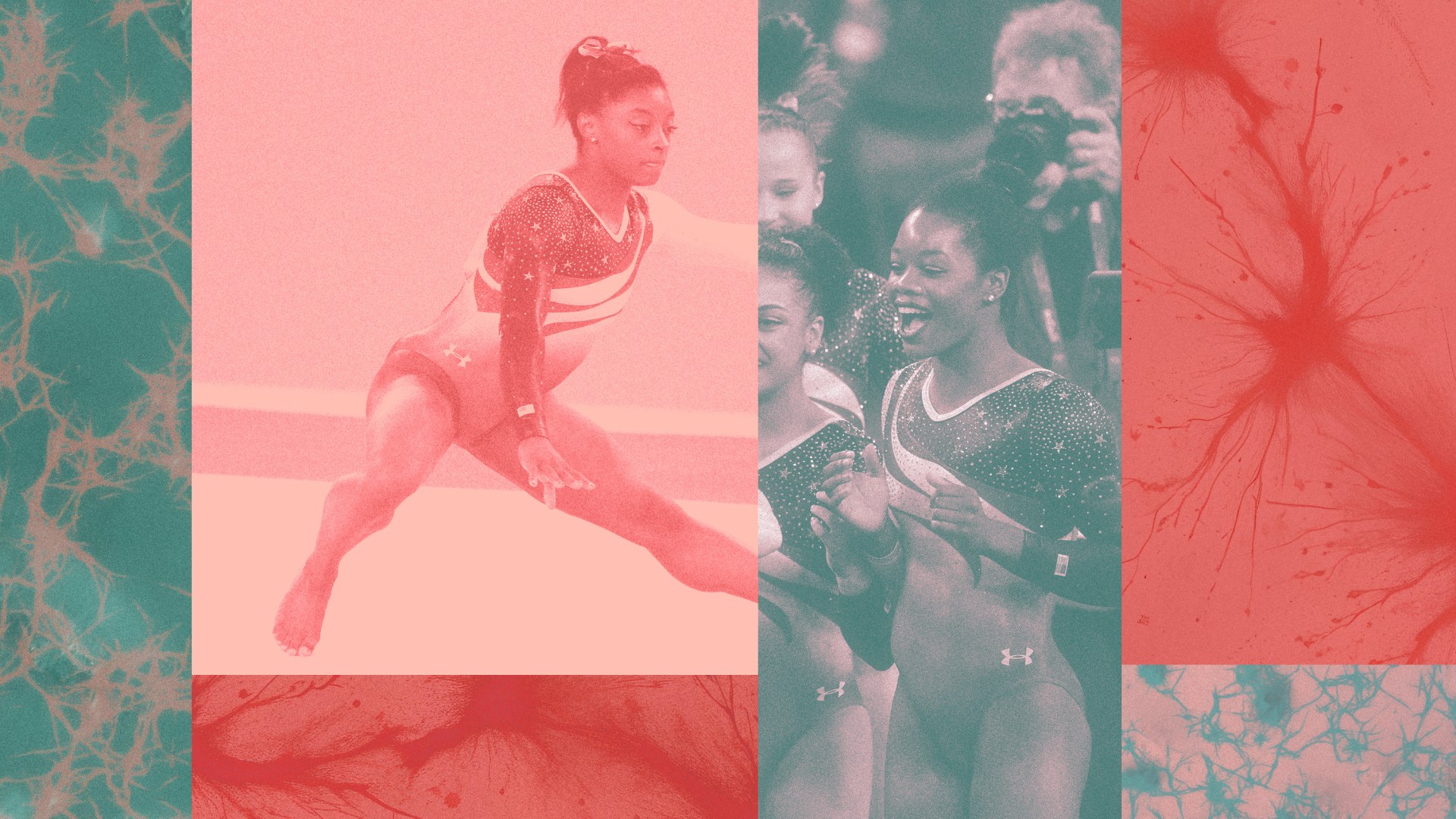
I am 9 years old, and I have just quit ballet classes because it’s become painfully apparent that I don’t have the basic sense of rhythm the other girls do. But it’s also the 2008 Olympics, and Shawn Johnson is flipping her 4-foot-11-inch self over the balance beam. I roll up a blanket into a makeshift beam on my bedroom floor and practice spinning on it.
Then I am 13 years old, and Gabby Douglas is vaulting to victory, solidifying Team USA’s gymnastics dominance on the world stage. My friend and I practice cartwheels and roundoffs in our backyards for hours and even sign up for a tumbling course, where girls half our age put us to shame. But we don’t care.
Later, I am 17, and Simone Biles is about to shock the world at her first Olympics. I don’t know it yet, but in just a few short weeks, everything in my own life is going to change.
Everything, that is, except for my love of the Olympics.
In my senior year of high school, a tendon strain from the year before came back to haunt me. Only this time, it wasn’t a discrete line tethered to my left elbow but a radiating pain that hopped around from joint to joint like a grasshopper from some biblical plague. Suddenly it was both elbows and both wrists and both shoulders and my neck and my upper back. In a few weeks, pain became my first thought and my final word, my midnight companion and my invisible midday shadow.
Thus began years of going to doctors from every specialty under the sun to try to make sense of how a 17-year-old girl found her life upended by what began as a weightlifting injury. I deferred a college acceptance and then disenrolled completely. I gauged how bad a day was going to be by how much it hurt to lift my toothbrush after breakfast.
I have never been coordinated, and after my failed stint with ballet, I never participated in any organized sports. But I discovered CrossFit in high school and fell in love with the variety of the workouts that can be adapted to most bodies. For the first time in my life, I felt strong. For the first time in my life, I consciously liked having a body.
And then, somehow, the gift of that experience collapsed in on itself and became my greatest curse, and it felt like my body had betrayed me. Or maybe I had inadvertently betrayed my body, done some harm to it that I hadn’t intended, and now it was going to hate me forever.
We have journeyed, my body and I. Now, 10 years later, I have been mercifully brought to a plateau of more manageable levels of pain. The possibility of backsliding, returning to a life where I cannot function, still exists, looming like a sheer cliff a hair’s breadth away. But I am learning to get up each morning in hope anyway. I am learning to see my body as a companion and less as a combatant.
I have fought for years to find beauty in my physical limitations. I have come to love stillness, silence, and hiddenness in a way I never would have without this pain. Pain has made me more attuned to my body, which on my better days I am able to recognize as a great gift. Without it, I would steamroll over this hunk of flesh without thinking twice. I would notice less pain, yes, but also less pleasure. Now I am acutely aware of the grace of warm water sliding over my skin, the release of a tight muscle, the endorphin rush of a hug. So much of who I am—so many of my favorite things about myself—have been shaped by embracing this new normal of disability.


Every couple of years, though—and today, again, with the opening ceremony of the winter Olympics—I wonder: Am I abandoning all that progress when I turn on the Olympics? Is watching these athletes is a guilty pleasure? Am I speaking out of both sides of my mouth to celebrate limitations while also praising the people whose bodies take them beyond the breaking point, who shatter limits?
How can the spectacle of everything I can’t do be such a source of joy and even comfort?
In the harrowing one-man play Sea Wall (performed here by Andrew Scott), a religious skeptic claims that science has found not one hint of God, for all its incredible discoveries. His believing father-in-law contends otherwise. Our protagonist demands: “Where is God then? Is he at the farthest reaches of our universe?”
His father-in-law responds:
He’s in the feeling of water. Sometimes there’s the shape of the roll of the land. He’s in the way some people move. He’s in the light falling over a city at the start of an evening. He’s in the space between two numbers.
He’s in the way some people move.
I love the Olympics because in the way these athletes move, I get to see a glimpse of God—the God who designed tendons and ligaments, fast-twitch muscles and red blood cells. The God who crafted some bodies to seem untethered from gravity, free from friction and strain. And this Godward gaze, directed toward the maker of these athletes and not the athletes themselves, lifts me out of myself and into his work in the world.
It is what Tim Keller calls, inspired by the writings of the apostle Paul, the freedom of self-forgetfulness. This is not a forgetfulness of being embodied; it’s a forgetfulness of the false narrative that I and my experience are the sum total of reality or the primary lens through which I should see life.
“The world is charged with the grandeur of God,” poet Gerard Manley Hopkins wrote. I can choose to celebrate this or to twist my attention in on myself until my disappointment is the only reality I see. The movement of great athletes is a kinetic psalm of praise, and to my great relief, it can’t be silenced by my pain.

In 2022, I held my breath as American figure skater Nathan Chen started his free skate, the second of two skating competitions that combine to give figure skaters their final score. It’s seemingly impossible, what skaters attempt to do, notching one thin blade into ice for less than a second and, from that briefest moment of contact, generating enough power to soar through the air for yards while also spinning like a top—and then landing precisely on one foot. But Chen did that incredible feat over and over again. By the end of the program, in a sport where winning often depends on fractions of a point, he’d taken the lead by over 22 full points, shattering the world record.
I watched Chen move with that bewitching combination of power, speed, and grace, alchemizing ice and metal into art, harmonizing his whole body into a visual song. Four years earlier, he had fallen catastrophically several times and missed the podium. This time, he knew he had won 30 seconds before the program was over. Even now, as I rewatch that skate, I feel not a single shred of bitterness that I can’t do something like that.
It is enough that someone can do it, that someone’s dream came true. That someone’s body didn’t break—even if it’s not mine.
As I watch people perform the seemingly impossible, for a moment it doesn’t matter that I—or the vast majority of those watching—will never be able to shoot a bullseye or run 26.2 miles in under two and a half hours. Because the greatness we witness is for all of us to enjoy and be inspired by.
Obviously, the opposite can happen. Jealousy and vainglory can corrode our souls, whether as competitors or devoted fans. And ecstasy about humanity and its excellence, turned into an idol, can delude us into forgetting about our Maker.
But all the same, I have experienced moments of joy at the mere fact that some people’s bodies move in marvelous ways, moments that have lifted me outside of my own circumstances and reminded me that I, simply due to my existence as a human being, am part of something glorious, a people made in God’s image.

David Foster Wallace once wrote in a brilliant article about the tennis master Roger Federer that “great athletes seem to catalyze our awareness of how glorious it is to touch and perceive, move through space, interact with matter.”
I love the Olympics because I often feel my body is a prison, a foe, a letdown; I resent being bound by matter; I am suspicious of touch because it is more often associated with pain than with pleasure. But when I watch people who are so completely at home in, at one with, their bodies, I remember that being embodied is a gift too. I share in the dignity and gift of being an embodied human, even though the details of my experience are different from an Olympian’s. I get a taste of experiencing the Edenic truth that my body is good.
I will not pretend I do not dream of the day, either somehow here on this Earth or in the new creation, when I am turning cartwheel after cartwheel again, swimming upstream, and perfecting my pull-ups. I and other people with disabilities sometimes aren’t sure that healing is even an accurate or helpful term to describe what will happen to some conditions we have. Will we retain some or all of these traits in the new heavens and the new earth? Are people “disabled” or “differently abled”? There are certainly differences between conditions we are born with and conditions we acquire, but even then, as I have found for myself, there are aspects of my acquired, unasked-for condition that I have come to count as precious and essential to me.
Jesus’ healing of physical, mental, emotional, and spiritual sorrows was a hallmark of his now-and-not-yet kingdom throughout his ministry. As Paul writes in Romans 8:23–4, “We groan within ourselves, eagerly waiting for the adoption, the redemption of our body. For we were saved in this hope.”
We were saved in the hope of redeemed bodies, which implies some kind of positive change from their current state.
Even so—Jesus is also scarred. I do not think those scars cause him pain (Rev. 21:4), but they exist. They are, in some way, “imperfections.” If the new heaven and the new earth were a promise of photoshopped, ultra-fit bodies fit for magazine covers or big screens, Jesus’ resurrected body would not fit that picture.
My current theory is this: In the new heaven and the new earth, the gifts of our disabilities or different abilities will be preserved, while the sorrows of them will melt away. Jesus ate. He could be touched. He had scars. He could also appear and disappear in different places, no longer bound by time and space in the ways we are. Old and new. A return and an inauguration. A homecoming and a breaking of new ground.
This is where I must quibble with Foster Wallace. Right after his quote about great athletes catalyzing our awareness of the glories of touch and matter, he adds, “Granted, what great athletes can do with their bodies are things that the rest of us can only dream of. But these dreams are important—they make up for a lot.”
Dreams may well make up for a lot, but I disagree that dreams are all we have, or even that they make up for a lot. I’m not content with dreams. I want more. Through Christ, we are promised not ephemeral fantasies of physical ability but instead confidence that one day our real, flesh-and-blood bodies in this real, earth-and-sky world will carry ease, strength, and freedom that we cannot imagine.
So I hold the gifts of my disability and how it has shaped me close to myself, trusting that those gifts will be preserved when I rise again, like scars that no longer hurt. And this week, I’ll watch the Olympics in hope—hope for healing in God’s presence. I watch the Olympics to rejoice in the embodiment that I share with these athletes, going beyond my own experience. And I watch these games in awestruck wonder at our God, who does all things well.
Aberdeen Livingstone lives in Vancouver, British Columbia, where she is pursuing a master’s of theology at Regent College. Her poetry and essays have been published in Plough, Ekstasis, and Fare Forward, among others. She published her debut poetry collection, Velocity: Zero last year. She writes regularly for her Substack at Awaken Oh Sleeper.