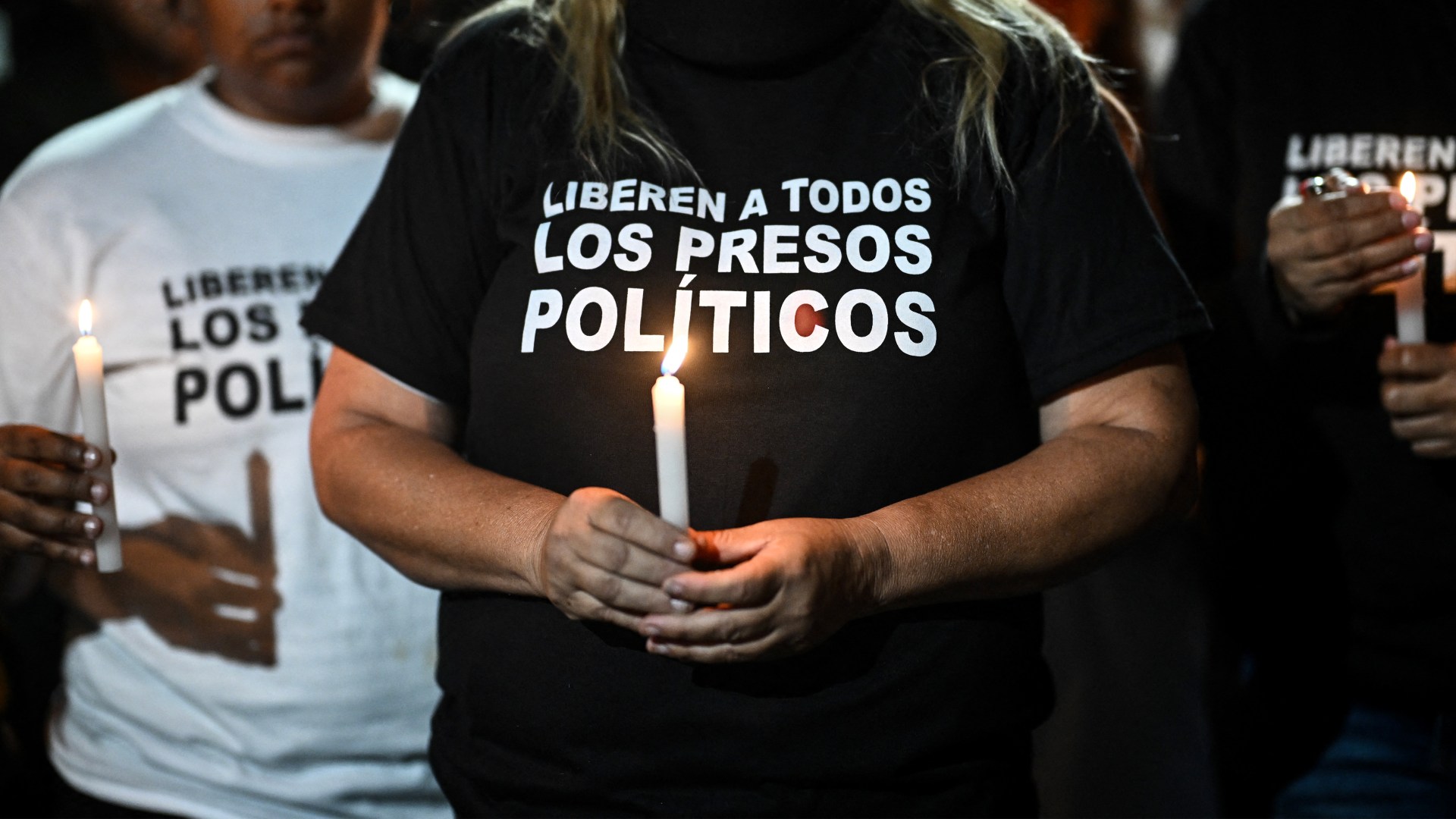
On the evening of January 17, dozens of people gathered outside Zona 7 detention center in Caracas, Venezuela. Holding candles and signs calling for the release of political prisoners, they joined pastor Luis Méndez in prayer: “We cry out for freedom for innocent political prisoners. Let the prison gates be opened throughout this country, in the name of Jesus of Nazareth.”
Behind him stood police in full riot gear.
Since January 9, the family members of political prisoners have held vigils outside some of the 120 detention facilities in Venezuela, including El Helicoide, El Rodeo I, Tocorón, Ramo Verde, Yare, and Zona 7. Some wore black and white shirts reading, “Free all the Political Prisoners,” as they lit candles, sang worship songs like “Way Maker,” and knelt in prayer. At one vigil, people wore chains around their necks while holding up a Venezuelan flag.
The families are pressing the acting government in Venezuela to make good on its promise to release the country’s political prisoners following president Nicolás Maduro’s capture on January 3. The government had said it would release political prisoners as a gesture of goodwill and willingness to respond to US demands.
Since then, the interim government led by Delcy Rodríguez claims to have released more than 600 prisoners. Yet human rights group Foro Penal found that only 383 political prisoners have been freed, while about 650 remain behind bars.
After 21 nights of vigils, Rodríguez announced on January 30 that she would propose an amnesty law to the National Assembly. The law would drop the charges imposed since 1999, the year Hugo Chávez rose to power, against all political prisoners.
Yet relatives of the prisoners and human rights organizations remain skeptical about the announcement.
“We welcome with optimism, but also with caution, the announcement of the amnesty law that will encompass all political prisoners and those persecuted in Venezuela,” Alfredo Romero, director of Foro Penal, said in a statement. “We hope that this step will contribute to justice, freedom, peace, and national reconciliation.”
Marcos Daniel Velazco, whose father, Julio, is still being held in Zona 7, agreed. “The amnesty law will only make sense when all political prisoners are freed,” he told CT. “Since the announcement was made, there has been no real, large-scale gesture of release and forgiveness for political prisoners.”
Velazco said his father’s only crime was driving a bus for supporters of opposition leader María Corina Machado during the May 2025 elections.
“My father was kidnapped by the regime and disappeared for 49 days,” said Velazco, who currently lives in the US. “We learned of [his arrest] only when the Caracas court handed down a 30-year prison sentence, falsely accusing him of terrorism and of attempting to lead a plot to assassinate Diosdado Cabello, the minister of the interior.”
But Velazco said Julio is neither an activist nor a politician. Rather, he is a meat-products distributor and a Christian passionate about sharing the gospel message with everyone he encounters.
Velazco believes the real reason for his father’s arrests is that the government wants to use him as a pawn to gain more information about Machado through Velazco, who is friends with the Nobel Peace Prize winner. After Machado met with US president Donald Trump on January 15, she ran into Velazco outside the US Capitol building and gave him a big hug.
Born into an evangelical family, Velazco became interested in politics at a young age, joining the Christian Democratic Party. He studied political science at the Central University of Venezuela and led groups of youth aligned with the opposition party Vente Venezuela.
When he first heard authorities had detained his father, he was shocked.
“I didn’t feel hatred but a lot of helplessness in the face of injustice,” he said. “Seeing a family member kidnapped as a consequence of the work one does is very, very painful.”
He worries about his father’s health, as the detention centers are overcrowded and unsanitary, with the Venezuelan Prison Observatory recording 25 deaths of political prisoners since 2015.
Since Maduro came to power in 2014, the regime has detained nearly 19,000 political prisoners and held them in 120 prisons around the country. The most famous is El Helicoide, a former futuristic shopping mall Chávez transformed into a massive prison and torture center. Instead of housing luxury stores, it holds prisoners captured by the Bolivarian National Intelligence Service (SEBIN).
Josnars Adolfo Baduel spent four years inside El Helicoide, where he faced beatings, electric shock, and suffocation, according to his sister Andreina, who heads the Comité por la Libertad de los Presos Políticos (Committee for the Freedom of Political Prisoners). At one point, prison guards hung him from his tied wrists for days.
“We have been persecuted with cruelty simply for having the last name Baduel,” Andreina said.
Andreina and Josnars’ father, General Raúl Isaías Baduel, was responsible for restoring Hugo Chávez to power after the coup attempt against him in 2002. In return, Chávez appointed him commander of the army in 2004 and minister of defense in 2006.
But a year later, his relationship with Chávez broke down as he spoke out against the dictator’s constitutional reform that would keep him in power and turn Venezuela into a socialist state. For this, authorities imprisoned Baduel in 2009 and again in 2017. He died under unclear circumstances while in prison in 2021. Authorities also detained his three sons, including Josnars, who is currently serving a 30-year prison sentence for the crime of “conspiracy.”
Two years ago, authorities moved Josnars to El Rodeo I prison, where Andreina said he is allowed weekly visits. Yet “he has asked me not to go see him,” she said, “because I could be arrested due to my activism for the freedom of all political prisoners.”
Another prominent political prisoner is Leocenis García, a presidential candidate for the ProCiudadanos party. After he shared a video on social media denouncing Maduro for electoral fraud, SEBIN detained García on September 11, 2024, accusing him of terrorism. A few months before his arrest, García spoke to CT about how Maduro sought to court evangelical voters. Yet “with faith in political leaders—both government and opposition—disappearing, people have increasingly clung to religious beliefs,” he said at the time.
García’s father, who bears the same name, feared the worst on the night of Maduro’s capture, as Diosdado Cabello, Maduro’s right-hand man, had threatened to kill political prisoners if the United States launched military action against Venezuela.
Now García’s father sees the prisoners being used as leverage in Chavismo’s negotiations with Trump.
“They are releasing people selectively,” the senior García said. “Political prisoners are like bargaining chips for this regime.”
Since last year, he has been able to see his son every Saturday. He is also allowed to bring him food and hygiene products, which his son shares with other inmates who still can’t see their families.
Meanwhile, Velazco noted that in the detention centers, the number of evangelicals is growing.
“We have a lot of Pauls and Silases in Venezuela’s torture centers,” said Velazco, who has heard stories from the families of political prisoners. “I’m sure their prayers will break chains and bring about their release. Many went in as unbelievers and have been transformed and touched by the Lord inside.”
One of the converts is former opposition congressman Freddy Superlano, also detained in El Rodeo I, whom his wife, Aurora, saw for the first time in 18 months on January 24. “Don’t stop praying for us. Don’t stop praising God, because we can hear you from inside, and we are praying with you,” she remembers him stating before saying goodbye through the security glass that separated them.
Like Superlano, more detainees have been allowed visits since Maduro’s ouster. Julio Velazco’s wife was able to see him for the first time on January 27, nearly 150 days after his arrest. She found him thinner but hopeful, convinced that the day of his freedom was near.
Behind bars, he said he draws strength from Isaiah 41:10, a verse he memorized with his children when they were young: “So do not fear, for I am with you; do not be dismayed, for I am your God. I will strengthen you and help you; I will uphold you with my righteous right hand.”