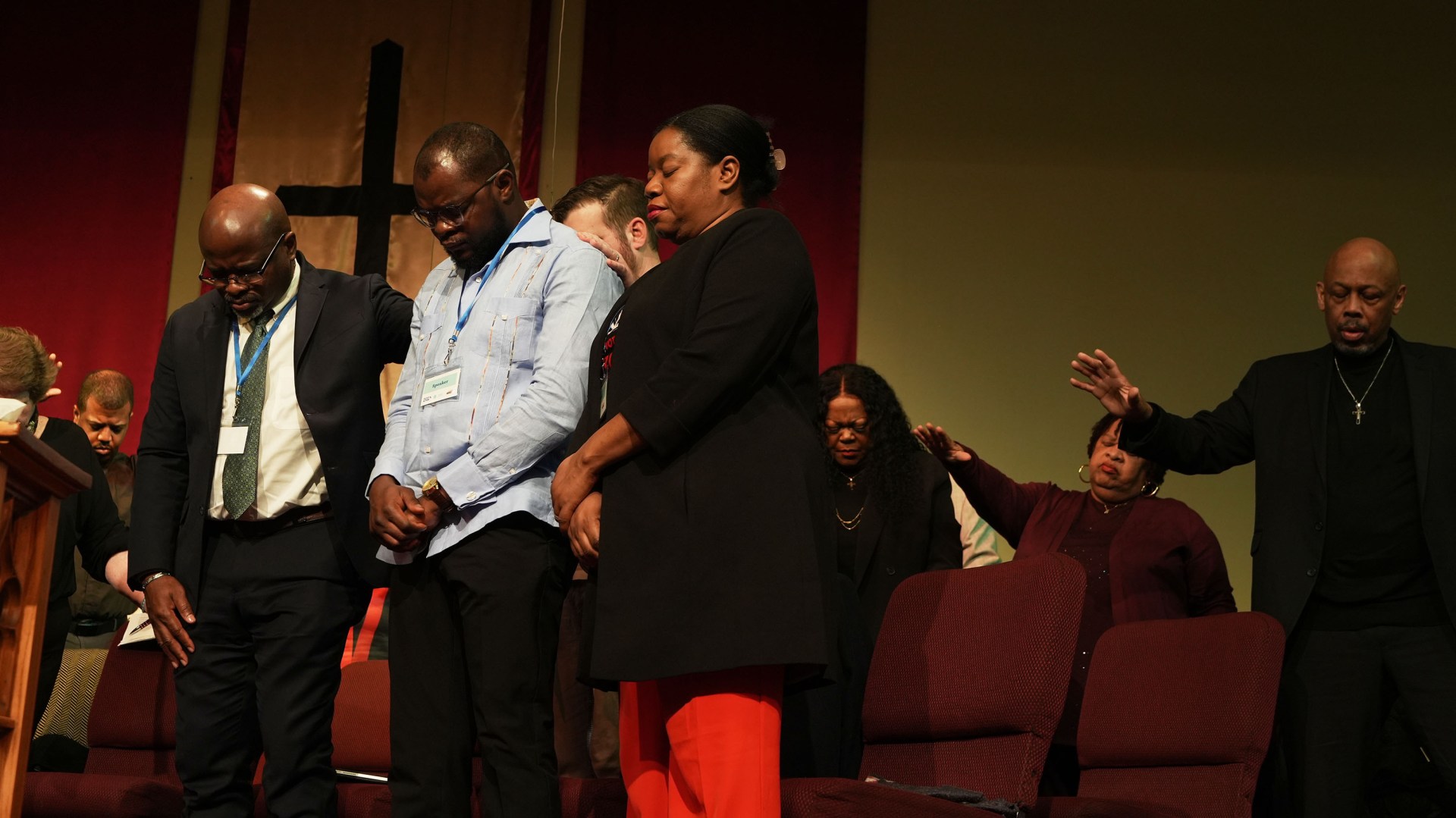
Two songs in, the fire official interrupted. Another 150 volunteers needed to leave the overcrowded church before worship could continue.
More than 1,000 people descended Monday morning on a special church service in Springfield, Ohio, to sing and pray and wave signs on the day before deportation protections were set to expire for more than 300,000 Haitian immigrants across the United States.
Visitors came from as far away as Florida and Washington, DC. They parked blocks from St. John Missionary Baptist Church, some of them linking arms to steady one another as they traipsed over snow and slush. They spilled out of the sanctuary and into the foyer and out the door.
Tim Voltz, a pastor at Champion City Church, told the crowd it was “a defining moment for our city.”
“This isn’t political talking points,” Voltz said in an interview afterword. “This is real life for us.”
While the country’s largest Haitian communities are in South Florida and New York, central Ohio took an improbable leading role in America’s immigration debate in 2024, after then-presidential candidate Donald Trump and his running mate JD Vance repeated false claims that Haitian immigrants in Springfield were stealing and eating pets.
The ensuing media frenzy—and traumas like dozens of bomb threats—tore the community apart. Before the maelstrom, the city had attracted an estimated 15,000 Haitian immigrants. Most of them had Temporary Protected Status (TPS), a legal designation granted by the US government to groups from countries experiencing armed conflict or other disasters.
The Trump administration ended or attempted to end TPS for more than a million immigrants from different countries last year. Protections for Haitians, the largest remaining group, were set to expire Tuesday night. Organizations across the country called for prayer and support.
Churches and other faith groups in Springfield have spent months preparing for the day Immigration and Customs Enforcement (ICE) agents might amass in their city. They’ve hosted trainings on constitutional rights and have helped hundreds of immigrant residents get passports and birth certificates. They have passed out orange whistles like those that became the soundtrack of Minnesota’s anti-ICE protests.
Roughly 20 Springfield congregations have collaborated to establish safe communication networks and to lay groundwork for emergency food distribution and childcare.
And on Monday, all those preparations culminated in a worship service.
Speakers, mostly local evangelical and mainline pastors, stepped into the pulpit and preached about the immigrants who are everywhere in the biblical narrative. They invoked the kingdom of God and the soon-returning Christ, and they prayed for Haitians to receive an extension of TPS.
Their prayer was answered—but not until everyone had gone home for the night.
Geoff Pipoly, a Chicago attorney representing a class-action suit challenging the Department of Homeland Security’s move to end TPS for Haitians, stood near the back of the sanctuary and joked about the heat from so many people in the room. “Hard to believe it’s winter outside,” he said.
Pipoly was reasonably confident the court would temporarily block the government from deporting Haitians before their protection expired at midnight. He’d had a feeling ever since the oral arguments earlier in January. Judge Ana C. Reyes, of the Federal District Court in Washington, asked the government’s lawyers, facetiously, if they thought Homeland Security secretary Kristi Noem could end TPS for virtually any reason. Could she end it simply because she doesn’t “like vanilla ice cream”?
“Yes, your honor,” they eventually replied.
In the worship service, Pipoly checked his phone constantly. Reyes’s decision was due any moment; he thought he might even see the emailed opinion while the crowd was still gathered, and they could celebrate or mourn together.
While he waited, pastor Carl Ruby spoke from the front. “Welcoming immigrants is as important as welcoming Christ himself,” he said. “Rejecting them is, in Christ’s own teaching, a form of rejecting him.”
Ruby’s congregation, Central Christian Church, sits at the heart of Springfield’s fight for Haitian immigrants. Viles Dorsainvil, a former pastor who runs the Haitian Community Help and Support Center, attends Central. Dorsainvil’s brother, a physician who fled Haiti in 2021 on a tourist visa and now works in Springfield as a registered nurse, is one of the lawsuit’s plaintiffs.
Haiti has, for more than a decade, been on a Dantean descent into ever-more desperate levels of hardship. Thousands of Haitian immigrants were first granted TPS by the Obama administration in 2010, following the earthquake that laid waste to much of Haiti’s capital, Port-au-Prince.
In ensuing years, the government continued extending protections and deeming Haiti unsafe for return. A devastating cholera epidemic triggered the withdrawal of United Nations security forces. Into the power vacuum swept legions of heavily armed gangs that now control an estimated 90 percent of Port-au-Prince and surrounding areas, kidnapping, pillaging, and warring with relative impunity.
During his first administration, President Donald Trump tried unsuccessfully to end TPS protection for Haitians. Following the 2021 assassination of Haitian president Jovenel Moïse and a spiraling hunger crisis, the Biden administration renewed and expanded TPS protections for Haitians already in the United States.
“Temporary protected status exists precisely for a moment like this,” Dorsainvil told the crowd at St. John. He referenced Nehemiah, the Old Testament figure who rebuilt Jerusalem’s crumbling walls.
“In Haiti today, the walls are broken as well—the wall of security, the wall of governance, the wall of basic human dignity,” Dorsainvil said. “Forcing Haitians to return under these conditions is neither safe, humane, nor just. The crisis is real. The suffering is real. And until the walls are built and the people are safe, return is not an option.”
Springfield is divided in opinion on its outsized Haitian community. Immigrants have helped revitalize the city, opening restaurants and small businesses and building homes in a city that had been a poster child for Rust Belt decline.
While the Trump administration insists it seeks to end deportation protections to pursue dangerous criminals, officials in Clark County, where Springfield is located, say they have charged almost no Haitians with violent crimes.
But many residents—Ruby, the Central Christian pastor, calls them “a vocal minority”—see Haitians as burdening public services, slowing down lines in the grocery store, and driving up local rent. In an online survey conducted by a local newspaper, slightly fewer than half of respondents said Springfield would be better off once TPS protections ended.
“It will be nice to get our city back,” wrote one respondent.
In Ohio and elsewhere, Haitians are disproportionally employed in hospitals, senior homes, and home health care. At the church service, Keny Felix, senior pastor of Bethel Evangelical Baptist Church in Miami and head of the Southern Baptist National Haitian Fellowship, reminded the audience that Haitian workers also undergird the travel and hospitality industries, including airports and cruise lines.
“Extending TPS for our Haitian brothers and sisters is not just an economic issue, but it also reflects who we are,” Felix said. “We protect the vulnerable. We do not return people to danger.”
Reyes’s ruling finally arrived in Pipoly’s inbox on Monday evening.
In an unvarnished 83-page opinion that opened with a quote from George Washington, Reyes criticized the government for failing to demonstrate that Haitian TPS holders pose any public harm. She questioned how Noem could conclude that Haiti is safe for return, a legal condition for the cancellation of TPS, when other federal agencies warn that Haiti is unsafe for travel “for any reason.”
Reyes wrote it is likely that Noem “preordained her termination decision … because of hostility to nonwhite immigrants.”
“Secretary Noem, the record to-date shows, does not have the facts on her side—or at least has ignored them. Does not have the law on her side—or at least has ignored it,” the judge wrote.
The decision will almost certainly be appealed, a process that could stretch on for months. A higher court might choose to leave deportation protections in place while it considers the case, or it might choose to lift them.
But for now, Pipoly said, “ICE raids should not start.”
Pastors said Haitians wept at the news Monday night.
The decision will “lower the pressure quite a bit and ease the fear,” Dorsainvil told a reporter on Tuesday. He said he wants to get back to church on Sunday and tell his congregation, “God still speaks today.”
Andy Olsen is senior features writer at Christianity Today.
Related