I have always loved stories about dragons. Much of my fascination owes to the works of J. R. R. Tolkien, whose legends of Middle-earth tell of dragons like Ancalagon the Black, Glaurung the Golden, and Smaug the Impenetrable. In the tradition of Norse mythology, Tolkien’s dragons are insidious and bewitching, cunning and cruel, living embodiments of the lust for domination and destruction.
We are drawn to stories of dragons because they tell us something true about the world. Indeed, dragons (or something like them) also appear throughout the Bible. They fall into the category of “chaos creatures” and may be found in the depths of the sea, in the wilderness, or in the heavenly places.
Although originally a part of God’s good creation (since nothing is evil in the beginning), these creatures come to represent evil’s rebellion against God as the story continues. It is not for nothing that the book of Revelation names the devil as the “great dragon” and the “ancient serpent” who “leads the whole world astray” (Rev. 12:9). Dragons remind us that we must reckon with evil.
We are also drawn to stories of dragons because they teach us that dragons can be defeated. In Tolkien’s stories, Smaug is killed by Bard’s arrow, Glaurung is slain by Túrin’s sword, and Ancalagon is cast from the sky by Eärendil. In Scripture, the enormous red dragon is identified primarily to assure us of his defeat (v. 2). We are promised that despite the power of evil, it is not strong enough to stop God’s work in the world (v. 8).
Although that is good news, we wonder what it means and what it will take to subdue the dragonish impulses we feel inside us. The way of the dragon is manifest whenever we see our neighbors as obstacles or objects, things to devour or possess. We feel it in our pride and wrath, in our deceit and despair. We find it in the craving for glittering things, the obsession with our own reflections, and the longing to sit atop the pile in the place of God. Who will rescue us from the dragons within?
Think of the incorrigible Eustace Scrubb in C. S. Lewis’s Narnia books. Eustace happens on a dead dragon’s horde and decides to keep it for himself. Falling asleep in the dragon’s cave thinking “greedy dragonish thoughts,” he wakes to realize that he has become a dragon.
The dragoning of Eustace offers a powerful image of the danger we are in. We too live in a world of dragons, and unless we are vigilant, we too may fall asleep in the dragon’s lair and be conformed to the “pattern of this world” (Rom. 12:2).


Can our dragon-sickness be healed? One remedy, Tolkien believed, is to read dragon stories that expose us to the truth. Similarly, Lewis tells us that Eustace might have known better than to fall asleep in a dragon’s cave if he had been raised to read “the right books.”
Both authors held that exercising the imagination with fairy tales might help readers recover their health, training their powers of discernment and cleansing their souls with mythic truth. When we fail to care for our imaginations, stronger medicine is required, an intervention like the undragoning of Eustace. But how do we undragon our imaginations?
Early in my academic journey I was encouraged by a mentor to find a foundational question to orient my vocation, and it didn’t take long for me to find it: What does it mean to disciple the imagination? I became convinced that the imagination is at the heart of discipleship: What we imagine must be transfigured and trained by the true and beautiful story found in Scripture. For the last decade I have been trying to understand how the imagination works and how theology can nurture the imagination for cultural discipleship.
I am still convinced of the value of my keystone question. But in recent years I have started to wonder whether my research question assumes too much. My working model of discipleship was a training regimen composed of gospel truth and spiritual exercise. This is a common thread in books on spiritual formation: We preach truths and prescribe practices in hopes that both will take root in our hearts.
And yet, many well-intended plans for spiritual growth devolve into information transfer and behavior modification. When they succeed, they reinforce our sense of mastery and control; when they fail, they produce frustration and shame. Something has gone wrong.
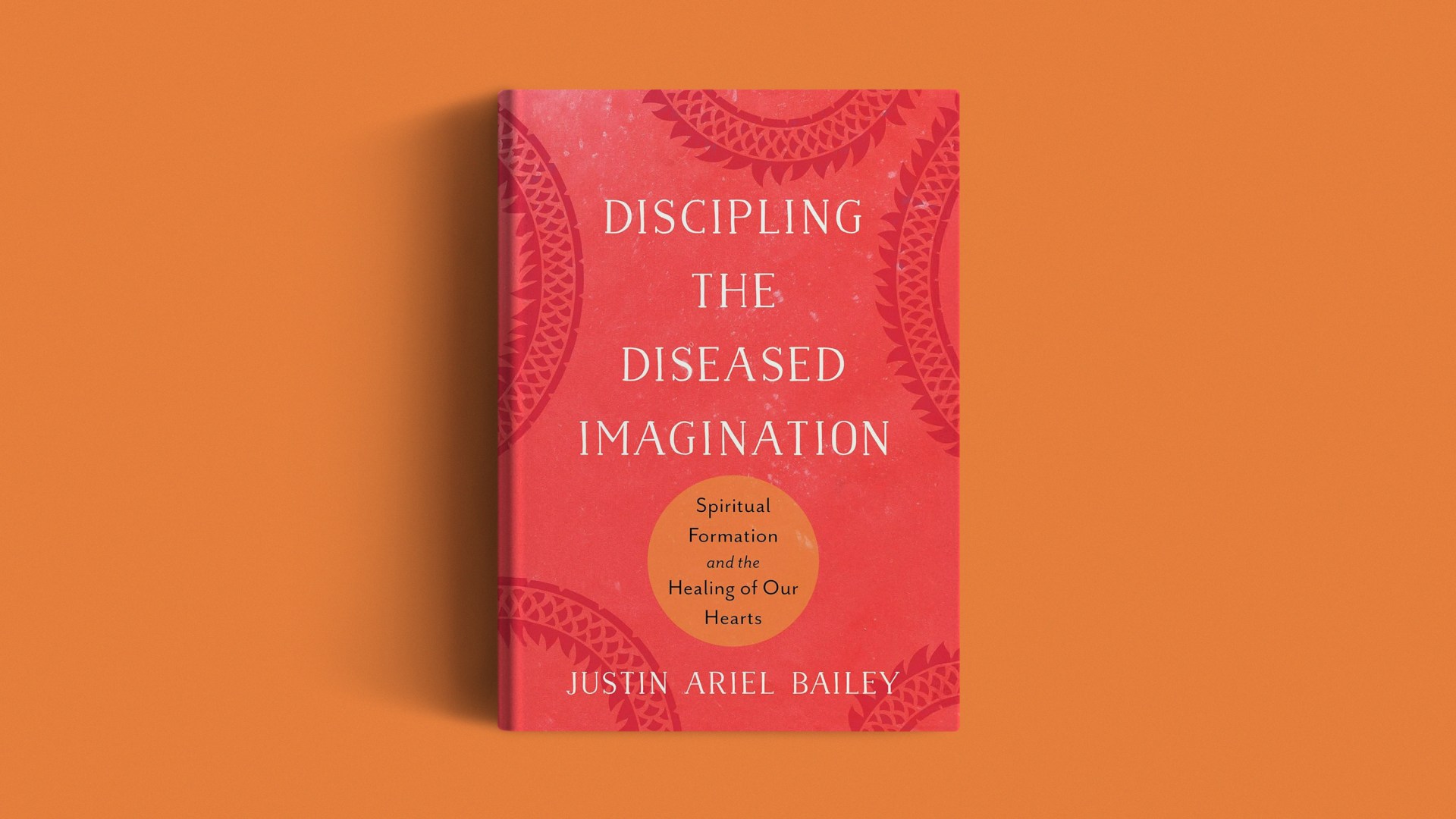
My new book, Discipling the Imagination, has been borne out of a deep sense of lament at my own failure to be formed, a failure shared by the church more broadly. Why does it seem like so many devout believers have been unable to escape the gravity of more powerful cultural, political, and economic currents? Why are we unable to imagine better futures for ourselves, for our neighbors, and for the places we live? Are our imaginations too diseased to be discipled?
I’m convinced that if the imagination is to be discipled, it must also be healed. Healing and training are not necessarily opposed. But much depends on whether we view discipleship from the perspective of an elite athlete training for a triathlon or an accident survivor relearning to walk. Both kinds of training require discipline and self-denial, but the second kind of training is truer to the overarching story of Scripture.
The imagination enables humans to live creatively in God’s created world. It is precisely because the world is full of possibility that we are always using our imaginations, filling in the gaps so that we can live more securely in the world. The imagination is active when we plan a vacation, rehearse a presentation, or hear a noise late at night. It’s engaged when we listen to a story, read a novel, or exercise empathy in relationships.

I grew up reading the King James Version of the Bible, and like anyone accustomed to its style, I knew that the translators consistently rendered the imagination with negative associations, consistently speaking of human imaginings as “evil” (Gen. 6:5), “wicked” (Prov. 6:18), and “vain” (Rom. 1:21). These passages highlight human creativity gone awry, the way it goes when we ponder the possibilities of life without God. Detached from its anchor in God, the gift of imagination becomes a curse. It misdirects human imagining toward idolatry and injustice.
The prophetic hope is not just for individual renewal but so that one day the nations will no longer walk “after the imagination of their evil heart” (Jer. 3:17, KJV).
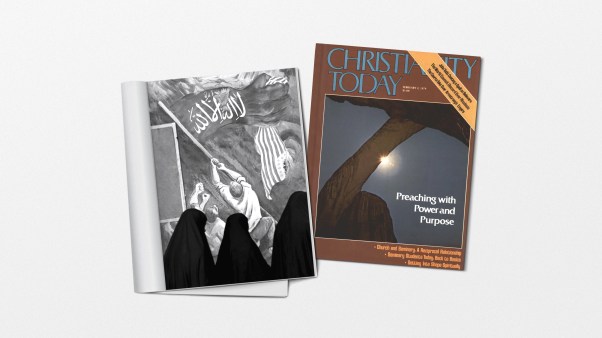
We might say that these idolatries are dragonish enchantments, spells that enslave us to evil powers. This brings me to a key term that shifts us from a magical metaphor to a medical one: the diseased imagination. I learned this phrase from Willie Jennings, who invokes “diseased social imagination” when describing how Western Christians constructed the category of race and the institution of race-based slavery.
Racial hierarchy was an imaginative fabrication; it offered an expansive story to justify the colonization and enslavement of nonwhite people groups under the guise of improvement and evangelism. Jennings’s analysis is sobering, especially for someone writing a book about Christian imagination.
It is devastating to read his account of Christian societies imagining, producing, and justifying diabolical practices and institutions. It makes plain how our lust for power and control compels us to embrace the way of dragons, to accept the domination and destruction of others as ordinary, simply “the way things are.”
If slavery seems like a distant example to some readers, let me offer one closer to home. I am a mixed-race, Filipino American man with skin that darkens considerably in the summer months. I grew up in suburban Kansas City, and although I felt different from my peers, I rarely felt unwelcome. In college I became interested in dating a girl who happened to be white, and it was a painful awakening when I heard an argument for racial separation—my separation—on the basis of Scripture for the first time. God made the races, I was told; there must be a reason. So stay in your place.
I would later learn that these lines of interpretation were taken for granted by previous generations, leveraged mostly against Black Americans. I do not for a moment believe that I have borne anything like the burden carried by my Black brothers and sisters. I share my experience to give a personal edge to the diagnosis, to testify to the inability of Christians in the dominant culture to imagine joining their lives with cultures unlike their own.


I do not believe this imaginative failure is exclusive to Christians in general or white Christians in particular. Rather, it represents the enchantments of power and comfort and the way we resist anything that might disrupt our perch at the top of the pile. Dreaming like dragons, we have become unable to imagine anything significantly different from what we have already seen and known.
We must reckon with the severity of the diagnosis before we can be healed, and Jennings tells us the truth: Christians can suffer from a badly diseased imagination. When the light in us is darkness, how great indeed is the darkness (Matt. 6:23)!
But although the diagnosis is painful, it is also a gift for three reasons. First, if the imagination is diseased, then we know that something foreign has taken it captive. Perhaps what has been learned can be unlearned; what has been taken for granted can be called into question.
Second, the diagnosis may make us more hesitant to wallow in shame. This does not mean we have no reason to be ashamed; “all have sinned and fall short of the glory of God” (Rom. 3:23). There is evil we have done and good we have left undone. But tracing sin to a diseased imagination may lead to a more careful, compassionate, and comprehensive approach. Yes, we have sinned. But we have also spent our lives in toxic ecosystems, consuming poisonous food and drink.
Like Eustace, we have not been reading the right books. Enchanted by Mammon and other idols, we no longer see a true image of ourselves, our neighbors, or the places we live.
If the imagination is diseased, the humbling truth is that we cannot fix ourselves through sheer willpower. If sin is more like an addiction or an enchantment, if we are slowly turning into dragons, it will not be enough to say, “Stop it.” We must have help from outside ourselves.
Our great hope is that God is healing all creation.
I have started praying like this: “O God who heals my diseases, heal my diseased imagination.”
The wonderful news of the gospel is that while we are still stumbling in the dark, God comes and finds us. He knows the sickness of our hearts and what we are doing to ourselves. Though we are turning into dragons, God moves to rehumanize us after the pattern of Jesus, the true human.
One of the most beautiful passages in the Narnia stories is when Eustace recounts meeting the great lion Aslan and getting undragoned. Eustace tries to peel his scales off by himself, but no matter how hard he tries, he finds that he is still a dragon. And so he must lie still and submit himself to Aslan’s claws. The lion peels the dragon skin from Eustace, layer by layer, then throws him into the water, signifying a sort of baptismal rebirth. Eustace is undragoned as he embraces a pain that goes “right into his heart” that also ultimately heals it.
Although the healing process is painful—in the Narnia stories and in our world—the amazing thing is that the healer makes sure that the worst of it falls on himself. Despite our failure to see, hear, and feel, the Lion who is also the Lamb (Rev. 5:5–6) shows up all the same. His great act of grace is stronger than the power of dragons, and it is the heart of our hopes to be set free from the way of the dragon. For “by his wounds we are healed” (Isa. 53:5).
Justin Ariel Bailey is a professor of theology at Dordt University. He is the author of Interpreting Your World: Five Lenses for Engaging Theology and Culture and Discipling the Diseased Imagination. Content taken from Discipling the Diseased Imagination by Justin Ariel Bailey, ©2026. Used by permission of Baker Academic.