Back in my online dating days, I once had a match almost cancel our dinner plans. No, she hadn’t caught me lying about my age, height, or hairline. But an unexpected red flag had surfaced as our correspondence drifted—on eHarmony, mind you, not Tinder—toward contested points of Christian theology. Before agreeing to meet in person, she needed to know where I stood on the doctrine of predestination.

I told her I affirmed it, because the Bible does (Rom. 8:29–30). She told me she couldn’t support any worldview that denies our freedom to embrace the gospel or undercuts our duty to share it. I replied that I didn’t see any conflict between God deciding who receives his gift of saving faith and God’s ambassadors laying it on the table for anyone to claim. And I extended an olive branch: this CT article,written by an avowedly non-Calvinist theologian, that argues likewise.
Détente achieved, we went on our date, enjoying a polite, theology-free meal. And that was that.
But the story lives on, for me, as one useful illustration of a deep-running aversion to doctrines—like predestination—that emphasize God’s sovereign ordering of human affairs above our free-willed responses. Like me, my eHarmony match took Scripture as her highest authority. But like many other committed believers, she also recoiled at the notion of God fixing every person’s eternal fate before the dawn of creation.
Of course, every Bible-believing denomination and church tradition recognizes divine sovereignty, in some form, as a genuine article of Christian faith. Historically, though, the most emphatic and sophisticated apologias tend to flow from movements carrying the Reformed banner. Theologically and institutionally, Reformed communities exist downstream from Reformation-era stalwarts like John Calvin and Ulrich Zwingli, along with seminal statements like the First and Second Helvetic Confessions (1536 and 1562), the Belgic Confession (1561), and the Westminster Confession of Faith(1643).
I have spent most of my adult life in and around the Reformed universe after stumbling into it almost by accident. I know the reputational baggage Reformed theology carries. Critics often regard it as stern, severe, and cold-hearted. Some see Reformed communities as breeding grounds for dour rigorists who delight in drawing and policing inflexible boundaries.
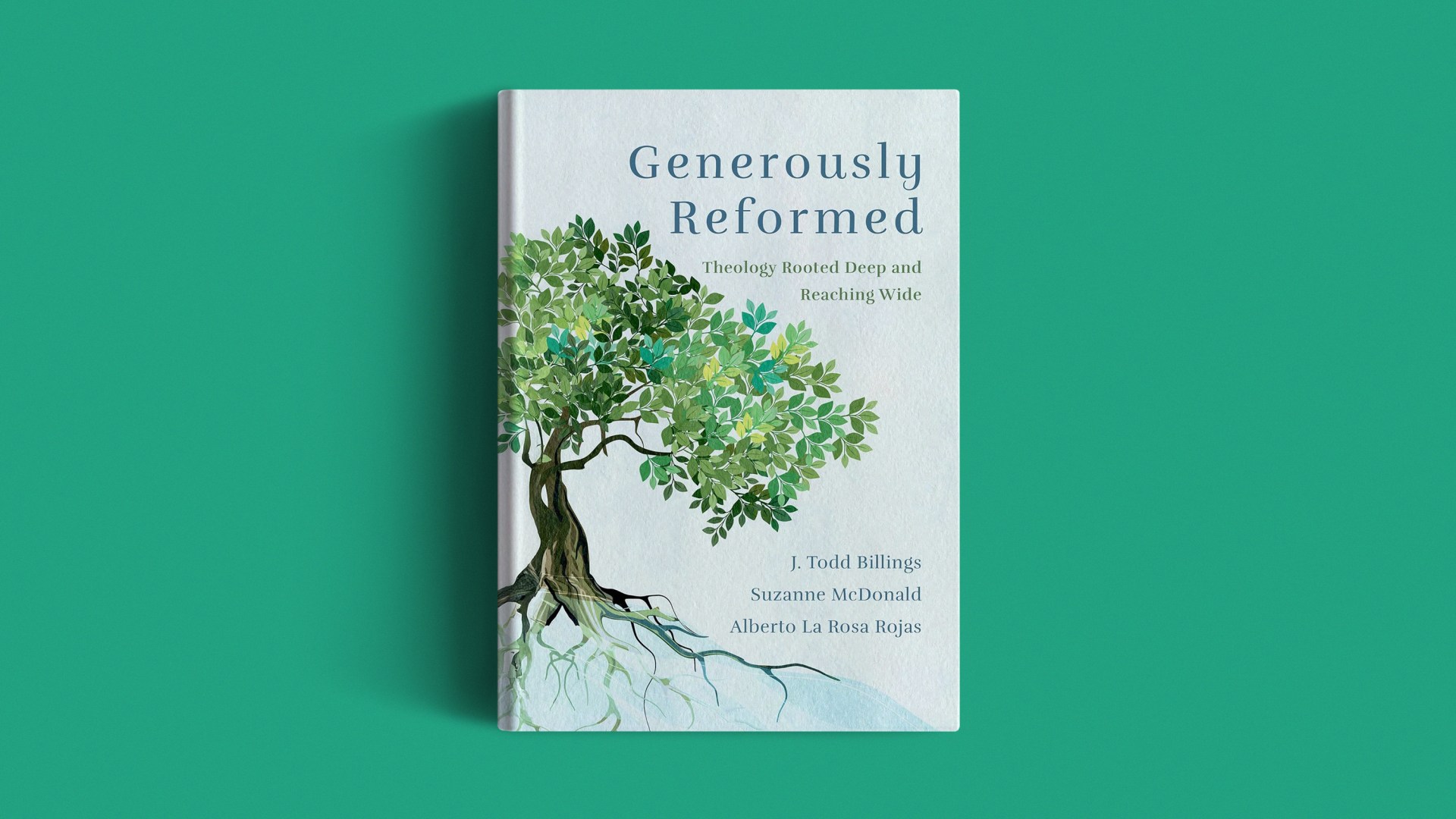
The three authors of Generously Reformed: Theology Rooted Deep and Reaching Wide are aware of the shadow cast by such stereotypes. J. Todd Billings, Suzanne McDonald, and Alberto La Rosa Rojas are professors at Western Theological Seminary in Michigan. Like me, they discovered the Reformed tradition later in life, and their book is a welcome effort at overturning misconceptions about its historical and theological track record. More importantly, it makes a positive and persuasive case for seeing Reformed Christianity as a gateway into the fullness of historic Christian truth, rather than a fortress of purity to huddle pridefully within.
Billings, McDonald, and Rojas commend the Reformed tradition as a “spacious” and “expansive” home combining firm foundations and open doors. Like a tree, they write, it “reaches down with deep roots for life outside of itself (in God) and branches out widely to the life of the world in which we live.”
related


The authors go about demonstrating Reformed spaciousness in two broad movements. First, they trace the contours of Reformed thinking in general.
As the book readily grants, this can be a frustratingly slippery task. There is no Reformed pope or college of Reformed cardinals acting as supreme authorities on matters of faith and practice. The various Reformed confessions agree with the consensus of the early church as expressed in its foundational creeds and councils. And they agree on a lot else besides. But they differ dramatically on significant subjects, like the proper forms of worship and church governance.
Those confessions were never meant to command the consciences of Reformed believers in all times and places. In many respects, then, it makes more sense to speak of Reformed habits, tendencies, or emphases than Reformed decrees that apply without exception. Unbound to any one church body, these characteristic modes of faithfulness don’t stay contained among Presbyterians and formally Reformed denominations. Many Baptist, Anglican, charismatic, and independent churches lay claim to parts of this heritage.
Given its diffuse nature, then, many understandably try to collapse Reformed theology into some person, slogan, or formula. But the authors of Generously Reformed push back on the simplifiers. Reformed teaching, they insist, is not synonymous with historical heroes like John Calvin or contemporary figures like John Piper and R. C. Sproul. Nor is it reducible to the five Reformation “solas,” which distill “some of the pressing theological issues at stake” but leave plenty of areas untouched.
Even the acronym TULIP, arguably the most popular Reformed shorthand, receives a thorough demystifying. Some of the book’s most insightful sections reacquaint readers with TULIP’s historical background, as a localized rebuttal to theological opponents, while cataloging both its rhetorical weaknesses and its insufficiency as a signature statement of Reformed doctrine.


For the authors, the difficulty of setting the Reformed tradition’s boundaries is actually one source of its strength. As they argue, Reformed churches and confessions enjoy a “deep contextual flexibility.” To cite one Reformation rallying cry, the church is a “creature of the Word.” Which means it can’t be held in the proprietary grip of any ethnic faction, geographic region, or ecclesial hierarchy.
Wherever the Word goes, then, believers are empowered to adapt the message of salvation to new contexts and needs. As the authors observe, “Reformed churches around the world—from South Africa to Cuba—have continued to generate confessional documents that clarify the gospel’s witness in their own times and places.” Thus does Reformed theology expand its reach and broaden its appeal while remaining securely anchored in the faith once entrusted to the saints.
After outlining the basic shape of Reformed thought, the book moves toward explaining specific pieces of Reformed theology and practice. Two later chapters—on Reformed approaches to justice and public life and Reformed contributions to end-times debates—struck me as helpful but somewhat secondary.
The topics themselves are first-order, of course. But the theological deficits the authors address—individualistic views of redemption and escapist notions of eschatology—echo common indictments of evangelicals in general, even if Reformed teachings give valuable guidance.
(For what it’s worth, I thought the justice sections leaned too heavily on wholistic portraits of the gospel that merge canceled debts and Christlike living, or liberation from sinful hearts and from oppressive conditions. These portraits supply essential correctives. But I don’t see them establishing either the fact or the wisdom of a sweeping mandate for social activism on the church’s part, as distinct from the vocations of individual members.)
To my mind, the book’s finest chapters answer objections to Reformed teachings on predestination, infant baptism, and God’s providential caretaking of everything from cosmic forces to individual lives. In most dialogues with the free-will side of the Christian family, this is where battle lines form. I’m no trained theologian, so I won’t attempt to analyze these sections exhaustively. Instead, I’ll pull on one prominent thread—the pure grace of salvation—that illuminates why I dwell most hospitably in Reformed neighborhoods, despite some lingering attachments to rival zip codes.
related


Truth be told, I’m a fence-sitting squish on infant baptism. My young son got sprinkled, as our church prescribes. But I got dunked myself, and occasional wavering aside, I still think the dunkers have the better biblical argument.
I’m even a little wobbly on predestination—if not doctrinally, then at least experientially. My childhood church had a custom, after baptizing new believers, of singing “I Have Decided to Follow Jesus.” I still choke up at the memory of that chorus and the heartfelt testimonies that summoned it forth. Today, I cringe at how “decision” language obscures God’s paramount role in quickening dead hearts. But I’m also uneasy about disdaining it as a species of self-deceit.
What resolves these tensions in favor of ongoing fellowship with Reformed congregations? More than anything, it’s the Reformed insistence on saving faith as God’s achievement, through and through. Obviously, other traditions preach grace, not works, as the basis of our admission into God’s family. But robust theologies of predestination and infant baptism slam the door on a temptation to boast. We can’t pretend our meager stores of biblical literacy or spiritual maturity made the slightest difference. We can’t take credit for giving the gospel a fair hearing instead of a cold shoulder.
We’re left, instead, to marvel at the mystery of being chosen by the same God who chose a conniving trickster to multiply his people, a hardened persecutor to grow his church, and “the foolish things of the world to shame the wise” (1 Cor. 1:27). It’s grace all the way down. Hallelujah!
In their introduction, the authors of Generously Reformed clarify the parameters of their project. “The primary focus of this work,” they write, “is the theological dimension of Reformed confession and theology; it is not a work in cultural anthropology, sociology, or church history.”
I’m of a few different minds about this. The first thing to say, without reservation, is that the authors need no permission—certainly not from uncredentialed scribblers like me—to write whatever book they wish to write. Reformed theology, as they acknowledge, isn’t the whole of Reformed spirituality, community, and public witness. But theology shapes those other areas profoundly. And the authors, as theologians, justifiably play to their strengths.
related


I fear, though, that this strategy avoids grappling with other, equally potent sources of anti-Reformed sentiment. People, after all, encounter this tradition as something more than a body of theological reflection, however nuanced and multilayered. They also encounter it as a network of overlapping subcultures marked by distinct styles of engagement and badges of authenticity.
Like it or not, actual existing Reformed identity doesn’t always run a direct pipeline from the Belgic Confession or the Heidelberg Catechism. For good or ill, it soaks up the buzzwords and hobbyhorses of podcasters, social media voices, and celebrity figureheads. It pours forth in wildly divergent streams, from the gentle erudition of Tim Keller’s Manhattan pulpit to the theocratic rumblings of Douglas Wilson’s Idaho citadel.
To see why this matters, consider the book’s chapter on God’s providence, which recalls Reformed reactions to the 2004 tsunami that killed over 200,000 people after battering Indonesia’s coast.
Assessing a pointed critique from Orthodox commentator David Bentley Hart, the authors agree that certain pastors embarrassed themselves by glibly proclaiming the tragedy an expression of God’s righteous and infallible will. From their perspective, the error owed more to lopsided theology than tone-deaf boorishness: These pastors weren’t wrong about God’s righteousness and infallibility, or his power over the wind and waves. But they had neglected biblical and Reformed precedents for raging against suffering rather than blithely accepting it.
I understand why the authors propose theological remedies for theological missteps. Yet I can’t help wondering if they overlook another possible warping the Reformed witness. Reformed leaders often favor bold, uncompromising postures. And there are good reasons for this. If God’s truth is at stake, you can’t cower before every social and intellectual taboo.
There’s often a fine line, however, between steadfast conviction and fetishized boldness—between telling the truth, no matter who it offends, and almost reveling in the lack of a gentle, loving spirit. I don’t think most Reformed writers and thinkers are guilty of crossing this line. But the strident minority who do surely bear some blame for making their movement appear more narrow than generous.
Billings, McDonald, and Rojas would doubtless concede that some Reformed exemplars behave crudely, speak intemperately, and otherwise give the tradition a bad name. Indeed, the authors emphasize how sin and prejudice corrupt every branch of Christian faith, including their own. I suspect they think there’s a better way of defeating bad influences than going round for polemical round. Why not drill beneath the terrain of controversialists, present Reformed theology in all its beauty and complexity, and let readers decide who embodies it best?
That sounds about right to me, which is why I can’t fault any hesitation to duke it out with Christian nationalists, the more extreme male headship crowd, or other groups with a presence on the Reformed fringes. There’s a useful analogy, here, with the challenge of defining and defending evangelicalism itself. No, you can’t ignore the ugly stuff—the black marks on civil rights or the lame excuses for Donald Trump’s pagan inclinations. But ultimately, people need to see the inheritance—not just denunciations of the ones squandering it.
In the same way, Generously Reformed succeeds by digging for deep roots rather than wallowing in the mud. May it remind Reformed readers of the spacious tradition they inhabit, while convincing others that there’s always room someone new.
Matt Reynolds is a writer and a former CT editor. He lives with his wife and son in the suburbs of Chicago.
Related