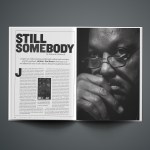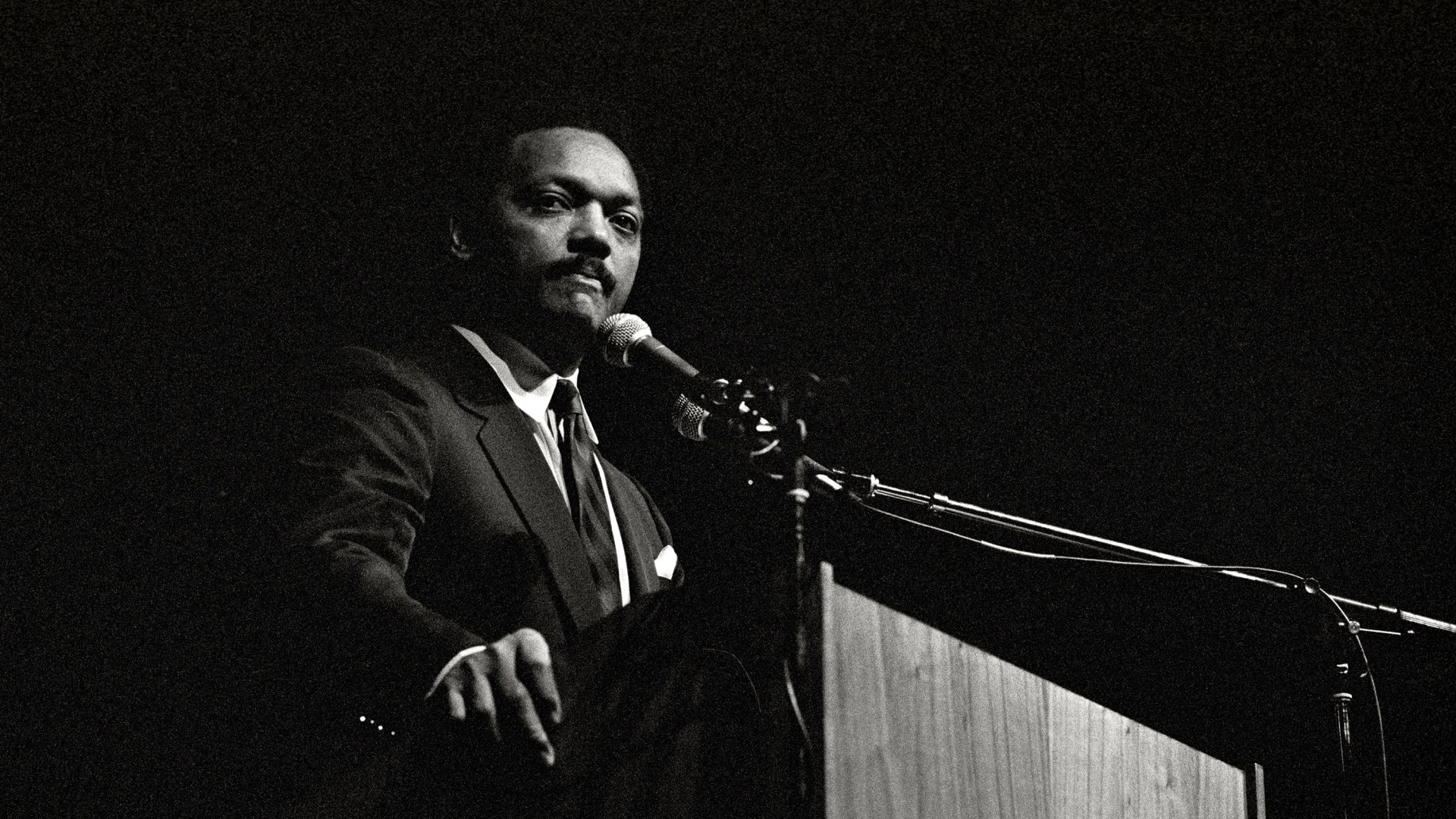
Jesse Jackson, the towering civil rights leader and Baptist minister who played a prominent role in Democratic politics for nearly 60 years and laid out a populist vision for America that shaped a generation of Black pastors, activists, and politicians, died this week. He was 84.
Jackson’s family confirmed his death, which came just three months after the former presidential candidate was hospitalized for a rare neurological disorder called progressive supranuclear palsy. Jackson had previously been diagnosed with Parkinson’s disease.
Born in the segregated South in 1941, Jackson became active in the Civil Rights Movement during his college days, leading demonstrations and sit-ins in his hometown of Greenville, South Carolina. After college, he moved to the Midwest to study at Chicago Theological Seminary, where he organized a group of students and faculty members who drove down to Selma, Alabama, to support Martin Luther King Jr.’s campaign for voting rights.
When King was assassinated in 1968, Jackson positioned himself as his successor and went on to achieve significant influence within the Democratic party. He ran for president twice in the 1980s, shoring up support among the nation’s Black churches. Years later, former president Bill Clinton tapped him to serve as a special envoy to Africa and later awarded Jackson the Presidential Medal of Freedom, the nation’s highest honor for a civilian.
Throughout his career, Jackson remained a political lightning rod. He also faced some controversies and personal blunders. In 2001, he revealed that he’d had an affair, which resulted in the birth of his daughter. Several years later, he apologized after being caught on a hot mic making a crude comment about then presidential candidate Barack Obama. The former president, who accepted the apology, said this week that he credited Jackson with laying the foundation for his own successful presidential campaign.
This week, Christianity Today reached out to several Christian leaders to learn about Jackson’s work and influence. Here is what they said.
Justin Giboney
History demonstrates that political establishments thrive off the perception of having it all figured out and under control. Unquestioned, this deceit cultivates complacency in the people and corruption in leadership. But the Bible consistently reveals how these leaders secretly fear an uprising from the people and often use various methods of misdirection and pacification to keep the common man from realizing their power (Ex. 32; Matt. 21:46; Mark 12:12). The people, and the system as a whole, always need a Jesse Jackson—a disruptor akin to Socrates’ gadfly—to call out the subterfuge and reset the terms of engagement.
Post Martin Luther King Jr., no one has shaken the establishment to its core and organized the grassroots like Jackson. Never short on shrewdness or ambition, he was a political mastermind who championed civil rights and Black dignity. But his impact wasn’t limited to Black America; he gave voice to Arab and Muslim Americans and white farmers as he called the US to account with endless energy, biblical allusions, and Black church homiletics. —Justin Giboney is president of the And Campaign.
Chris Butler
When I was growing up in Chicago, I attended routine Saturday morning meetings at Jesse Jackson’s organization, Rainbow PUSH Coalition. I watched pastors, precinct captains, union leaders, and neighborhood organizers gather to sing, pray, strategize, and then disperse across the city to register voters and advocate for housing, education, and employment. Weekend after weekend, the gathering was a vibrant display of faith and action. But this type of work did not just come about—the reverend himself made it happen.
Then, there was Jackson’s work on the national stage. One of his most consequential legacies may be something many Americans overlook: After Jackson ran for president in 1988, he successfully pushed the Democratic party to end a winner-take-all distribution of delegates during presidential primaries and instead award delegates proportionally. The change allowed minority and long-shot candidates, who were unfairly penalized by the previous system, more opportunities. Former president Barack Obama, for example, would have had a much tougher path to clinching the party’s nomination in 2008 if that institutional shift did not occur.
I am grateful for Jackson’s example that prophetic witness requires both moral clarity and political savviness. Gratitude, however, does not demand uncritical loyalty. In his later years, Jackson embraced positions I could not affirm—especially on some social issues. Still, his commitment to building systems that would outlast him remains instructive: Faithful activism plants trees under whose shade we may never sit. Nevertheless, we can trust God with the harvest. —Chris Butler is the senior pastor of Ambassador Church in South Holland, Illinois, and the director of Christian civic formation at the Center for Christianity & Public Life.
Charlie Dates
The children of Israel had Moses and Joshua. A later generation had King David and the prophet Isaiah. My grandparents had the Rev. Dr. Martin L. King Jr. And for many in my generation, we had Rev. Jesse L. Jackson Sr. whose voice and virtue changed our lives.
Pundits and politicians will note the political significance of the civil rights leader; as a consequence of Rev. Jackson’s presidential runs, the United States ultimately elected its first African American president. Economists will speak of the Black entrepreneurs who were awarded significant contracts because of his demands of corporate America. Civil rights scholars will name him as the champion of society’s nobody. But I remember his impact in ministry.
When I was a senior in high school, Rev. Jackson gave me the opportunity to introduce him at a commemorative event honoring King in Chicago. At that point, it was one of the largest audiences I had ever addressed. During my conversations with him, he told me to reach for the moral high ground. As a pastor, he pleaded with me to make my sermons passionately human. He told me the world needed to hear my preaching, and that my voice should not merely be kept inside the church but also reverberate outside of its walls to dismantle despair and instill hope. He was right. He was our reverend. —Charlie Dates is senior pastor of Progressive Baptist Church and Salem Baptist Church in Chicago.
Mika Edmondson
One of my most formative memories of Rev. Jesse Jackson was his 1972 appearance on Sesame Street. For roughly a minute and a half, he led a beautifully diverse group of children in his unforgettable refrain: “I am somebody.” With poetic power and pastoral clarity, he captured the doctrine of “somebodyness”—a deeply biblical truth that every human being bears unassailable dignity and immeasurable worth. This was the core conviction of the Civil Rights Movement and of Martin Luther King Jr., Jackson’s mentor.
From Operation Breadbasket to his presidential campaigns, Jackson’s public life was an attempt to embody that belief: Everybody is somebody. As a Black child growing up in the housing projects of East Nashville, those words widened my horizon and helped reshape my sense of self:
I am somebody …
I must be respected,
Protected,
Never rejected.
I am God’s child!
For that gift, I will always be grateful to Jesse Jackson. —Mika Edmondson is lead pastor of Koinonia Church in Nashville and the author of The Power of Unearned Suffering: The Roots and Implications of Martin Luther King, Jr.’s Theodicy.
Delano Squires
The Rev. Jesse Jackson was a towering figure in the Civil Rights Movement, a powerful orator, and a skilled political operator. But as a Christian who covers issues related to human flourishing, I am most interested in his work on matters of the family.
In the immediate aftermath of the Supreme Court’s Roe v. Wade ruling, Jackson stood up for the unborn. In 1973, he told Jet magazine, “Abortion is genocide.” He heard the economic arguments abortion defenders made to justify their stance but understood that you do not eliminate poverty by eradicating the poor. Unfortunately, he changed his position on the issue. But his concern about the state of the Black family persisted.
In 1986, CBS aired a documentary called The Vanishing Family: Crisis in Black America. In a roundtable discussion after the program, the civil rights leader described the rise in out-of-wedlock births and broken homes as a problem of “moral degeneracy.” Years later, he gave a platform to C. Delores Tucker, an activist who criticized rappers and music executives pushing lyrics that degraded women.
Jackson will undoubtedly be remembered most for his contributions to civil rights and politics. But we shouldn’t forget his other efforts to strengthen the moral fabric of the country. —Delano Squires is the director of The Heritage Foundation’s Richard and Helen DeVos Center for Human Flourishing.
Christine Jeske
Jesse Jackson rooted his call to “hold on to hope” in the Biblical promise that though Christ, suffering produces character, and character produces a hope that does not disappoint. But how do you hope when your dreams are labeled “unelectable”? When you stand beside your mentor at his assassination? When justice seems impossible? Jackson’s life and teaching offer insight into how to hold on to hope through disappointment.
In my early 20s, I worked at a camp serving children from under-resourced families. Each week, our director led us in Jackson’s famous call and response: “I may be poor … I may be small … But I am somebody. … I am God’s child!” This truth—that we each deserve respect as the somebody we are—continues to guide my work as a researcher today, and it carries a hope that we need as much now as ever. —Christine Jeske is an associate professor of anthropology at Wheaton College and the author of Racial Justice for the Long Haul: How White Christian Advocates Persevere (and Why).