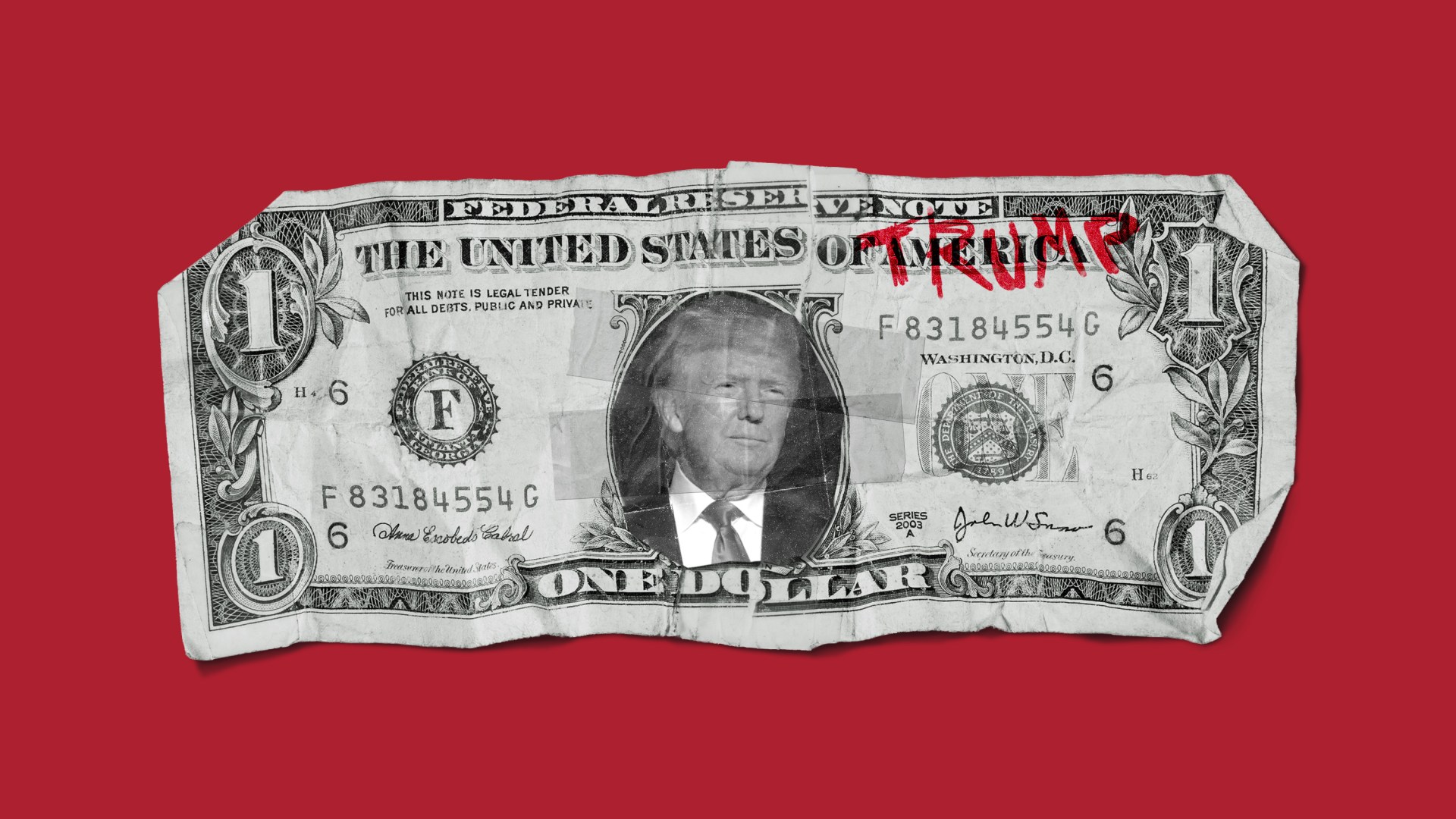
As a businessman, President Donald Trump put his name on buildings, vodka, and steaks. As a political candidate, he put his name on a “God Bless the USA” version of the Bible and offered head-to-toe merch, from fire engine red baseball caps to other wearables. So far in his second term in office, the president seems to want his face on all kinds of other things, from national park passes to money, and he has the might and resources of the federal government behind him.
In an inexhaustive list, there are prescription drugs on TrumpRX, savings accounts for babies called Trump Accounts, and a path to citizenship for those willing to drop a cool $1 million to apply for a Trump Gold Card. The president’s name is also affixed to the US Institute of Peace and the Kennedy Center performing arts venue. The Treasury Department has plans to make a $1 coin bearing Trump’s likeness, and the Navy will emblazon the president’s moniker on a new class of battleships.
The latest is a large banner with a portrait shot of Trump draped on the Justice Department headquarters. Last year, similar signage went up on the departments of Agriculture and Labor (costing taxpayers $16,400).
White House press secretary Karoline Leavitt in an interview said the credit goes to Trump as the “brander in chief. He’s an expert at marketing.”
“All of these fun little names are his ideas, and he has a team who’s very much willing to bring them to life,” Leavitt added.
Trump’s team has pointed to Washington, DC, and the Hoover Dam to defend the renaming streak as in company with past presidents.
It is true that past US presidents have had landmarks, buildings, and, in George Washington’s case, cities and states named after them. However, historians told Christianity Today that Trump’s efforts are unprecedented for an American president.
“The main difference here is that these were not things that the presidents lobbied for,” said John Fea, a historian at Messiah University. “This is completely new in the history of the republic, a sitting president jockeying to name buildings and institutions after himself.”
While Washington submitted to the capital city being named in his honor, he usually called it the District of Columbia or the federal city. He also rejected a handful of lofty titles to refer to his office suggested by Vice President John Adams: “His Elective Majesty,” “His Mightiness,” or “His Highness, the President of the United States and the Protector of their Liberties.”
“Washington pretty much dismissed all of those out of hand,” said Mark Caleb Smith, director of the Center for Political Studies at Cedarville University. Washington “adopted ‘Mr. President’ as a way to connect to the people, not to elevate himself above the people.”
Smith said the scramble to remake America in Trump’s image reminds him of Percy Shelley’s poem “Ozymandias.” The short work tells of a traveler who comes across the remains of a giant statue.
“Look on my Works, ye Mighty, and despair!” the pedestal reads. But only the desert and the statue’s own broken pieces surround the now-empty boast.
Depending on who next occupies the White House, many of the homages to Trump could be just as short-lived as the statue described in Shelley’s poem. Most of the efforts lack congressional authorization, and a future president could undo such efforts with the stroke of a pen.
Other renamings will have the force of law: On Thursday, Florida lawmakers approved a measure to rename the Palm Beach International Airport to the President Donald J. Trump International Airport.
There’s likely more to come: The Trump Organization, Inc. filed an application to trademark the use of Trump’s name for airports and Republicans have introduced a bill to rename an airport in Northern Virginia after Trump. The president also reportedly wants to put his name on the new Washington Commanders football stadium.
Trump has denied accounts that his officials tried to pressure Senate minority leader Chuck Schumer to rename New York’s Pennsylvania Station in the president’s honor as a condition of releasing federal funding for a tunnel to link New York and New Jersey.
“Traditionally in American history, leaders try to do a good job and presume that if they do a good job, they will be remembered fondly,” said Jeffrey Engel, a historian and director of the Center for Presidential History at Southern Methodist University. “Trump seems to have it the other way around, that he wants his name on things before he’s demonstrated that he’s done a good job.”
Historical preservationist Sehila Mota Casper said that in her field, experts observe a “50-year rule” before a particular site can qualify for national recognition as a historic place.

“Whenever we commemorate a person or a site … we are saying this history has value to it, a certain validity to it,” Casper said.
The goal is to let some time pass to more clearly determine whether something is worth preserving. Building the consensus to recognize a particular historical site or contributions of a certain public figure can often take years of effort by grassroots organizers.
“The administration is really skewing that,” she added. “Instead of being bottom up, it’s top down.”
Some jurisdictions have adopted a similar long view, and have laws curtailing naming public areas after living or currently elected officials. Minnesota has a law forbidding naming laws, councils, buildings, roads, or other facilities or entities “after living people.” Louisiana similarly largely prohibits naming public buildings or amenities after living people.
Caleb Verbois, a political science professor at Grove City College, said those rules are to avoid embarrassments later: “There’s a fairly lengthy history of buildings being named after living politicians that then had to be renamed after scandals, tax evasions,” he said. “You name a building after somebody, and then it turns out five years later they had a massive ethical breach, so you have to sandblast the name off.”
Most jurisdictions, though, lack such prohibitions. “You drive through West Virginia, and everything is named after a Klansman,” Verbois added, a reference to former Sen. Robert Byrd, who as a young man was a recruiting member of the Klu Klux Klan. Byrd later described his involvement with the KKK as a mistake.
Some Democratic lawmakers have introduced legislation to stop sitting presidents from being able to name federal buildings after themselves, though it’s unlikely to advance in the GOP-controlled Congress.
Past sitting presidents have resisted such temptations: Congress unanimously approved a measure to rechristen a federal building in Gerald Ford’s honor in his hometown of Grand Rapids, Michigan. Lawmakers introduced the measure when he was still vice president, but by the time it passed, it raised the question over whether it was right for a president to sign into law a bill honoring himself.

Ford ultimately decided against it. He wrote in a draft of his veto that while presidents had “generally deferred” to Congress on such matters, he judged that to approve such a move would be “improper.”
“Several of our Federal offices have been named after members of Congress but I can not recall any that have been named after a President while still in office,” he wrote.
Federal buildings, he added, should reflect the needs of the people they are meant to serve, not “constructed as monuments” to public servants.
While the language of his final veto was briefer, his initial draft contained his true feelings on the subject.
“I would hope,” Ford wrote, “our Presidents will be remembered for their labors in building better Government rather than for their efforts in construction of public works projects to themselves.”