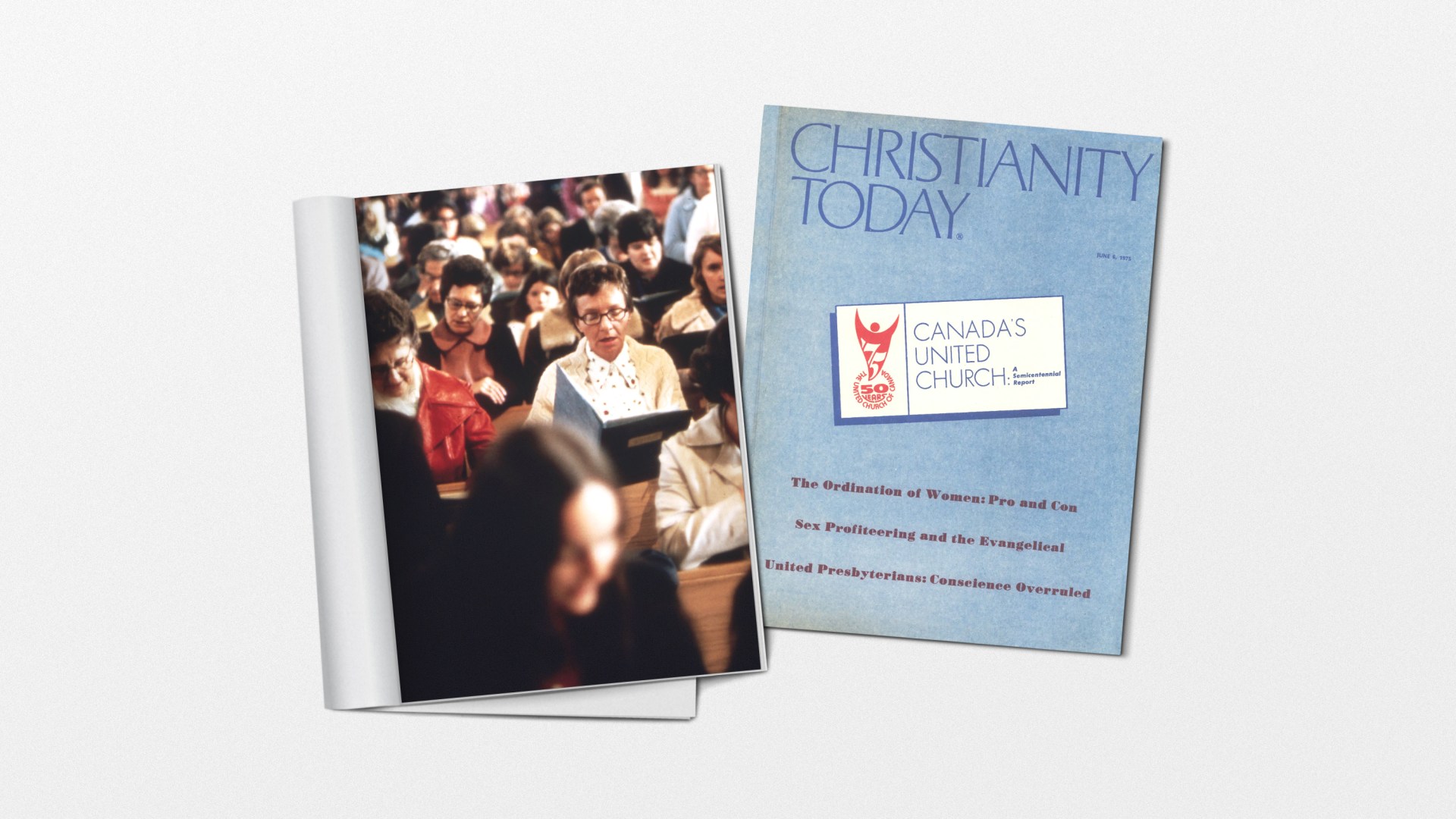
In 1975, CT tried to understand the charismatic movement. Was it evangelical? Was it biblical? Was it good for the church? The magazine published a charismatic theologian making the case for the movement in February.
As one involved in the movement for the past decade, I should like to set forth a brief profile of it. … Persons in the charismatic movement ordinarily stress first the recovery of a liveliness and freshness in their Christian faith. This may be expressed in a number of ways. For example, the reality of God has broken in with fresh meaning and power. God, who may have seemed little more than a token figure before, has now become vividly real and personal to them. Jesus Christ, largely a figure of the past before, has now become the living Lord. The Holy Spirit, who previously had meant almost nothing to them, has become an immanent, pervasive presence.
The Bible, which may have been thought of before as mostly an external norm of Christian faith, or largely as a historical witness to God’s mighty deeds, has become also a testimony to God’s contemporary activity. It is as if a door had been opened, and walking through the door they found spread out before them the extraordinary biblical world, with dimensions of angelic heights and demonic depths, of Holy Spirit and unclean spirits, of miracles and wonders—a world in which now they sense their own participation. …
All of Christian faith has been enhanced by the sense of inward conviction. Formerly there was a kind of hoping against hope; this has been transformed into a buoyant “full assurance of hope” (Heb. 6:11).
Even evangelicals who were sympathetic to ecstatic charismatic practices, like speaking in tongues, often found themselves clashing with the charismatic Christians, though. One pastor wrote of the hard conclusions he had reached.
I have tried my best to make a climate of Christian fellowship and worship that will accommodate both those who speak in tongues and those who do not. My intention was to open the doors of Christian sharing to everyone who loves the Lord Jesus as Saviour.
Having had about a dozen persons in the congregation who speak in tongues, I have come to some hard conclusions after a year of effort. These conclusions have been heart-breaking to me. …
They carried their Bibles and became a part of the congregation’s program and fellowship. However, after some months it was obvious that they had a spiritual superiority complex, and it became obnoxious. Professing to be filled with the Spirit of humility and holiness, these persons expressed the opposite. The subtle but real spiritual conceit became more and more apparent until the words “Spirit-filled” came to have a regrettable taint. …
These persons are insensitive to the concept of Christian discipline.
The magazine also looked at two sides of another debate dividing Christians of the time: the role of women in church. CT reported on a landmark meeting of evangelical feminists and the growing numbers of women going to seminary. Should they be preparing for ministry? Elisabeth Elliot, then a regular CT columnist, presented a case against women’s ordination.
Changes made by the Church merely to accommodate changes taking place in the world have resulted in a loss of power. This week’s “relevance” is next week’s irrelevance.
The question of the ordination of women has been raised inevitably because of the women’s liberation movement. The confusion wrought by this question in the Church is one of many symptoms of a general malaise. As Christians we ought always to be testing our assumptions and priorities against the Word of God, for we are daily subjected to undermining by the secular presuppositions of our age. …
The exclusion of women from ordination is based on the order established in creation. The first chapter of Genesis gives an account of the creation of the world and its creatures. The creation of man and woman in the image of God himself was the culminating act. This act is more specifically described in the second chapter, in which it becomes clear that the man Adam was created first. When God brought to Adam all the beasts of the field and the birds of the air he named them, but among all the creatures “there was not found a helper fit for him.” It was then that God made the woman, fashioning her from Adam’s own flesh and bone. …
The principles of obedience, submission, and authority are clearly set forth in both the Old and New Testaments. Every creature of God has his appointed place, from cherubim, seraphim, archangels, and angels down to the lowliest beast. Man himself is “made a little lower than the angels,” and was commanded to have dominion over the fish of the sea and over the birds of the air and over every living thing that moves.
A Fuller Theological Seminary professor made the case in favor of ordaining women.
The creation account … need not be thought to subordinate one sex to the other. Rather, mankind in the divine image is created a partnership of male and female. By the same token the new mankind “foreordained to be conformed to the image of his Son” (Rom. 8:29, ASV) is likewise a partnership of the sexes. Translated into the language of ecclesiology, this is to say: The Church is a universal priesthood of all believers in Christ, female as well as male. …
I conclude that women have full title to the order of Christian ministry as God shall call them. Let those who scruple consider what it has cost the Church not to use the talents of the woman. Let anyone consult the hymnbook and see what women poets—Fanny Crosby, Charlotte Elliott, Frances Havergal, Christina Rossetti, Anne Steel—have taught the people of God to sing and then ask what it would mean if such women were allowed to move beyond the relative anonymity of the hymnal to full visibility in the Church as evangelists, preachers, and teachers.
And let all who would help them attain such visibility remember that sharing the ministry with women does not mean requiring them to think, speak, and act like men. This would be to misunderstand the meaning of our sexual complementarity. Because God made Man male and female, in the natural realm men are fathers and brothers, while women are mothers and sisters. So it must be in the spiritual realm. And when it is, then, and only then, will the Church be truly the family of God.
Carl F. H. Henry, the emeritus editor in chief, weighed in as well in several columns over several issues on the “battle of the sexes.”
The Bible nowhere teaches male superiority and supremacy and female inferiority and servility. What the Bible pattern establishes instead is the indispensability under God of man and woman to each other in the context not only of society but also of the home as its basic unit. God’s superiority is the fundamental emphasis (cf. 1 Cor. 11:11, 12, “God is the source of all”). Paul expounds this divinely intended order in a Corinthian milieu where, contrary to the practice in Christian churches, a strong effort was under way to introduce a confused equality.
Equality in Christ, Paul insists, destroys neither apostolic authority in the Christian community as a determination of the crucified and risen Lord, nor the order that God intends.
Not every change in church life was contentious in 1975. CT looked at the explosion in sermon cassette tapes.
Tape recorders and players have been around for a long time, but the bulkiness of the equipment and the vulnerability of the tapes limit their creative use by most pastors. …
Cassette-makers are sprouting up everywhere. Christians with gnostic tendencies who gather in “underground” cells glory in circulating cassettes. They have about them the aura of the clandestine samizdat without the risk of discovery. Cassettes can be made by anyone who has a little imagination and relatively simple and inexpensive equipment. They are a boon to every ism in the land. …
Christian schools are involved in producing and distributing cassettes: Bethany Fellowship, Columbia Bible College, Luther Theological Seminary, Moody Bible Institute, and Regent College. Christian Bookseller Magazine periodically reviews the latest offerings of the major religion-market companies.
There are a growing number of cassette clubs, operating in the familiar pattern of book clubs. The Episcopalians have the Catacomb Cassette Club, and, from another part of the spectrum, Pillsbury Baptist Bible College in Minnesota will enroll you in its fiery evangelist-of-the-month.
The most pressing political question was America’s responsibilities in Southeast Asia, after the military’s withdrawal from the war in Vietnam. CT reported on the dire situation missionaries faced.
Seven missionaries and a child, however, were presumed to be in the hands of the Viet Cong or North Vietnamese invaders. They are:
Mr. and Mrs. Norman Johnson, both 39, of Hamilton, Ontario (Christian and Missionary Alliance); Richard and Lillian Phillips, 45 and 43, of Bloomington, Minnesota (CMA); Mrs. Archie Mitchell, 54, of Bly, Oregon (CMA); and John and Carolyn Miller and their five-year-old daughter, of Allentown, Pennsylvania (Wycliffe Bible Translators).
All were at Ban Me Thuot in the central highlands, where the CMA operates a leprosarium and hospital. The Johnsons fled into the jungle at the outset of the attack on the town early last month and still had not been heard from as of March 26. The others, along with one or two other foreign civilians, had reportedly sought shelter in the compound of the International Commission for Control and Supervision as fierce fighting raged through the area. Radio contact with the group was lost on March 14.
President Gerald Ford urged Congress to send aid to Cambodia, another Southeast Asian country wracked by civil war. CT reported that, “politics aside,” the support would help Christians in need.
The crisis comes at a time of responsiveness to the Gospel on a scale unprecedented in the Buddhist country’s history. Last year the Khmer Evangelical Church, associated with the Christian and Missionary Alliance (CMA) and embracing nearly all the Protestant congregations in the land, experienced a 300 per cent increase in growth, according to CMA spokesmen. In the event of a Communist takeover, growth will be curtailed and Christian activities severely restricted, if the Communists follow their pattern elsewhere.
“I fully expect to be behind bars one day because of my love for Jesus Christ,” commented one young Cambodian believer.
The US government decided to accept refugees from Southeast Asia—the “biggest all-at-once influx of refugees” in American history—and asked church groups to help. CT explained the resettlement program and urged evangelicals to volunteer.
When Christ saw the crowds, “he had compassion for them because they were harassed and helpless” (Matt. 9:36). But many of his followers never quite see things that way. …
The refugees must have official sponsors before they can leave the rustic conditions of the camps and make their debut in North American society. Life in these temporary quarters is by no means luxurious: the refugees are cramped into tents and old barracks. Food is adequate, however, and recreation opportunities are provided, so that conditions are bearable. But the sooner sponsors are found the better. … All they need is some help in the transitional period. …
Even if refugees eventually cause some problems, the compassionate Christian should not turn away from helping. These people are God’s creation as much as native North Americans are, and he will do the rewarding. The Samaritan spirit calls for making room not only in our homes but in our hearts. Whatever one thinks about the Viet Nam war, the refugees should be extended a genuine welcome as fellow human beings.
Americans ultimately helped resettle approximately 130,000 refugees from Vietnam, Laos, and Cambodia. Evangelical groups including the Christian and Missionary Alliance, the Southern Baptist Convention, the Assemblies of God, Food for the Hungry, and World Vision played an active role.