“Fuel the grind and honor the soul” is one of the slogans on the website of the yet-to-be-released energy drink Praise Energy. Bryce Crawford, a Christian influencer with 4.1 million followers on TikTok and more than 3 million on Instagram, shared a video in January announcing he had been “secretly” working on a Christian energy drink. According to Crawford, his Christian canned beverage will have 100 milligrams of caffeine, “natural flavoring,” no artificial colors, and no sugar.
“I just got convicted. I’m a big energy drink connoisseur and was like, ‘I’m tired of drinking stuff that’s got like 50 ingredients and is gonna, like, give me heart issues in five years,’” Crawford said. “I want to actually honor God with what I consume.”
Energy drinks are an $80 billion dollar business. Praise Energy is an example of the “wellness washing” of energy drinks. It’s also an example of the newest Christian diet-and-health wave and the ways the “Christian” label is being used to sell supplements, skin care, and other wellness-adjacent products, largely through influencers online. Faith washing has become its own form of wellness marketing, and savvy influencers and supplement companies are finding that it’s an effective way to reach Christian consumers.
American Christians are accustomed to having a menu of ways to live out their faith by spending money on consumer goods. We raise the public profile of Christianity by supporting faith-based films, attending Christian concerts, and adding Christian athleisure to our rotation of gym clothes. For people who are very online, supporting Christian influencers like Crawford can feel like supporting evangelistic ministries.
The influencer sphere is full of enthusiastic creators who blend the language of faith with the hustle jargon of wellness grifting. The combination of Christianese (familiar uses of words like stewardship and temple) and the promise of a product that both improves physical health and puts the consumer in alignment with God’s created order (sometimes just nature) is a potent marketing strategy.
The global wellness industry, a broad term for goods and services related to nutrition, fitness, appearance, sleep, mindfulness, and general physical health, is valued at over $6 trillion dollars and projected to hit $7 trillion this year. Its growth since the mid-2000s has been driven by trends like the “food movement” sparked by Michael Pollan’s 2006 book An Omnivore’s Dilemma and the subsequent intensification of moralizing marketing that mobilized words like natural, organic, and clean to sell food and beauty products. Over the years since, many consumers have come to see formerly low-stakes decisions about breakfast cereals and household cleaners as choices that could have life-or-death impacts for themselves and their families.
In recent years, books like Rina Raphael’s The Gospel of Wellness and Tara Isabella Burton’s Strange Rites have examined the religiosity of wellness culture—citing the ways brands like SoulCycle create exercise classes that seem to emulate megachurch services, and the ways the prosperity gospel echoes in the marketing of products and advice. “Healthism,” which Christy Harrison defines in The Wellness Trap as “the belief … that physical health is the be-all and end-all of well-being, a goal that’s attained primarily, if not entirely, through individual lifestyle choices,” can become a religion of its own.

These days, wellness influencers and entrepreneurs aren’t just borrowing the trappings of religious devotion. They are also mobilizing well-known Bible verses (1 Cor. 6:19, for example) and (often generalized) tenets of the Christian faith. There is still plenty of run-of-the-mill inspirational language, but it has become easier to find influencers marketing perfume, raw honey, and diets as explicitly biblical. Their content is gaining traction, and companies are taking notice.
It’s surprisingly frictionless for a supplement company to partner with an influencer to sell a product. To form a partnership, a business can reach out to a content creator and offer to pay a commission each time the influencer posts about the product or talks about it on an Instagram story for a certain amount of time. Former wellness influencer Andrea Ellis told me in an interview that the process has become so seamless that influencers usually don’t have to do anything more than post; the company does all the packaging and shipping.
Ellis also said influencers can reach out to supplement companies and ask for “white-label” supplements to sell as their own branded products. Companies can then create new brand names and designs for those influencers while selling the exact same substance as a different supplement under another name.
“There are no guardrails,” said Ellis. “A lot of influencers will say that mainstream medical providers are shills for the pharmaceutical industry, but the supplement world actually works exactly the way they say Big Pharma works.”
In the current political environment, where public trust in established medical institutions is declining, the supplement industry and alternative health-and-wellness influencers are trying to win trust from health care skeptics. We are in the era of personality-driven health care.


This is perhaps why Christian wellness content and products are gaining ground in the marketplace. If more people are making health care decisions based on trust in individuals on the internet, a shared worldview goes a long way toward establishing that trust. Christians wading through the glut of online wellness content might see a cross emoji or Bible verse in a creator’s bio and trust that, at the very least, this person shares their faith. The influencer might not be a doctor but may ascribe to the Apostles’ Creed.
For an influencer, Christianese can be shorthand for “You can trust me.” Supplement makers have figured this out and are already experimenting with ways to cut out the middlemen (influencers) and go right to the consumer with the message, delivered by a trustworthy-seeming messenger generated by artificial intelligence.
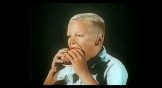
For example, this video of a one-sided conversation on a nameless podcast may at first appear to be just another wellness content clip. The speaker says, “If you’re a good mother, you’re living highly in accordance with God.” He’s addressing Christian mothers, affirming their importance and power in the lives of their children. There’s something slightly off about the language he uses, but he hits predictable notes (e.g., “You’re practicing the highest form of stewardship”).
A few tells might indicate the person onscreen isn’t actually a real human being: The way his mouth moves isn’t quite right, and he’s wearing a lanyard that appears to have the word speaker on it, but the tag at the end of it has indecipherable words. Scroll down on the Instagram page for the account, and you’ll find a clip that begins the same way, featuring the same person in the same outfit, but on the opposite side of the room.
The text overlays for these two AI-generated videos are “God didn’t make you a mother by accident” and “The TRUE connection between motherhood and God.” In both videos, the speaker awkwardly transitions from a series of truisms and inspiro-speak about motherhood to a pitch for a supplement. A link in the caption directs viewers to buy it on Amazon.
“We only value true nourishment,” a seemingly AI-generated Amish influencer tells 348,000 Instagram followers. The account page features an array of videos about how she feeds her (fictional) Amish family of 12. Videos appear to be taken outside or inside a barn or sometimes at a supermarket (which has become a wellness-grifter video trope).


I was curious to know whether the college students in my media literacy class would be able to recognize that the Amish woman on the screen was likely AI-generated; they knew it immediately. The red flag, they said—other than an Amish person spending a bunch of time posting to an Instagram account—was the cadence of her voice. The voice, while expressive, has the uncanny lilt of other AI-generated speech apps and videos.
Other tells are the slight variations in her appearance from video to video, the slightly inhuman mouth movements, and the distorted text on the nutrition labels of foods she appears to hold up for the camera. In one video, she holds her hands over a pot of boiling water, close enough to be burned by the steam.
Why use the persona of an Amish woman to sell supplements? The persona is shorthand for a value system many Christians can get on board with—she looks like a person of Christian faith who rejects many of the developments of modernity and speaks the language of created order and natural living. Wellness-minded Christians can easily fall for the naturalistic fallacy: the belief that something is good simply because it is found in nature.
“For many people, ‘natural’ feels godly,” said Ellis, who stopped selling supplements and wellness products a few years ago and now researches and writes about misinformation. “‘Natural’ feels closer to God and God’s created order.”
Ironically, Ellis points out, the substances sold as supplements by vendors on Amazon are unregulated, are rarely tested by reputable labs, and in some cases are counterfeits of other popular products. Since the Dietary Supplement Health and Education Act passed in 1994, supplements don’t have to obtain approval from the US Food and Drug Administration before going to consumers. Testing and accountability, if there is any, come after the sale of these products, usually if a customer experiences negative side effects or suspects he or she is taking snake oil.
This is why trust is a key component of the supplement niche of the wellness industry—you have to trust the seller enough to buy an unregulated substance and put it in your body. Supplement manufacturers rely on parasocial relationships with wellness influencers, an extension of the multilevel marketing model of older supplements like Herbalife. Manufacturers rely on the networks of intrepid representatives (usually women, from what I’ve seen) for distribution.
Now, Christian wellness influencers offer a network that is bound by parasocial relationships and shared worldview. And companies may try to cut out the real people if they can—to isolate the messages that make them trustworthy and repackage them with AI-generated personas that don’t need to be paid and certainly won’t have any questions about the quality of the products they are selling.
The AI tells in the videos circulating right now are likely going to disappear soon. It’s only going to get harder to tell whether an unfamiliar content creator is a real person or AI persona. Oddly, I find myself cautiously optimistic about the decline of trust in influencers. I don’t want to live in the era of “trust me” health care. More specifically, I don’t want to live in an era of “trust me” health care where everyone is competing for credibility by faith washing everything from creatine to caffeine. If AI breaks that, I’ll be glad.
Kelsey Kramer McGinnis is the worship correspondent for Christianity Today. She is a coauthor The Myth of Good Christian Parenting and writes broadly on Christian music and the intersection of American Christianity and popular culture.