CT made the tough decision to hike subscription prices in 1979. The cost of 22 issues per year increased from $15 to $18.
We’ve all been hit by inflation—25 per cent since 1975. But in that same period, the printing and paper costs for putting out Christianity Today have increased even faster. Postage has gone up an incredible 120 per cent! That’s a per unit cost; it has nothing to do with our circulation growth.
But the worst is yet to come. The post office has decided to greatly increase nonprofit publications’ rates. Talk about planned inflation. In the next three years alone, postage (second class) for mailing the magazine will increase another 160 per cent and for promotional mailings (third class postage) 190 per cent! The figures are so large one feels like rubbing one’s eyes or tossing the papers skyward.
The magazine also put more resources into investigations of conservative Christians. CT reported on ongoing questions about televangelist Jim Bakker’s financial management of PTL (Praise the Lord) Network. CT dug deep into the twisty stories of traveling minister John Todd, who said before he was saved that he was a Grand Druid high priest in the Illuminati. CT found his account didn’t match the facts, and the facts suggested he couldn’t be trusted.
Todd pleaded guilty to contributing to the unruliness of a minor and served two months of a six-month sentence in a county institution.
Todd’s police record shows that a felony warrant was issued against him in New Mexico for passing a bad check. He was arrested in Columbus in 1968 for malicious destruction of property. He was treated for drug overdose at an army installation in Maryland in 1969. A warrant for his arrest awaits him in Ohio, as does a judgment against him for $22,000 in a defamation case.
Todd claims many of the police are associated with Freemasonry, an Illuminati organization, and therefore should be considered enemies. …
Todd was given psychiatric examinations twice while in the army. His records indicate evidence of an unstable home background and possible brain damage as a result of beatings. The second examination a few months later labeled his malady “emotional instability with pseudologica phantastica.” Todd finds it difficult to tell reality from fantasy, says a medical report.
Editor in chief Kenneth Kantzer said it was “embarrassing” to have to report on such things, but necessary as part of CT’s mission to serve the church.
Several Christian leaders who travel the nation … tell us that Todd is the most talked-about topic of these days. Letters continually land on editorial desks, asking in effect, “Is what John Todd is saying true?”
No, it is not. …
We can learn too from the response to Todd. Some of us are altogether too gullible—too quick to believe negative reports about those with whom we disagree, and not quick enough to believe substantiated negative reports about people who tell us what we were already inclined to accept. Many unscrupulous individuals take advantage of gullible Christians who would not be duped by a Jim Jones, but then give credence to the claims of a John Todd.
The magazine also profiled several prominent Christian leaders who would go on to shape American evangelicalism in the 1980s, including Francis Schaeffer. CT introduced many readers to James Dobson, reporting his decision to prioritize time with his children.
Men should give their families first priority, said James Dobson last month at the Roman Catholic Religious Education Congress in Anaheim, California. “If the family is going to survive,” he challenged the males in his audience, “it will be because husbands and fathers again begin to assume the lead in the family.”
That being said, the noted pediatrician revealed that he would be taking his own advice. Dobson, who has been making public appearances for the last fifteen years, said this would be his last speaking engagement. He wanted to spend more time with his 10-year-old son and 13-year-old daughter.
On the staff of the University of Southern California School of Medicine and author of such child-rearing books as Dare to Discipline and The Strong-Willed Child, Dobson cited a Cornell University study showing that fathers of preschool children on the average spend 37.7 seconds per day in real contact with their youngsters. In contrast, the study indicated that children watch television approximately fifty-four hours per week.
CT encouraged readers to be open to Christian psychologists, such as Dobson, and listen to their professional advice, as long as Scripture informed it.
Just as truth about God’s created universe may come through natural sciences like medicine, or physics, or philosophical logic, or the insights of students in the humanities, so can truth come by way of psychology, psychiatry, and other social sciences.
There is, of course, much within psychology that the Christian cannot accept. Some psychological conclusions about man’s nature, for example, some techniques used by professional counselors, and some proposals for altering our future are clearly contrary to Christian ethics and the teaching of Scripture. If we test our psychological conclusions empirically, logically, and against the inspired Word of God, however, we will discover that the psychological sciences contain much of practical value to the Christian seeking to serve Christ both inside and outside the church.
CT tackled marriage-and-family issues facing Christians in 1979, including dealing with singleness, divorce, and second marriages. A counselor wrote about pastoral care for divorced Christians struggling to follow biblical teachings about sex outside of marriage in “Sex and Singleness the Second Time Around.”
Based on 203 participants (146 women and 57 men), only 9 percent of the men and 27 percent of the women were celibate, although many noted the intimacy had been with only one partner and/or in a “serious” relationship. It is worth noting that 67 percent of the men and 58 percent of the women reported a conflict between their faith and sexual experiences. ….
The absence of clear, precise teaching frustrates most formerly married Christians. The large numbers of undisciplined Christians and the misuse of Scripture (by foes and advocates alike) fuels the debate between unbelieving realists and unrealistic believers.
If Paul did not flinch in addressing the behavior and attitudes toward sex, why are we so timid?
The magazine also reported a government study on the ethics of in vitro fertilization and research on “test tube babies.”
Since 1975, the government has banned any new grants for in vitro fertilization research because of the ethical and moral questions involved. … Some observers fear Huxleyan possibilities: manipulation of the reproduction process that would include surrogate mothers for hire. Prolife groups condemn in vitro fertilization as abortion, since fertilized eggs are often discarded in the experimentation process that leads to a successful pregnancy.
With these arguments in mind, the board suggested safeguards for in vitro research: that in vitro fertilization be made available only to married couples who volunteer (scientists promote in vitro fertilization as a means of enabling women with blocked fallopian tubes to have children); that research be funded only if it provides important information that otherwise cannot be obtained; and that research be limited to human embryos in their first fourteen days of development after fertilization—the period before implantation. The ethics board noted that in light of limited government funds more pressing health matters might take precedence over in vitro fertilization research.
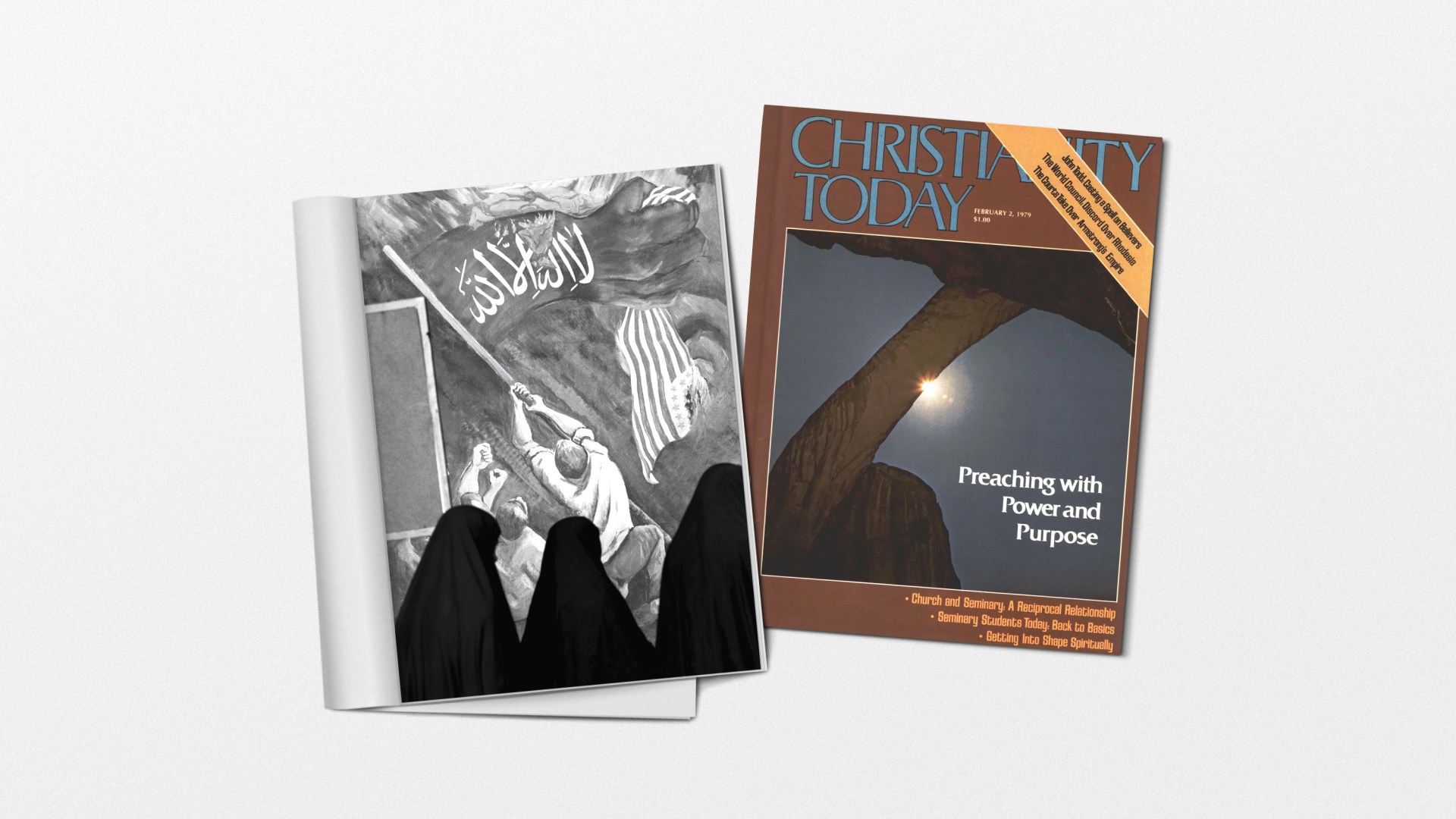
Evangelicals were worried about Islam in 1979. CT asked a professor of Islam and world religions to write about the “renaissance of the Muslim spirit.”
The subject is of considerable importance to both the world and the church. Economically, the world is virtually dependent on Arab oil. Politically, many of the world’s trouble spots are Muslim areas: Iran, the Middle East, and much of sub-Saharan Africa. Religiously, Muslims represent one of the great unreached peoples for Christian missions. Certainly, for the church of God, the world’s 700–800 million Muslims are one of the greatest challenges with which it must deal. Let us therefore try to catch a glimpse of the main developments of the fourteenth Islamic century, and their implications for Muslims today.
The last hundred years of Islamic experience have been the most startling and decisive ones since the religion’s founding. … A powerful mix of internal and external stimuli have brought about this Muslim revival. Granting that the influence of these factors is complex, I would like to suggest three major ones: (1) the influence of modern education, (2) the recovery of economic and political power, and (3) the pressure of Muslim laity for social reform. ….
It is the task of the church in the days ahead to achieve such a relation with Muslims and to communicate well his powerful message of love.
An old Arab proverb says: “What comes from the lips reaches the lips; what comes from the heart reaches the heart.” I hope that Christians in the coming century will be able to convey, from their heart to the Muslim heart, God’s message for all people everywhere, in every condition.
The collapse of the government of Iran and success of a radical Muslim revolution grabbed headlines. CT checked in with Christian leaders and missionaries with long experience in the Persian Gulf.
Syngman Rhee, missions official in the U.S. office of the United Presbyterian Church, said his denomination had no plans to evacuate its dozen U.S. personnel from Iran. Henry Turlington, a Southern Baptist who pastors an English-speaking church in Teheran, had sent word to his home office that he and his wife would stay. Other Southern Baptist couples, who were outside Iran during the worst of the violence early last month, were advised not to return.
No Western missionaries had been physically harmed. (An American oil executive was killed in Ahwaz in late December, however.) For the most part, anti-American reaction surfaced in “Yankee Go Home” graffiti on city walls, telephone threats, and letters of warning. But it was enough to send packing 20,000 of 41,000 Americans living in Iran, with more waiting to depart.
Anti-American, rather than anti-Christian sentiments, were behind most problems facing U.S.-based missions agencies and U.S. missionaries. “Although there has been a feeling of anti-Americanism expressed in various ways,” said Rhee in a news release, “there have not been any specific feelings expressed against the church or the presence of missionaries.”
Like many international observers, CT did not know what to expect from the new regime.
The role of religion in the overthrow of the Shah and the perhaps temporary rise of Ruhollah Khomeini is of particular interest to Christians. Our feelings are mixed. On the one hand it is good to see that belief in the transcendent is still very influential in human affairs. On the other hand, ideologically-based governments (whether rooted in a traditional religion or in communist faith) have been notoriously hostile to evangelistic ministries and even to the proper range of shepherding ministries for believers. The fact is that the record of predominantly secular governments, such as most of those in the Western world, is notably better than that of governments that have a close link with some Christian or non-Christian faith. …
Whether the successor to the Shah’s government in the long run proves less corrupt, less given to torture, less restrictive of certain personal and political liberties remains to be seen. As Christians concerned about freedom to evangelize and to shepherd the relatively few disciples of Christ in that overwhelming Muslim land, we certainly hope so.
At the end of the year, Iranians took 66 Americans hostage at the US embassy in Tehran. The crisis lasted 444 days and became a major issue in the 1980 presidential election.
CT failed to comment on President Jimmy Carter’s big address on what he called a national spiritual and moral crisis. (Critics called it the “malaise speech”). At the end of 1979, though, CT expressed general disappointment in his presidency.
Candidate Jimmy Carter, who publicly identified himself as an evangelical, won the nation’s highest office. He was the first evangelical in this century to do so. Yet thus far, to some observers, Carter has failed to demonstrate any significant Christian influence on the federal administration, in spite of his noble-minded human rights campaign and unquestioned personal integrity. The disillusionment of many over the President’s performance has cast a shadow on evangelical hopes of influencing American life from the top down.
While evangelicalism was thus failing to win the leadership of America’s political institutions, despite its momentary appearance of success, America’s political machinery was beginning to make definite challenges to evangelicals and their religious institutions. Indeed, the new evangelical involvement in politics sometimes furnishes the pretext for an expanded governmental interference with religion and the churches.