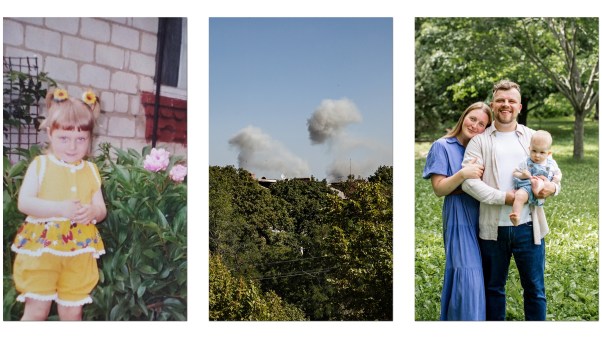
The window in Yevheniia Poliakova’s apartment in Vinnytsia, Ukraine, almost shattered when military aircraft rocketed through the city. Debris was falling in nearby fields—shredded remnants of drones and missiles.
“You can hear the booms,” Poliakova—who goes by Zhenya—recalled of that winter in Ukraine. “I can’t really see. I can just hear. It was very loud at night. I just remember it was sometime in the morning when a girl who lived in a different room came in and said, ‘The war started.’”
For weeks prior, Zhenya had seen the bustle of Vinnytsia morph into mild panic at the threat of Russian invasion. People hustled luggage to bus stops and train stations until, on February 24, 2022, “everything stopped,” she said. “Every store closed. Everything was alive, but not this day.”
Before long, endless sirens pierced her apartment complex. “And you just saw on social media, in some chats,” she told me: “It’s not a game. It’s real. You don’t know if the Russian soldiers are coming to your city. Maybe the next day they will come.”
Just 23 years old at the time, Zhenya traversed the globe in search of safe harbor, carpooling with other women and children to Western Ukraine, then France and Spain. When she finally arrived in America after a legal pathway for people fleeing Ukraine was cleared that April, she carried only what could fit in her backpack: a water bottle, a few pairs of socks, and a Bible.


Born in Zhmerynka, Ukraine, Zhenya did not hail from a Christian family. Her mother was divorced three times and struggled with alcohol abuse. “I asked my mother, too, if she loves me,” Zhenya recalled, “and she would say, ‘Go somewhere else.’” Somehow still, “I always knew there is a God somewhere, and I had a trust that when I grow up, I will be happy—I will have a good marriage, a good husband, and everything will be good, so it’s okay to have a worse life right now.”
Zhenya found reason to believe while working for a coffee shop in Vinnytsia before the war. She didn’t realize it at first, but the shop doubled as a coworking space and covert church. Hooked on the shop’s uplifting—and noticeably alcohol-free—atmosphere, she was surprised when the owner, who was also the pastor, urged her to avoid calling the space a church. He did it, she said, “because we had a bad culture in Ukraine,” and some congregations outside the Orthodox church worried about being branded extremists.
Poliakova had dabbled in Buddhism, but she couldn’t stay away from the church after encountering its worship. “I never saw or heard singing about this very interesting love,” she recalled. “Like, someone loves you? And this really touched my heart. It was about God’s love. I realized God is really alive.” Zhenya became a Christian, was baptized, and dived deeper into the Word. She came to trust that God would provide her with a family of her own.
And a family showed up. They were missionaries, originally from Ukraine but more recently from Minnesota. They’d come to Vinnytsia to foster church growth, but after the war started, they shifted from cultivating Bible studies to helping Ukrainians escape bloodshed. Zhenya was among the Ukrainians they helped, and it was to their home in Minnesota—to work as a live-in nanny—that she went when she arrived in America with her backpack.


“There was only one family who cared about me when the war started,” she told me. “I didn’t know what I needed to do. I was in a panic. I called my mother to ask her, ‘Can I come home?’ And she just screamed at me. She was very angry. She wanted me to stay where I was. And she doesn’t remember this call, so I now understand that it was from God.”
Zhenya also credits God with the love story that followed. After her arrival in the States, Zhenya attended a program at Bible Mission International, a Minnesota school and ministry serving primarily Eastern European immigrants. She recruited volunteers to stuff Christmas envelopes at the ministry, and one of them happened to be Tim Gidenko, a young man who had previously spent two years working at Bible Mission.
“When he came into the room,” Zhenya recalled, “I heard a voice from God say, ‘He is your husband.’ And I don’t even look at him! I was like, ‘Why God? No, please, I don’t understand.’ But I was sure that’s from God. I was really close to God, because I was broken with a lot of stuff.”
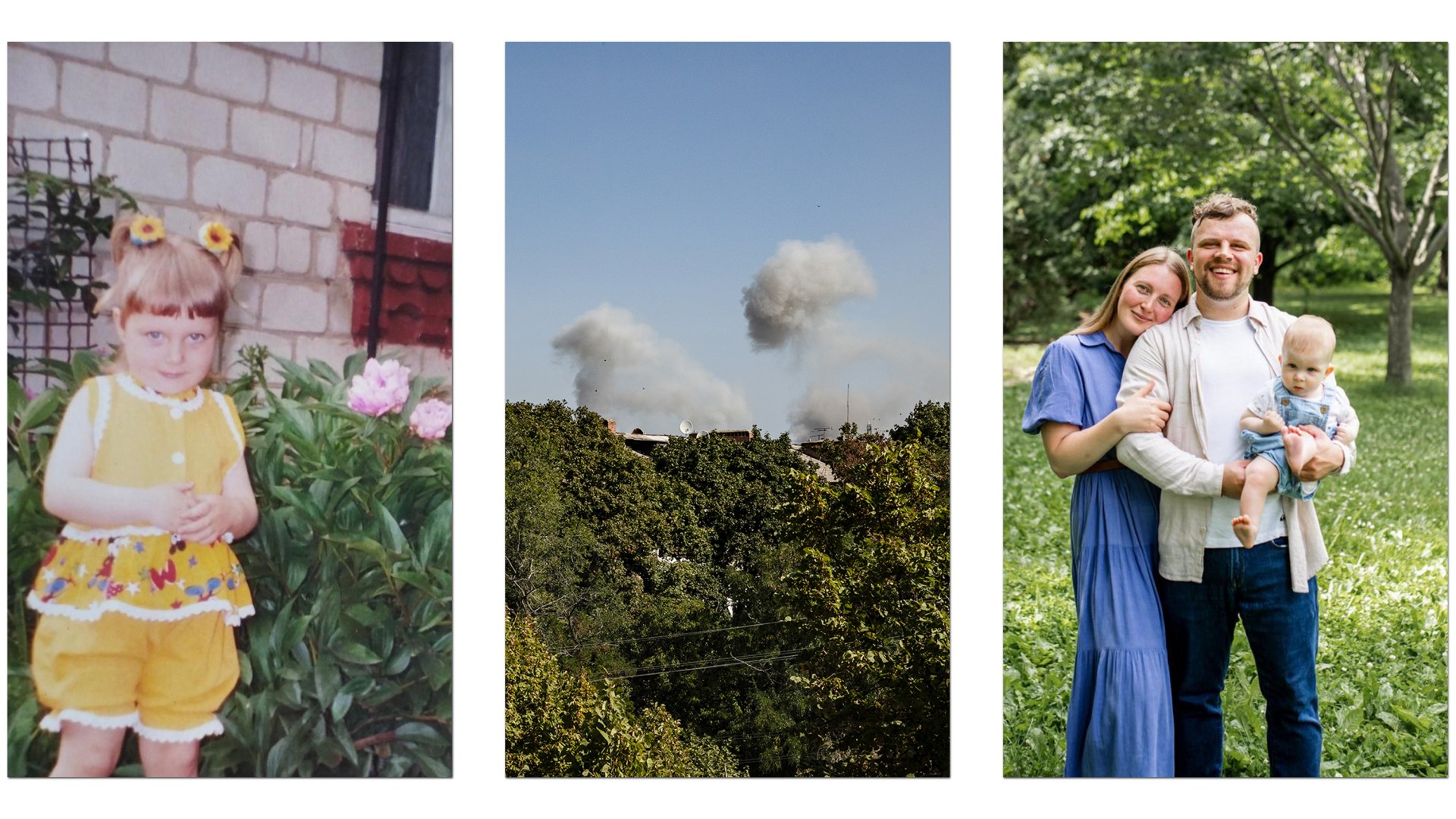
Tim was finishing college to become an engineer, and he was no stranger to God working across borders. His parents had left Ukraine for America in 1992, after the fall of the Soviet Union, and raised him in a Slavic Baptist church in Erie, Pennsylvania, where his father, uncle, and grandfather all held the pulpit. It wasn’t long before he too came to see marriage to Zhenya as God’s will for them. After just two months of dating, they were engaged, then married a few months after that, in March of 2023.
The Gidenkos—who now have a son, Yonathan, and a daughter on the way—could have sought an established church for their first years as a family. Instead, they decided to plant a church in Red Wing, a Minnesota river town of roughly 16,000, south of the Twin Cities. They partnered with a pastor named Willie Grimm to build a community of demanding discipleship.
“Here in Red Wing, a woman from our core group met some people from her neighborhood and was talking about Jesus, and they said, ‘We never heard about Jesus,’” she continued. “How is it possible?”


The new church is called Harbor Point, and so far, it’s staying small. That’s not a bad thing, Zhenya said, because it forces intentionality, deep relationships, and immediate gospel-sharing rather than the work of navigating the established infrastructure of larger congregations.
This path is a natural extension of her own story, she said: “I want to share about Jesus. So yes, I have stories from my childhood—my alcoholic mother, bad relationships, immigration, a broken heart. But no matter what my experience, the only thing that matters is sharing the gospel. So what I want to talk about is Jesus, just like someone talked to me.”
This isn’t a glamorous push for more attention in an age of digitized influence. It’s a prioritization of neighborhood prayer walks, worship nights in quiet farmland chapels, opportunities to mow the unkempt lawn of a single mother on the “wrong side” of town.
“Our hope,” Tim said, “is not to bring people to us but to bring people back to God.”
Zhenya has moved across nations—or, rather, been moved, as she tells it—sometimes by blaring sirens, or the animosity of a distant mother, or the fear of oncoming soldiers, or the tugs of a missionary family. But above all, she’s been moved by a God who loves and pursues her.
“I think maybe, in the beginning, it was what I was chosen for,” she said of the church plant. “I remember I once wanted to go to some village in Ukraine where nobody had heard about God. Maybe it was something God put in my mind for this experience, for what I have right now.”
Correction: An earlier version of this story gave the incorrect date for the Gidenkos’ wedding.
Related