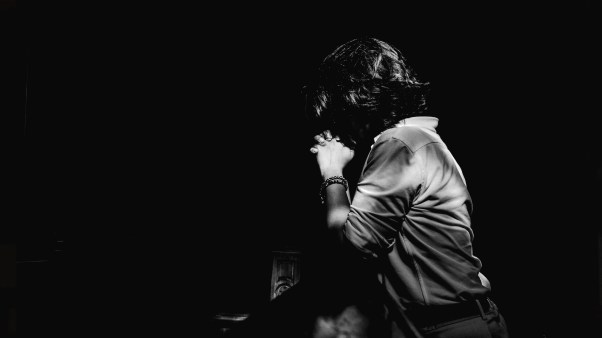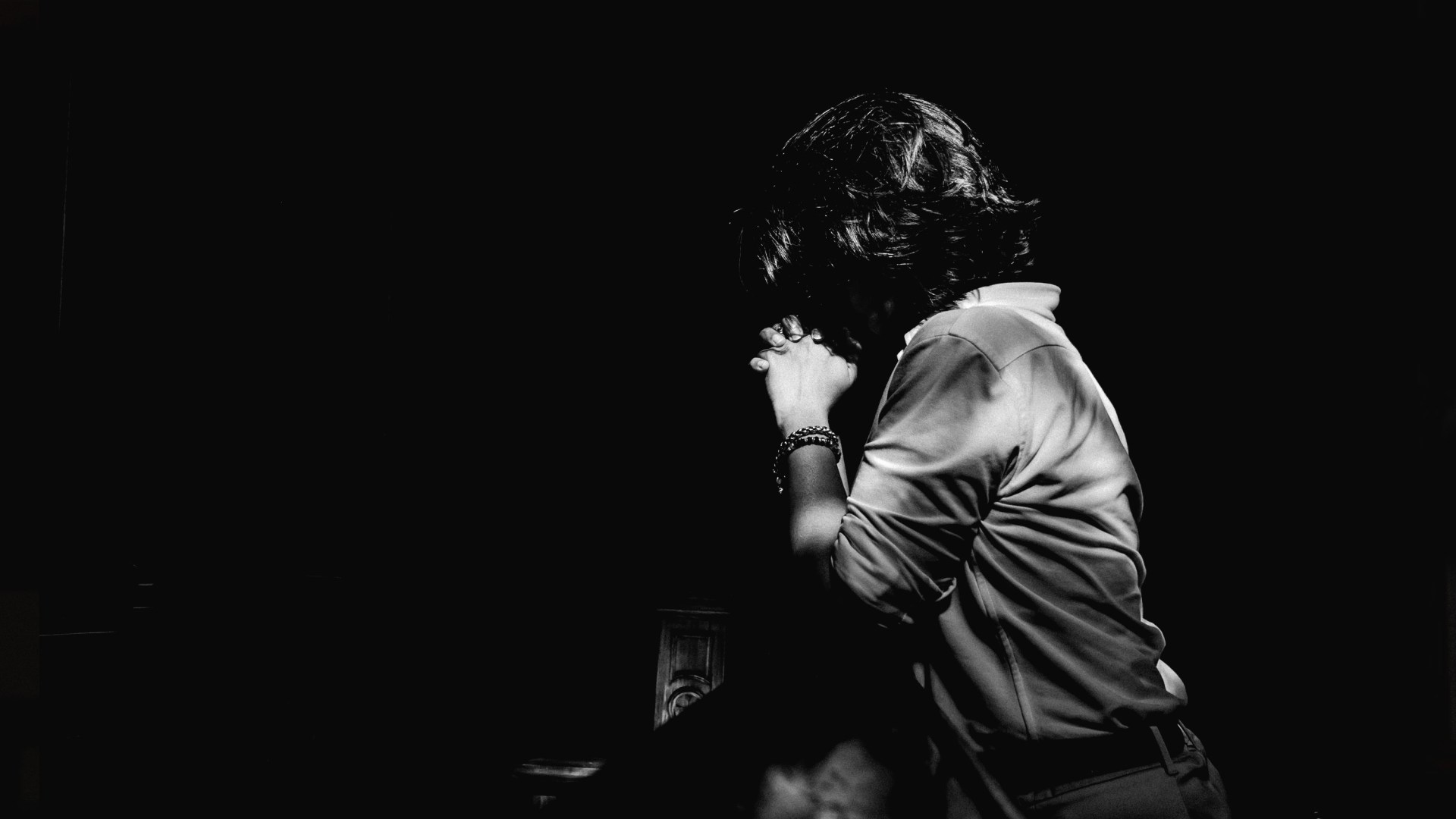
When I was in college, my grandparents showed me a room in their house they called their prayer room. It had a big Bible in it along with a padded kneeler so they could pray on their aging knees without too much discomfort. I remember thinking it odd that they chose to pray in such an inconvenient posture. Raised evangelical, I associated daily prayer with my big comfy chair and a cup of coffee.
I’ve since realized that all my years of praying in ways that suited me grew my faith in a therapeutic direction. My devotion to God was at least partially a devotion to myself and my comfort. I now believe that kneeling—and other less convenient approaches to prayer—are not only appropriate but also important. They teach us something essential about the one to whom we pray and the ways in which we are called to relate to him. Prayer is not only about intimacy. It is also about reverence.
In theological terms, the gospel shows us a God who is both transcendent and accessible: “In the beginning was the Word, and the Word was with God, and the Word was God. … The Word became flesh and made his dwelling among us” (John 1:1, 14). The Protestant tradition has always championed God’s accessibility.
The early Reformers and their forebears took great risks to translate the Bible and the church’s liturgy into familiar languages so people could hear and speak to God in words they understood. God has come near to us—so near that we can hear him in what missionaries call a person’s “heart language.” In his humility, we encounter a God who has become like us so we can know him.
However, God’s desire to be accessible does not change the fact that he is still God. He remains transcendent: holy and wholly other than creation. We “approach God’s throne of grace with confidence” (Heb. 4:16), but it remains a throne. In emphasizing God’s nearness, many Protestant evangelicals have lost sight of God’s transcendence. We have lost our sense of reverence.
Without reverence for God as one worthy of our worship—however inconvenient that worship may be—we also lose our sense of awe at his willingness to condescend and draw near. The gospel is a scandal precisely because a holy God has chosen to dwell among us. And our fellowship with him will never cancel our reverence for him. Even after he wipes every tear from our eyes, we’ll still be servants who worship around his throne (Rev. 21:4; 22:3).
Historically, an emphasis on God’s nearness and accessibility was a needed corrective in a time when Christian devotion was often characterized by fear and guilt (see, for example, A History of the Church in England by J.R.H. Moorman). Christians of all traditions have benefited from a greater appreciation for the intimacy on offer to us in the gospel of grace. But today, in a culture increasingly defined by casual, self-made meaning and therapeutic pragmatism, reverence for a transcendent God is a needed corrective.

One Body, Many Denominational Meetings
As a millennial raised in the church, I know Jesus is my friend. What I sometimes forget is that he is also my Lord. Recovering some of the practices of historic Christian devotion like kneeling for prayer, sitting in silence, and even fasting have helped me with that.
Embracing reverence as a vital aspect of our faith forms us as disciples of a holy God. But it also has missional value. In many parts of the world, converts from other religions expect worship to look like deference and honor. I recently heard the head of a missions agency explain that his own spiritual life changed when Muslim-background believers told him they wanted to pray in ways that visibly acknowledged God’s holiness. “When they came to Christian faith,” the missions leader said, “I led them in worship the way I’d grown up doing it in my house church—slumped on a couch. They felt this fell short of reverence to an almighty God.”
Something similar is happening even in the West. Though the data isn’t statistically clear, the amount of conversation happening about younger generations’ interest in liturgical church traditions—where worshipers practice silence, confession, bowing, fasting, and other disciplines—indicates that people are growing hungry for transcendence. In a world saturated with celebrity and self-fulfillment, we want to kneel before the mystery.
This mystery, of course, does not belong to only one church tradition or denomination. All Christians worship the holy God who came near. And practicing reverence can take many forms, some of which are culturally conditioned and not biblically commanded. In the South where I grew up, even nonchurchgoing men would customarily remove their hats before a prayer. This take on 1 Corinthians 11 is somewhat antiquated, yet it taught a generation that prayer is special. How are we conveying that today? How can I teach my young children to feel comfortable talking to God but also to practice reverence in conversation with him? These are important questions because the way we pray both reflects and shapes what we believe.

Time Is Scarce. It Should Be Sacred.
But they are questions that families, congregations, and church leaders can explore with curiosity, not condemnation. The gospel affords us the opportunity to keep learning and growing in our devotion to the transcendent yet accessible God. Thankfully, we have centuries of Christian history to help us learn. What began for me as an oddity introduced by my grandfather—a Baptist layman who knelt to pray—continued as a journey of discovering the riches of ancient church practices that have deepened and strengthened my prayer life.
The intuition of our bodies can also help us. What many of these ancient prayer practices teach us is that body language matters and is intuitive. Even if someone doesn’t use a kneeler or recite liturgical prayers, he or she can imagine Jesus in the room and wonder which posture would befit his presence.
My 4-year-old could probably follow that imaginative exercise. At church, she sees the adults kneel and stand and raise their hands. Sometimes she joins us. She also comes forward for a blessing at Communion and often hugs the pastor (her dad) instead. For me, this is a picture of Christian devotion: bowing the knee and receiving a hug. We need both postures to understand the whole story.
Hannah Miller King is the associate rector at The Vine Anglican Church in Western North Carolina and the author of Feasting on Hope: How God Sets a Table in the Wilderness.