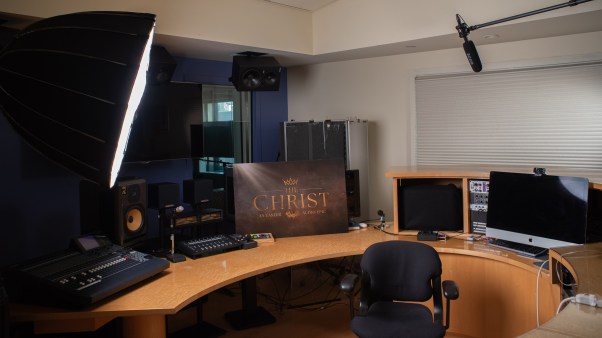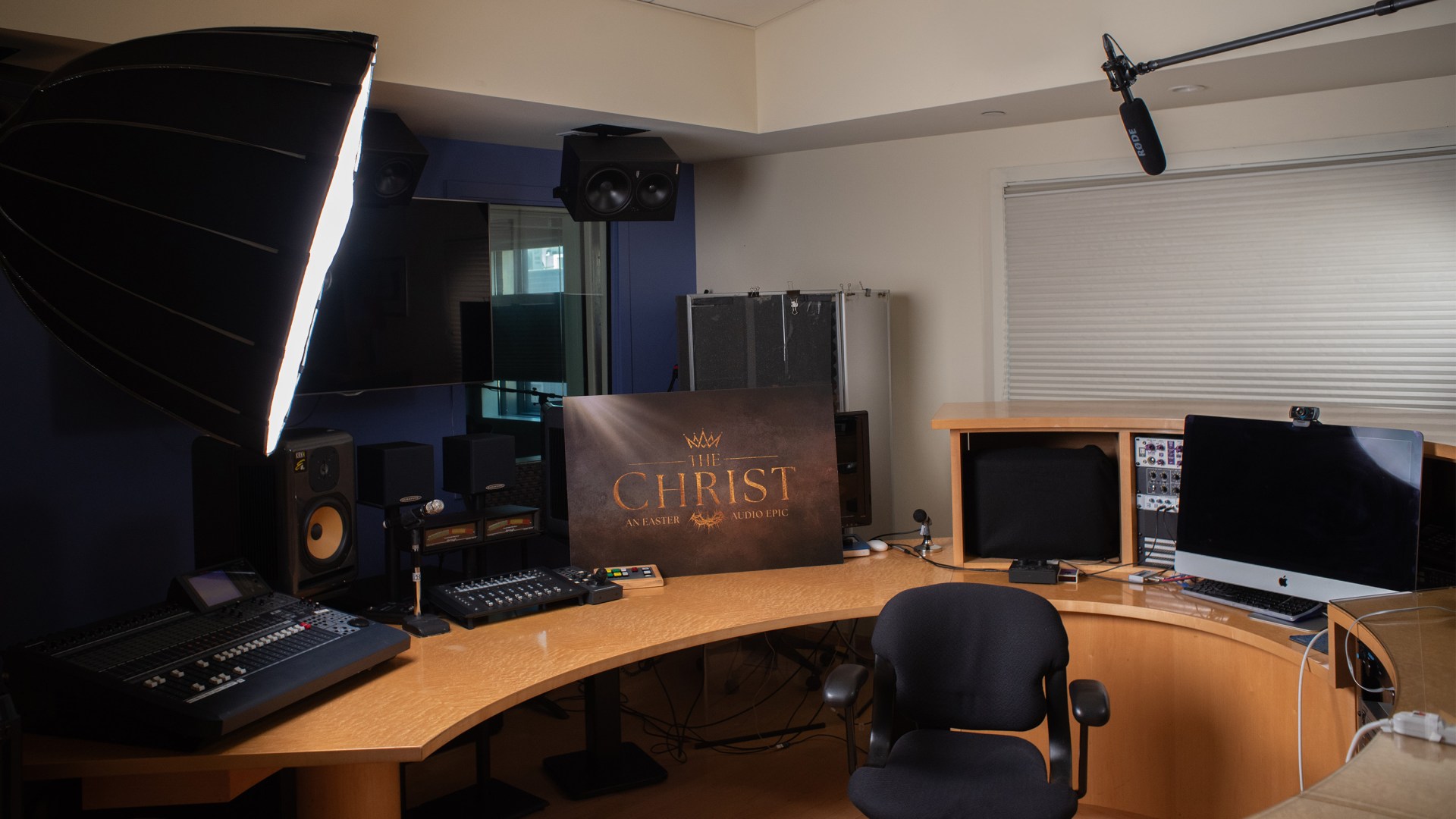
The story of Jesus has been told many times in print, in art, and on film. Now it’s been turned into a full-scale audio drama, The Christ, which is being released as a four-part podcast this week during the lead-up to Easter.
The podcast features some fairly big names, several of whom are veterans of the Bible-movie genre. David Oyelowo, who played Joseph of Arimathea in BBC’s The Passion and John the Baptist in The Book of Clarence, now plays Pontius Pilate, while Paul Walter Hauser, who recently voiced a sheep in The Chosen Adventures, plays John the Baptist. Patricia Heaton (The Star) hosts the show, while John Rhys-Davies, whose credits include One Night with the King and Peter: The Redemption (and, yes, a Bible-adjacent Indiana Jones movie or two), provides the narration. Jesus himself is played by Tom Pelphrey (Task, Ozark), who as far as I can tell is new to the genre but has spoken quite openly about his faith.
Listening to the podcast is a fascinating experience. When you read the Gospels, you can imagine how it all played out for yourself, and when you watch a movie or TV show about Jesus, the sights and sounds are provided for you. But listening to the drama—getting the sounds but not the sights—focuses the mind in different ways. It’s a little like watching an old silent movie about Jesus, except instead of showy facial expressions and hand gestures compensating for the lack of audio cues, you’ve got theatrical voices and precisely-timed laughter compensating for the lack of visuals (particularly when the villains are mocking Jesus). Even if the performances are a bit exaggerated to fit the medium, they can also be quite bold and effective, engaging the listener.
The producers of The Christ make good use of the form, from the hard-hitting sound effects when Jesus is crucified to the various storms and crowds in the background of other scenes. When Jesus goes into the desert after his baptism, his prayers overlap with flashbacks to his birth and childhood, and it feels like we’re listening to his thoughts and memories.
And just as Cecil B. DeMille’s silent classic The King of Kings showed Jesus healing a blind person from the person’s point of view, with a dark screen fading into an image of Jesus’ face, so too the podcast dramatizes the healing of the deaf-mute man by dropping the sound and muffling Jesus’ voice just before he says “Ephphatha!” (Mark 7:34).
The writing goes beyond the Gospels in interesting ways. In two of the Gospels, Jesus quotes a single line from Psalm 22—“My God, my God, why have you forsaken me?”—but in The Christ, he continues further, quoting even more of that psalm, while the narrator explains how another line from it was fulfilled when the soldiers cast lots for Jesus’ clothes. Sometimes the podcast makes its own connections to the Old Testament, as when Rhys-Davis quotes Jeremiah 17:9 (The heart of man is “desperately wicked”) while describing Jesus’ treatment on the road to Calvary.
The script also has a strong apologetic thrust. One of the disciples states that Jesus is either the biggest charlatan who ever lived or the sole supreme God; Heaton says Jesus fulfilled more than 300 prophecies; Rhys-Davies explains how Jesus was different from the false gods of his time; and the apostle John emphasizes the importance of deciding to believe that Jesus is the Christ.


Some of the creative choices are a little puzzling. Pilate’s wife keeps calling him “Marcus,” and only later do we learn the writers have expanded his name to “Marcus Pontius Pilate.” A historical basis seems to exist for creating a first name: Pilate’s personal name is not known, only his family names, and it stands to reason that his wife wouldn’t have called him by one of those, so the writers may have felt they had to invent another name for him. But because they don’t introduce him by his new name, his wife’s repeated use of it pulls us out of the drama just when it’s getting started.
Also, some of the plot points have been moved around in ways that might feel disjointed to listeners familiar with the story of Christ’s life. For example, when the disciples go fishing in Galilee after the Resurrection (John 21:1–4), they still haven’t seen the resurrected Jesus for themselves, and they grumble (or at least Thomas does) that Jesus has already appeared to pretty much everyone but them. They mention the women at the tomb, his mother, and the people on the road to Emmaus, among others. Jesus seemingly doesn’t appear to the disciples in Jerusalem (Luke 24:36–49; John 20:19–29) in this version of the story.
The dialogue is a mix of modern and archaic. Sometimes it’s very casual and familiar: When one of the disciples asks Jesus to teach them how to pray, Jesus replies, “All right, all right, maybe this should have been my first sermon.” Other times it falls back on the more stilted thees and thous of the King James Version.
Some of the other creative decisions are more intriguing than puzzling. When John the Baptist says the Messiah will baptize “with fire,” he’s speaking to Herod, in this production, and it sounds like a threat. I always assumed the biblical John, who spoke of Jesus baptizing “with the Holy Spirit and fire” (Matt. 3:11; Luke 3:16), was alluding to the tongues of fire that alighted on the disciples’ heads when the Spirit came upon them at Pentecost (Acts 2:3), but maybe he did mean it in a more apocalyptic way. Also, the rather sweet-voiced angel who appears to Jesus in Gethsemane (Luke 22:43) makes yet another allusion to the Old Testament that carries its own hint of menace aimed at someone else—not Jesus!—but still, it’s not what I expected.
The show has effective moments, too, conveyed through sensitive performances. The portrayals of Joseph and Mary, and their awareness of the suffering that awaits both them and their son, stand out in particular. Mary alludes to the sorrows ahead of her when she asks Jesus to intervene at the wedding in Cana. Even at a time of joyous celebration, she knows what she’s setting in motion, and you can feel her preparing herself for it.
The brief exchange between the 12-year-old Jesus and the elders in the temple (Luke 2:41–52) is also quite good. Many films simply show Jesus standing or sitting in front of the elders when Mary and Joseph find him, but an audio drama can’t take that shortcut. It has to give you a sense of what Jesus was saying, and this gives you a good sense of the public speaker that he will go on to become.
At the heart of it all, of course, is Pelphrey’s performance as the adult Jesus. Equal parts warm, compassionate, vulnerable, and sincere, his interpretation of Jesus is a pleasure to listen to, from his recitation of the Beatitudes to his playful exchanges with his mother and his forgiveness of Peter. You can’t exactly “come and see” his version of Jesus, but you can definitely come and hear.
Peter T. Chattaway is a film critic with a special interest in Bible movies.
Related