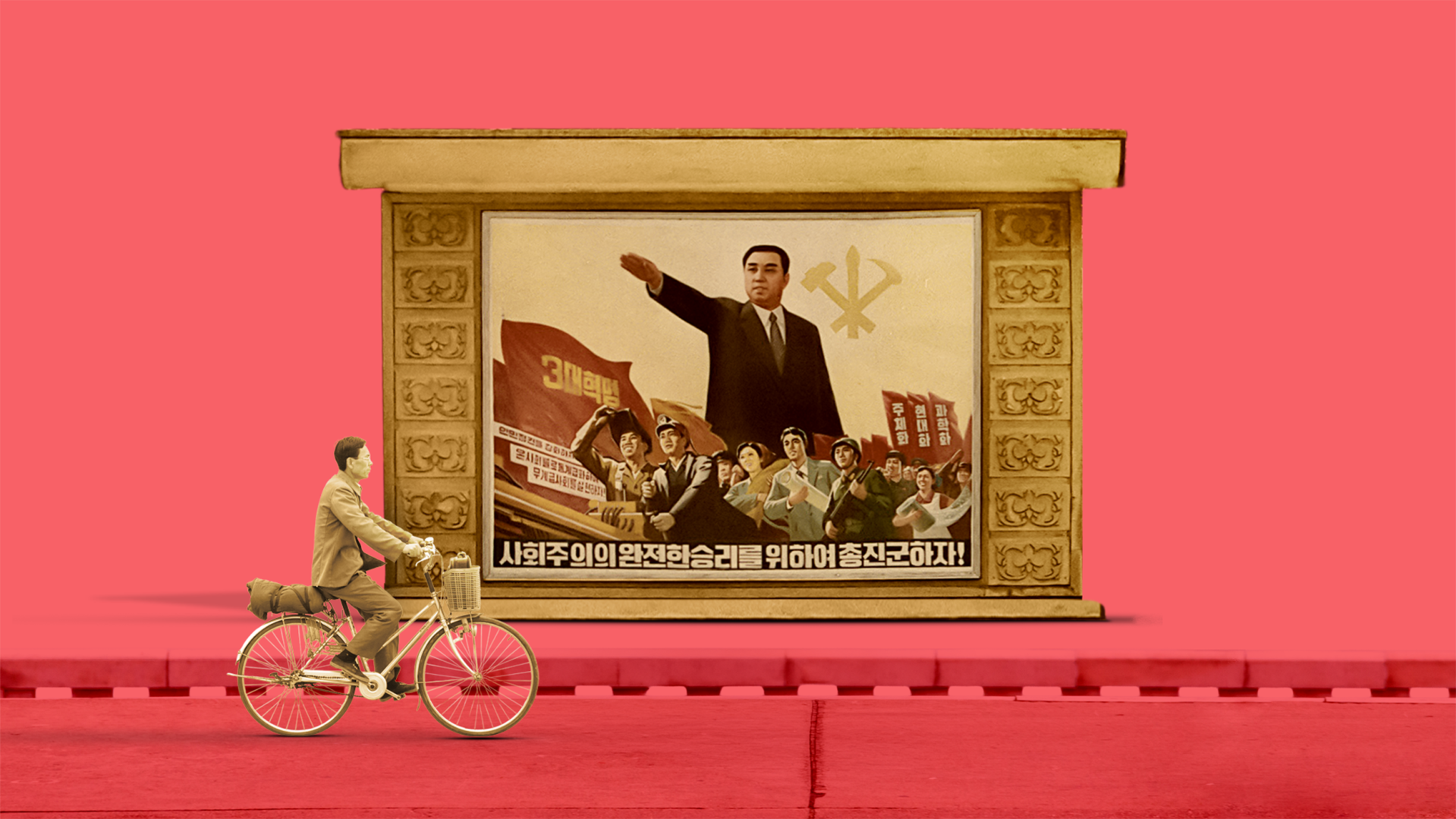
Last month, North Korean president Kim Jong-Un said in a speech that the war in Iran highlights his country’s need to continue its nuclear program to protect against potential American threats. Christians living in this Communist country daily encounter their nation’s aggressive defense of its sovereignty on all fronts: geopolitical, ideological, and religious. To better understand North Korea’s commanding presence over its people and its posture toward the rest of the world, The Bulletin‘s Mike Cosper sat down with Jonathan Cheng, China bureau chief at The Wall Street Journal and author of Korean Messiah: Kim Il Sung and the Christian Roots of North Korea’s Personality Cult. Here are edited excerpts from episode 262.
What did the emergence of evangelical Christianity look like in North Korea and in the Kim family?
When Kim Il-Sung, the founder of North Korea, and his family first encountered the faith over 100 years ago, it was brand new in Korea. It was almost like the Book of Acts: There wasn’t even a fully translated Scripture that they could turn to. The Bible was being translated as they were encountering the faith, so there were deviations from orthodoxy because they were bringing their own context and traditional Korean folk religions.
The Koreans were really taken by Christianity. It was revolutionary. At that time, Korea was loosely divided into northern Korea and southern Korea. The official division of Korea into North and South came after World War II. In 1948, the capital of South Korea was Seoul, but the capital of Christianity was in the North in Pyongyang.
Early missionaries were northern Presbyterians primarily, but also Methodists. They arrived in Seoul—but didn’t succeed—in the late 1880s. Missionaries in Pusan (now Busan) at the very south of the Korean Peninsula had even less success.
But then one missionary, Samuel Austin Moffett from Indiana, arrived in Korea at age 26 in January 1890. He headed to Pyongyang, and before long, he found that he couldn’t keep the inquirers away. Koreans were queuing out his door to hear the gospel Moffett was preaching. It got to the point where he didn’t have time to eat or to sleep. This is how Pyongyang became the center of Christendom in the East. It was so Christian it was known as the Jerusalem of the East. Pyongyang had the largest Presbyterian seminary in the world and this vast missionary compound with high schools, hospitals, and seminaries. Billy Graham’s wife, Ruth Bell Graham, went to high school there.
By the time Kim Il-Sung was born in 1912, the Christian missionaries and the Christian gospel had been in Pyongyang for about two decades. His grandfather had constructed a Christian missionary school attached to a church in the village where Kim Il-Sung grew up. His parents were both very devout—his father a Christian teacher, and his mother what they called a “Bible woman,” effectively equivalent to a deacon. She would go around to the villages with Bibles and talk to other women, spreading the gospel.
Though Kim Il-Sung followed his parents to church, he claimed in his memoirs after he became the supreme leader of North Korea that he didn’t find it particularly interesting. He said he went because the pastors would give away pencils, notebooks, candy, and other things. He would fall asleep in the pews. He even claimed that his dad was an atheist and that his mother went to church only because she was so tired from her workweek that she needed somewhere to rest on Sunday morning, and a pew provided a place to sleep. However, all evidence points to the contrary.
I think he deeply absorbed the power of the Christian message and saw the power and respect American missionaries commanded at the pulpit. He also recognized the power of faith in perhaps a more nefarious sense: to inspire but also to control.
Kim Il-Sung became the leader of North Korea at the end of World War II. Joseph Stalin and the Red Army of the Soviets took North Korea, stopping at what is now the 38th parallel. The Soviets backed Kim Il-Sung for various reasons, and the Americans came and took the southern half of the peninsula.
How did this personality cult evolve around the family that is now running the country?
Kim Il-Sung ruled North Korea for almost half a century. Stalin and Hitler were at the peak of their powers for a fraction of that time. Stalin attended one year of seminary, and he built his cult of personality and helped Kim Il-Sung do the same. From the very beginning, it was, in many respects, a classic Soviet bloc cult to personality. In the early years in North Korea, you would frequently see their portraits hanging side by side.
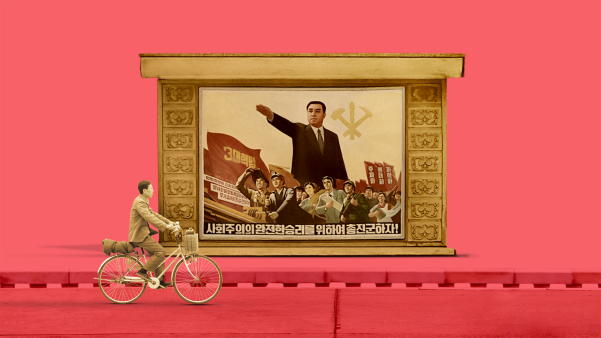
Very quickly, though, Kim surpassed Stalin. The first statues were erected in North Korea for Kim Il-Sung in 1948. Today, there are thousands of them. Very early on, he was deliberate about making sure the education system was built around him. History was rewritten for him. Poems, songs, and hymns were written for him. He instilled in his people what you and I might call a faith in this 30-something-year-old Korean messiah.
The difference with the USSR and Communist China was that, after Mao’s and Stalin’s deaths, successors said they shouldn’t have allowed that to happen, and the statues came down. Kim Il-Sung was challenged, but he was never taken down. Stalingrad was renamed, but that sort of thing never happened in North Korea.
Not only did Il-Sung last for almost half a century as the leader; he was able to designate his son as the successor, Kim Jong-Il. Then Kim Jong-Il designated his son, Kim Jong-Un, the current leader, as his successor.
Three generations of Kims is completely antithetical to orthodox socialism or communism. You never saw Stalin or Mao try to cultivate his son. Eighty years into this cult of personality, it’s only continued to grow. There was never a period where they decided they’d gone too far and ought to dial it back a little bit. Never has there been a period in which, like with China over the last 20 or 30 years, you saw more interaction between the country and the rest of the world.
What is it about North Korea—whether it’s the governance or the culture—that allows it to pull this off so completely?
Often, you hear Koreans say that the Korean people don’t do things by halves. You hear colloquially that the Koreans were, in some ways, more soviet than the Soviets, more Communist than the Communists were. They were more capitalist than the capitalists were. So when they embraced Christianity, it was to a degree that just floored the missionaries.
Many times in early missionary literature, you find missionaries exclaiming, We thought we were coming to Korea to spread the gospel. I did not realize I would find my faith challenged here. Their fervency puts me to shame. I can’t stand next to these people that I’m supposedly here to minister to. They’re ministering to me!
Many of the Christians from the North fled to South Korea, and South Korea is now the second-largest missionary-sending nation in the world. It has one-seventh the population of the US. The biggest megachurch in the world today is in South Korea. Those who embraced Christianity weren’t lukewarm. These Christians were there for Sunday-morning worship, for Wednesday-evening prayer meeting, for spreading the gospel, for itinerating through the countryside distributing tracts. They were all in.
When Kim Il-Sung rose to power, he understood that if you get people’s hearts and souls, you have them completely. You could call it a grotesque insight, but I think that’s what he knew intuitively. He never articulated this, but I think that’s at work here. On a certain level, he took the Trinity and sort of replaced it. He said, What if I’m the father? What if my son is the Son? What if my ideology is the Holy Spirit? He set himself up successfully as a Korean messiah.
How did the transition take place from a country shaped by the evangelical world to a nation of personality cult?
Kim Il-Sung was able to redirect the passions of some of his subjects. While many Christians fled to the South, of those that remained, some were more conservative and some more left leaning. He was setting up a socialist state, and there has been, throughout socialism’s history, a strain of Christian socialism that persists to this day. It’s usually not been the mainstream, but there is a strong current there that traces itself to the Book of Acts, where the disciples shared everything together. Christian socialists interpret that as a socialist Jesus.
As Kim Il-Sung set up his nascent state, he tapped into this and recruited enough pastors to his cause. For example, his distant uncle was a conservative, revivalist pastor. Kim Il-Sung brought him on board, and this Reverend Kang became his ambassador to the Christians. He introduced Kim Il-Sung as a Moses who would lead North Korea to the Promised Land. Kim Il-Sung said he’d bring justice and equality. That’s the socialist promise, but that’s also an ideal that many Christian socialists have had for centuries.
Life today in North Korea is miserable because of this corrupt regime. It’s heart-wrenching to learn that this comes from a certain kind of Christian framing.
This evangelical history is so incongruous with the image of North Korea that we have today. I made two trips there in 2013 and 2017. You see people bowing before the statues, the portraits of the great leader everywhere. You see North Koreans memorizing his scripture and singing his praises. There are so many of these echoes of faith that you see in North Korea—the religiosity and the construction of an all-consuming kind of religious society. It’s unmistakable where this all comes from.
When you come to research like this, you pinch yourself. Sometimes it’s hard to believe. Billy Graham visited Kim Il-Sung twice, in 1992 and 1994, and he was stunned at how Christian it felt in so many ways, even though he knew on so many other levels it was the antithesis of everything that he stood for. When Graham visited Pyongyang, the North Koreans took him to Kim Il-Sung’s birthplace. It’s this little thatched hut on the edge of the city. Billy Graham turned to one of his companions and said, All they’re missing are the manger and the three wise men.