In this series

Christianity Today asked four thoughtful voices in our movement to read our March cover story on The Benedict Option and answer the following question: “In a time of weakening institutions and in an increasingly pluralistic age, what is the best way for Christians to strengthen their local Christian community?”
I agree with much of Rod Dreher’s cultural diagnosis, though we differ in posture and tone. Like Dreher, I believe many of my neighbors hold wrong-headed views with real-world consequences. But I also see a lot of good in those neighbors and a lot that I can learn from them. Tim Keller and I have argued that our confidence in the gospel lets us find common ground with others even when we can’t agree on a common good. This confidence in our own beliefs and the institutions that sustain them is also what I’ve suggested allows Christians to pursue confident pluralism.
I share Dreher’s desire for partnership across faith traditions—but I would go further. Dreher references the 1990-era effort, Evangelicals and Catholics Together. Today we might think about something like Evangelicals and Muslims Together. I don’t mean that as a call for theological unity but for real friendships and public partnership. Evangelicals would benefit from these kinds of relationships with Muslims in pursuing charitable work on behalf of others, advocating the value of pluralism in this country, and defending the importance of religious liberty.
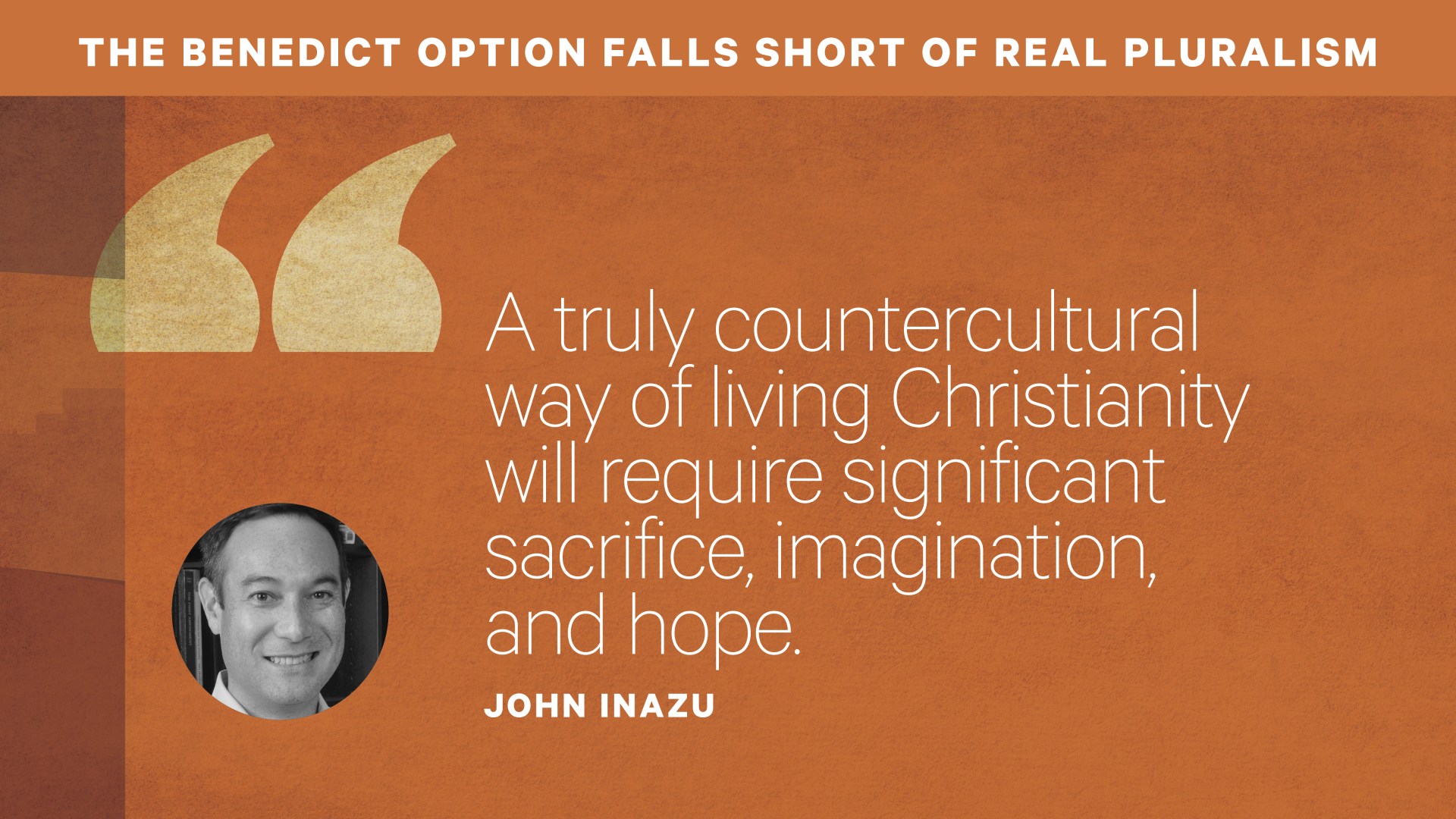
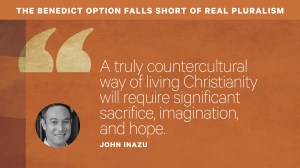
In calling for priorities and practices that make Christians look different from the rest of the world, Dreher joins a long line of thoughtful writers such as Stanley Hauerwas, James K. A. Smith, Tish Harrison Warren, and Brenda Salter McNeil. What he calls “a truly countercultural way of living Christianity” will require significant sacrifice, imagination, and hope. To take one example: as Andy Crouch argues in his forthcoming book, The Tech-Wise Family, if you want to get serious about a faithful response to the challenges of technology, “you don’t have to become Amish, but you probably have to become closer to Amish than you think.”
Those efforts toward formation must be grounded in the family of the church, not the nuclear family (Matt. 12:48–50; John 19:26–27). At times, Dreher seems to obscure that critical distinction. He offers some rich examples of ecclesial living in Augusta, Wichita, and Eagle River, but he also asserts that the family is “the most important institution to conserve” and suggests that learning the language of faith starts with “the community of the family.” The nuclear family is important, but for Christians, the determinative community is the family of God. That is the family into which we are called to learn the language of faith. And it is through the unity of that family that the world will know the love of God (John 17:23).
Focusing on the unity and witness of the church raises the stakes for Dreher’s project. Too often, our well-intended efforts to deepen Christian community leave us with people who look just like us, perpetuating divisions in the church over race, politics, and class. But the church of every tribe, tongue, and nation—and the church of every tax bracket, political party, and musical taste—requires more. Christians are called to overcome these barriers, for the sake of the church and the sake of the world.
John Inazu is the Sally D. Danforth Distinguished Professor of Law and Religion at Washington University in St. Louis, and the author, most recently, of Confident Pluralism: Surviving and Thriving Through Deep Difference (University of Chicago Press, 2016).