





Who was Joan of Arc? Loony schizophrenic? Demon-possessed adventurer? Or was she the saint that the Roman Catholic Church in 1920 made her out to be?

On Monday, March 21, at 10 p.m. (ET) on the Hallmark Channel, Faith & Values Media reopens a familiar debate in their new docudrama Joan of Arc: Child of War, Soldier of God. Pamela Mason Wagner, who oversaw last year’s docudrama Patrick, returns as director, Alfred Molina of Spiderman II and Chocolat fame narrates, and Academy-Award winning actress Anna Paquin is the voice of Joan (Lucie Vondrackova portrays Joan on screen). Various professors and authors offer on-air commentary.
Joan of Arc lived during a chaotic time in France’s history—England occupied Paris and much of the country during the Hundred Years’ War (1337-1453). A peasant from the French village of Domremy, Joan reportedly began receiving visions from God in 1425 at the age of 13. She was to go to the French Prince Charles (Dauphin), or so the “visions” said, and offer her services in the fight to relieve the city of Orleans besieged by the offending English.
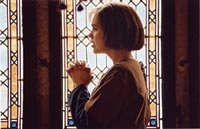
Joan’s leadership in the defense of Orleans is legendary, and the subsequent coronation of Charles was likewise the crown of her success. But Charles’ refusal to support her attack on Paris (the film speculates Charles was jealous of Joan’s fame) was but the first turn of misfortune that led to Joan’s capture and trial by the English. The English sympathizer Bishop Cauchon charged her with 70 counts of heresy, and on May 30, 1431, Joan was burned at the stake at the age of 19.
The tale is fraught with conundrums. What (or who) convinced this peasant girl to take up the sword and lead the French army to war at a time women were expected to stay within the domestic confines of the home? Did God really instruct Joan to fight the English—that it was the “will of God” that the French defeat their enemies? How can we be sure the “voices” Joan heard and obeyed really came from God?
Faith & Values Media shows admirable restraint in telling Joan’s story. Wagner does not sensationalize the drama (tempting though that might be) but puzzles through the twists and turns of an ordinary girl’s path to greatness. One must at least give Joan credit for her extraordinary courage, leading men (with a history of defeats) into battle with little training. Wagner aims to take Joan on her own terms, following her road to military success while avoiding the temptation to showcase Joan as a tragic victim of male political intrigue.
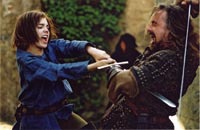
Joan of Arc offers a few glimpses of real insight. Francoise Meltzer of the University of Chicago, for example, astutely observes that those who dismiss Joan’s voices as a case of schizophrenia are ignoring the force of will and logic that Joan would later demonstrate (something most schizophrenics are unable to do). If anything, the films makes a convincing case that Joan descended into mental stress only at the point that her heresy trial interrogators pushed her to say her voices came from St. Michael, Margaret and Catherine, not God.
That’s not to say the documentary’s commentary is always spot on. Molina’s concluding comment—Joan’s story remains an inspiration to anyone who believes in following your voices even if it consumes you—is throwaway. That smacks of postmodern relativity foreign to the sensibilities of Joan’s age.
But don’t let that deter you. Joan of Arc is worth your hour, if only to hear Joan tell her own story in her own words (her testimony was saved in the trial’s proceedings). As for how to evaluate Joan’s spiritual standing, her answer to Bishop Cauchon may have to do for now: “If I am not [saved], may God put me there. If I am, may God keep me there.”
Steven Gertz is assistant editor of Christian History & Biography magazine and ChristianityToday.com







