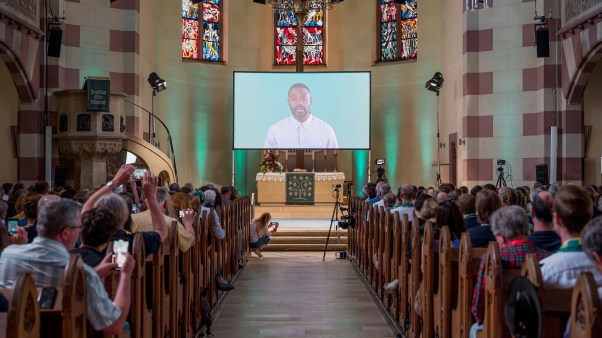
No one needs to tell any American evangelical born after 1980 that true love waits. The campaign, affiliated with the Southern Baptist Convention, has since 1993 urged young believers, by way of youth-group talks and paper pledges and purity rings, to abstain from premarital sex. The program and others like it root their argument for abstinence in the logic of payoff: “If you wait for marriage, your future sex life will be hot.” As communications expert Christine Gardner told CT recently, these campaigns “are using sex to sell abstinence. They are using the very thing they are prohibiting to admonish young people to wait.”
The Road We Know, a laudable new documentary about HIV/AIDS prevention in Botswana (is about a youth-led abstinence campaign of an entirely different kind. (Watch the trailer here, and watch the entire film here.)
Botswana, a relatively prosperous, peaceful nation in sub-Saharan Africa, has the second-highest AIDS infection rate in the world, behind nearby Swaziland. One of every four Botswana adults ages 15-49 is HIV-positive; the dire situation led the government to declare a national emergency in 2004. Social agencies and the Ministry of Health have distributed free condoms in the millions, yet Western social scientists and epidemiologists conclude that condoms have mostly failed to prevent the spread of AIDS throughout sub-Saharan Africa. As Harvard scientist Edward C. Green says in an interview in the film (and to CT in 2009), “Condoms have not worked in any country in Africa,” despite the good intentions of Western liberals who believe such a strategy will solve the AIDS crisis. (To the consternation of his fellow secular liberals, Green defended the Pope’s comments about condom use in 2008.)
In this life-and-death context, The Road We Know profiles seven Botswanan college students who teach that abstinence before marriage is the safest way to prevent the spread of AIDS. Unlike True Love Waits, their payoff logic has less to do with hot married sex and more to do with not dying at age 24. The feature-length documentary, which debuted last week on World AIDS Day by Citygate Films, follows the young adults as they preach their counter-cultural abstinence message to thousands of high school students across Botswana. Volunteering with the program Face the Nation, the students form a “rally team” that use performance—skits, dance routines, exhorting speeches—and personal counseling to convince teens that, as one team member says, “We are smarter than trusting our lives to a piece of plastic.”

The Road We Know follows the students as they journey in a rickety van to schools across western Botswana. Filmmakers Suzanne Taylor and Carolyn McCulley (who has written for CT) tag along to capture how the road trip affects the team members as they camp out in tents, battle fatigue and discouragement, fix flat tires, reflect on their own sexual regrets, and see more than 10,000 young Botswanans make a pledge of abstinence in just five weeks. Though none of the team members are infected, each member’s life has been touched by AIDS (usually by a family member’s infection), and each offers compelling reasons why they practice abstinence. Innocent Mudeni is abstaining because of his uncle, who partied hard, got infected, and now spends his hopeless days getting drunk. Odi Tswai abstains because his grandma was sick for a long time and might have passed the disease on to her family. Team leader Kez Samakabadi abstaining simply because she wants to obey God and believes the truth about his design for sexuality. As she explains, abstinence, once considered a “church thing” in her country, is just common sense for increasing numbers of Botswanan youth.
Taylor and McCulley call their project a work of filmanthropy, distributing it through a new technology that lets viewers digitally pass it to friends while simultaneously donating to AIDS prevention programs. While Face the Nation and many team members are Christian—and while the film debuted at SBC president Bryant Wright’s Johnson Ferry Baptist Church last week—the documentary largely omits Christian lingo. As such, it may attract more abstinence naysayers than if it were an evangelistic film, forging a path of compromise between religious conservatives and secular liberals who tout unfettered sexual freedom. But a meandering storyline and lack of conflict drag the film down at times, and the absence of experts (save Green) hurt the filmmakers’ premise.
Taylor and McCulley end the film by citing a 2010 statistic that HIV prevalence among young people declined by at least 25 percent in 15 of the 21 countries most affected by AIDS, Botswana among them. According to the United Nations, such reductions coincide with changes in sexual behavior. As to whether the rally team effected these positive changes, the evidence is scant. But at the least, The Road We Know shows that young people are leading another type of purity revolution on the other side of the world—and that the lives they’re saving may be their own.
Katelyn Beaty is an associate editor at Christianity Today magazine, where she manages our women’s blog and is editorial director of the This Is Our City project.
Copyright © 2011 Christianity Today. Click for reprint information.