


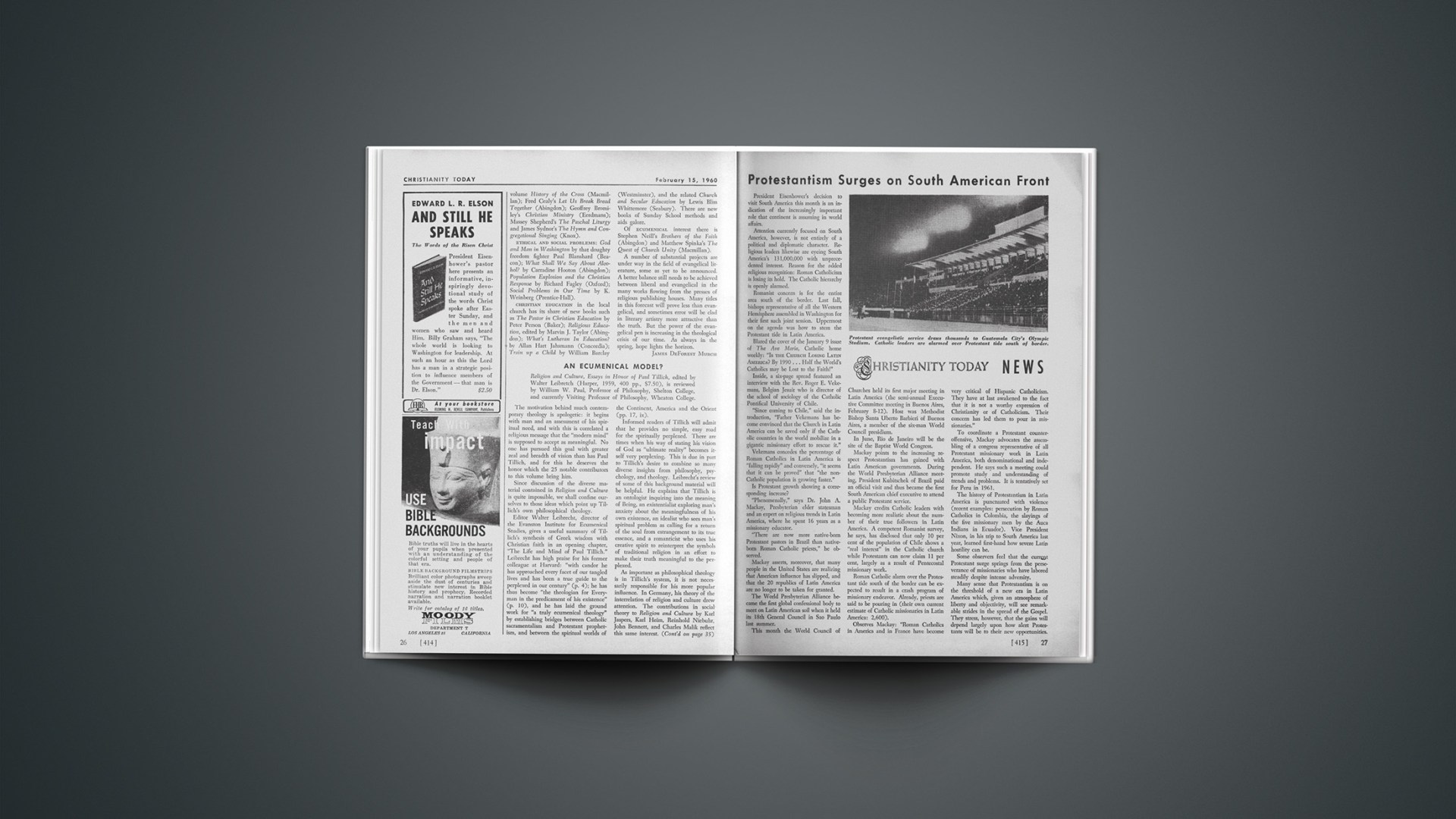

President Eisenhower’s decision to visit South America this month is an indication of the increasingly important role that continent is assuming in world affairs.
Attention currently focused on South America, however, is not entirely of a political and diplomatic character. Religious leaders likewise are eyeing South America’s 131,000,000 with unprecedented interest. Reason for the added religious recognition: Roman Catholicism is losing its hold. The Catholic hierarchy is openly alarmed.
Romanist concern is for the entire area south of the border. Last fall, bishops representative of all the Western Hemisphere assembled in Washington for their first such joint session. Uppermost on the agenda was how to stem the Protestant tide in Latin America.
Blared the cover of the January 9 issue of The Ave Maria, Catholic home weekly: “Is THE CHURCH LOSING LATIN AMERICA? By 1990 … Half the World’s Catholics may be Lost to the Faith!”
Inside, a six-page spread featured an interview with the Rev. Roger E. Vekemans, Belgian Jesuit who is director of the school of sociology of the Catholic Pontifical University of Chile.
“Since coming to Chile,” said the introduction, “Father Vekemans has become convinced that the Church in Latin America can be saved only if the Catholic countries in the world mobilize in a gigantic missionary effort to rescue it.”
Vekemans concedes the percentage of Roman Catholics in Latin America is “falling rapidly” and conversely, “it seems that it can be proved” that “the non-Catholic population is growing faster.”
Is Protestant growth showing a corresponding increase?
“Phenomenally,” says Dr. John A. Mackay, Presbyterian elder statesman and an expert on religious trends in Latin America, where he spent 16 years as a missionary educator.
“There are now more native-born Protestant pastors in Brazil than native-born Roman Catholic priests,” he observed.
Mackay asserts, moreover, that many people in the United States are realizing that American influence has slipped, and that the 20 republics of Latin America are no longer to be taken for granted.
The World Presbyterian Alliance became the first global confessional body to meet on Latin American soil when it held its 18th General Council in Sao Paulo last summer.
This month the World Council of Churches held its first major meeting in Latin America (the semi-annual Executive Committee meeting in Buenos Aires, February 8–12). Host was Methodist Bishop Santa Uberto Barbieri of Buenos Aires, a member of the six-man World Council presidium.
In June, Rio de Janeiro will be the site of the Baptist World Congress.
Mackay points to the increasing respect Protestantism has gained with Latin American governments. During the World Presbyterian Alliance meeting, President Kubitschek of Brazil paid an official visit and thus became the first South American chief executive to attend a public Protestant service.
Mackay credits Catholic leaders with becoming more realistic about the number of their true followers in Latin America. A competent Romanist survey, he says, has disclosed that only 10 per cent of the population of Chile shows a “real interest” in the Catholic church while Protestants can now claim 11 per cent, largely as a result of Pentecostal missionary work.
Roman Catholic alarm over the Protestant tide south of the border can be expected to result in a crash program of missionary endeavor. Already, priests are said to be pouring in (their own current estimate of Catholic missionaries in Latin America: 2,600).
Observes Mackay: “Roman Catholics in America and in France have become very critical of Hispanic Catholicism. They have at last awakened to the fact that it is not a worthy expression of Christianity or of Catholicism. Their concern has led them to pour in missionaries.”
To coordinate a Protestant counteroffensive, Mackay advocates the assembling of a congress representative of all Protestant missionary work in Latin America, both denominational and independent. He says such a meeting could promote study and understanding of trends and problems. It is tentatively set for Peru in 1961.
The history of Protestantism in Latin America is punctuated with violence (recent examples: persecution by Roman Catholics in Colombia, the slayings of the five missionary men by the Auca Indians in Ecuador). Vice President Nixon, in his trip to South America last year, learned first-hand how severe Latin hostility can be.
Some observers feel that the current Protestant surge springs from the perseverance of missionaries who have labored steadily despite intense adversity.
Many sense that Protestantism is on the threshold of a new era in Latin America which, given an atmosphere of liberty and objectivity, will see remarkable strides in the spread of the Gospel. They stress, however, that the gains will depend largely upon how alert Protestants will be to their new opportunities.