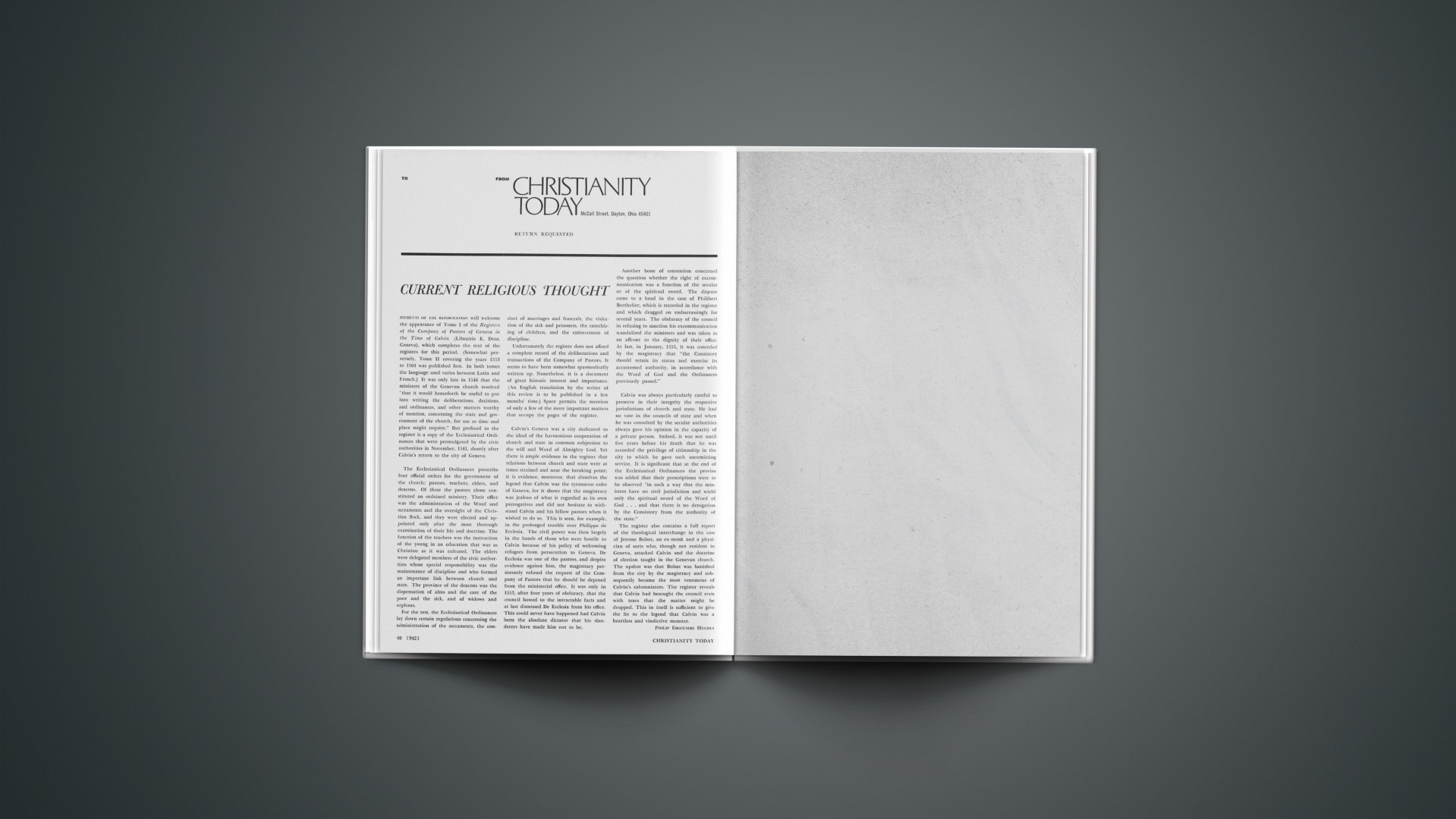
Students of the reformation will welcome the appearance of Tome I of the Registers of the Company of Pastors of Geneva in the Time of Calvin (Librairie E. Droz, Geneva), which completes the text of the registers for this period. (Somewhat perversely, Tome II covering the years 1553 to 1564 was published first. In both tomes the language used varies between Latin and French.) It was only late in 1546 that the ministers of the Genevan church resolved “that it would henceforth be useful to put into writing the deliberations, decisions, and ordinances, and other matters worthy of mention, concerning the state and government of the church, for use as time and place might require.” But prefixed to the register is a copy of the Ecclesiastical Ordinances that were promulgated by the civic authorities in November, 1541, shortly after Calvin’s return to the city of Geneva.
The Ecclesiastical Ordinances prescribe four official orders for the government of the church: pastors, teachers, elders, and deacons. Of these the pastors alone constituted an ordained ministry. Their office was the administration of the Word and sacraments and the oversight of the Christian flock, and they were elected and appointed only after the most thorough examination of their life and doctrine. The function of the teachers was the instruction of the young in an education that was as Christian as it was cultured. The elders were delegated members of the civic authorities whose special responsibility was the maintenance of discipline and who formed an important link between church and state. The province of the deacons was the dispensation of alms and the care of the poor and the sick, and of widows and orphans.
For the rest, the Ecclesiastical Ordinances lay down certain regulations concerning the administration of the sacraments, the conduct of marriages and funerals, the visitation of the sick and prisoners, the catechizing of children, and the enforcement of discipline.
Unfortunately the register does not afford a complete record of the deliberations and transactions of the Company of Pastors. It seems to have been somewhat spasmodically written up. Nonetheless, it is a document of great historic interest and importance. (An English translation by the writer of this review is to be published in a few months’ time.) Space permits the mention of only a few of the more important matters that occupy the pages of the register.
Calvin’s Geneva was a city dedicated to the ideal of the harmonious cooperation of church and state in common subjection to the will and Word of Almighty God. Yet there is ample evidence in the register that relations between church and state were at times strained and near the breaking point; it is evidence, moreover, that dissolves the legend that Calvin was the tyrannous ruler of Geneva, for it shows that the magistracy was jealous of what it regarded as its own prerogatives and did not hesitate to withstand Calvin and his fellow pastors when it wished to do so. This is seen, for example, in the prolonged trouble over Philippe de Ecclesia. The civil power was then largely in the hands of those who were hostile to Calvin because of his policy of welcoming refugees from persecution to Geneva. De Ecclesia was one of the pastors, and despite evidence against him, the magistracy persistently refused the request of the Company of Pastors that he should be deposed from the ministerial office. It was only in 1553, after four years of obduracy, that the council bowed to the intractable facts and at last dismissed De Ecclesia from his office. This could never have happened had Calvin been the absolute dictator that his slanderers have made him out to be.
Another bone of contention concerned the question whether the right of excommunication was a function of the secular or of the spiritual sword. The dispute came to a head in the case of Philibert Berthelier, which is recorded in the register and which dragged on embarrassingly for several years. The obduracy of the council in refusing to sanction his excommunication scandalized the ministers and was taken as an affront to the dignity of their office. At last, in January, 1555, it was conceded by the magistracy that “the Consistory should retain its status and exercise its accustomed authority, in accordance with the Word of God and the Ordinances previously passed.”
Calvin was always particularly careful to preserve in their integrity the respective jurisdictions of church and state. He had no vote in the councils of state and when he was consulted by the secular authorities always gave his opinion in the capacity of a private person. Indeed, it was not until five years before his death that he was accorded the privilege of citizenship in the city to which he gave such unremitting service. It is significant that at the end of the Ecclesiastical Ordinances the proviso was added that their prescriptions were to be observed “in such a way that the ministers have no civil jurisdiction and wield only the spiritual sword of the Word of God … and that there is no derogation by the Consistory from the authority of the state.”
The register also contains a full report of the theological interchange in the case of Jerome Bolsec, an ex-monk and a physician of sorts who, though not resident in Geneva, attacked Calvin and the doctrine of election taught in the Genevan church. The upshot was that Bolsec was banished from the city by the magistracy and subsequently became the most venomous of Calvin’s calumniators. The register reveals that Calvin had besought the council even with tears that the matter might be dropped. This in itself is sufficient to give the lie to the legend that Calvin was a heartless and vindictive monster.