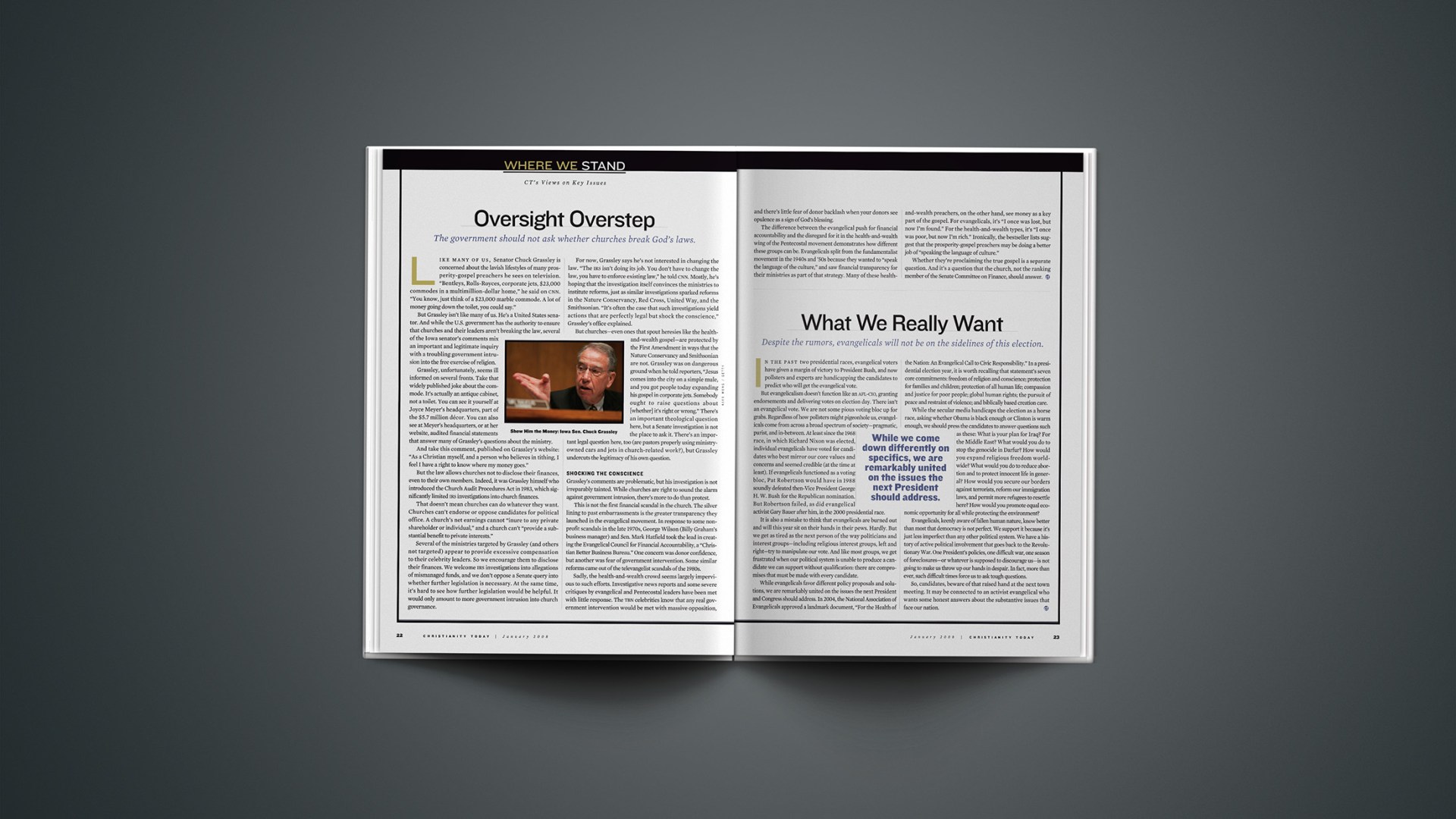

In the past two presidential races, evangelical voters have given a margin of victory to President Bush, and now pollsters and experts are handicapping the candidates to predict who will get the evangelical vote.
But evangelicalism doesn’t function like an AFL-CIO, granting endorsements and delivering votes on election day. There isn’t an evangelical vote. We are not some pious voting bloc up for grabs. Regardless of how pollsters might pigeonhole us, evangelicals come from across a broad spectrum of society—pragmatic, purist, and in-between. At least since the 1968 race, in which Richard Nixon was elected, individual evangelicals have voted for candidates who best mirror our core values and concerns and seemed credible (at the time at least). If evangelicals functioned as a voting bloc, Pat Robertson would have in 1988 soundly defeated then-Vice President George H. W. Bush for the Republican nomination. But Robertson failed, as did evangelical activist Gary Bauer after him, in the 2000 presidential race.
It is also a mistake to think that evangelicals are burned out and will this year sit on their hands in their pews. Hardly. But we get as tired as the next person of the way politicians and interest groups—including religious interest groups, left and right—try to manipulate our vote. And like most groups, we get frustrated when our political system is unable to produce a candidate we can support without qualification: there are compromises that must be made with every candidate.
While evangelicals favor different policy proposals and solutions, we are remarkably united on the issues the next President and Congress should address. In 2004, the National Association of Evangelicals approved a landmark document, “For the Health of the Nation: An Evangelical Call to Civic Responsibility.” In a presidential election year, it is worth recalling that statement’s seven core commitments: freedom of religion and conscience; protection for families and children; protection of all human life; compassion and justice for poor people; global human rights; the pursuit of peace and restraint of violence; and biblically based creation care.
While the secular media handicaps the election as a horse race, asking whether Obama is black enough or Clinton is warm enough, we should press the candidates to answer questions such as these: What is your plan for Iraq? For the Middle East? What would you do to stop the genocide in Darfur? How would you expand religious freedom worldwide? What would you do to reduce abortion and to protect innocent life in general? How would you secure our borders against terrorists, reform our immigration laws, and permit more refugees to resettle here? How would you promote equal economic opportunity for all while protecting the environment?
Evangelicals, keenly aware of fallen human nature, know better than most that democracy is not perfect. We support it because it’s just less imperfect than any other political system. We have a history of active political involvement that goes back to the Revolutionary War. One President’s policies, one difficult war, one season of foreclosures—or whatever is supposed to discourage us—is not going to make us throw up our hands in despair. In fact, more than ever, such difficult times force us to ask tough questions.
So, candidates, beware of that raised hand at the next town meeting. It may be connected to an activist evangelical who wants some honest answers about the substantive issues that face our nation.
Copyright © 2008 Christianity Today. Click for reprint information.
Related Elsewhere:
More Christianity Today articles on the 2008 Presidential campaign are available on our site.
Ted Olsen blogged about recent polling and the evangelical vote in Iowa.