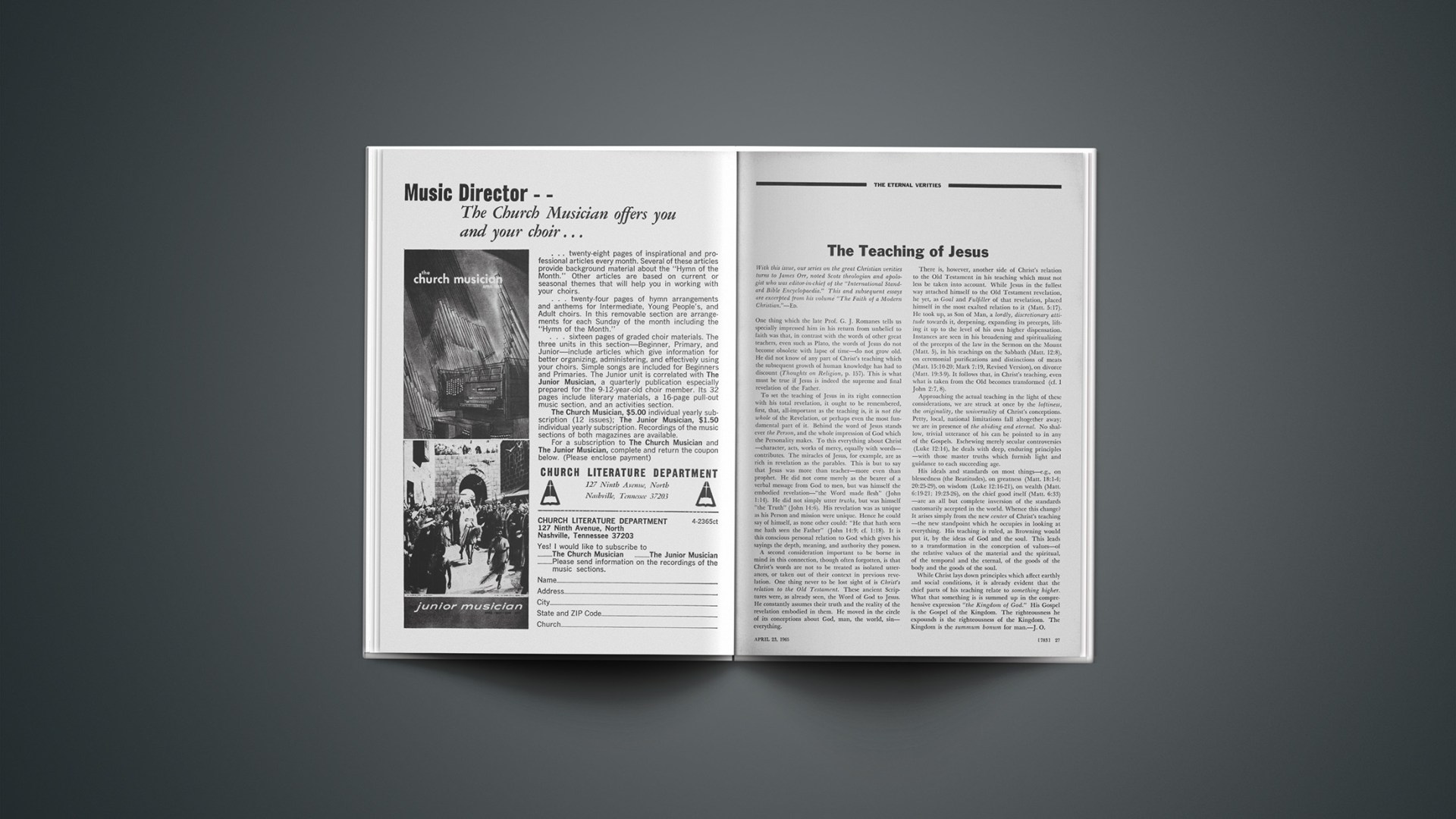

With this issue, our series on the great Christian verities turns to James Orr, noted Scots theologian and apologist who was editor-in-chief of the “International Standard Bible Encyclopaedia.” This and subsequent essays are excerpted from his volume “The Faith of a Modern Christian.”—ED.
One thing which the late Prof. G. J. Romanes tells us specially impressed him in his return from unbelief to faith was that, in contrast with the words of other great teachers, even such as Plato, the words of Jesus do not become obsolete with lapse of time—do not grow old. He did not know of any part of Christ’s teaching which the subsequent growth of human knowledge has had to discount (Thoughts on Religion, p. 157). This is what must be true if Jesus is indeed the supreme and final revelation of the Father.
To set the teaching of Jesus in its right connection with his total revelation, it ought to be remembered, first, that, all-important as the teaching is, it is not the whole of the Revelation, or perhaps even the most fundamental part of it. Behind the word of Jesus stands ever the Person, and the whole impression of God which the Personality makes. To this everything about Christ—character, acts, works of mercy, equally with words—contributes. The miracles of Jesus, for example, are as rich in revelation as the parables. This is but to say that Jesus was more than teacher—more even than prophet. He did not come merely as the bearer of a verbal message from God to men, but was himself the embodied revelation—“the Word made flesh” (John 1:14). He did not simply utter truths, but was himself “the Truth” (John 14:6). His revelation was as unique as his Person and mission were unique. Hence he could say of himself, as none other could: “He that hath seen me hath seen the Father” (John 14:9; cf. 1:18). It is this conscious personal relation to God which gives his sayings the depth, meaning, and authority they possess.
A second consideration important to be borne in mind in this connection, though often forgotten, is that Christ’s words are not to be treated as isolated utterances, or taken out of their context in previous revelation. One thing never to be lost sight of is Christ’s relation to the Old Testament. These ancient Scriptures were, as already seen, the Word of God to Jesus. He constantly assumes their truth and the reality of the revelation embodied in them. He moved in the circle of its conceptions about God, man, the world, sin—everything.
There is, however, another side of Christ’s relation to the Old Testament in his teaching which must not less be taken into account. While Jesus in the fullest way attached himself to the Old Testament revelation, he yet, as Goal and Fulfiller of that revelation, placed himself in the most exalted relation to it (Matt. 5:17). He took up, as Son of Man, a lordly, discretionary attitude towards it, deepening, expanding its precepts, lifting it up to the level of his own higher dispensation. Instances are seen in his broadening and spiritualizing of the precepts of the law in the Sermon on the Mount (Matt. 5), in his teachings on the Sabbath (Matt. 12:8), on ceremonial purifications and distinctions of meats (Matt. 15:10–20; Mark 7:19, Revised Version), on divorce (Matt. 19:3–9). It follows that, in Christ’s teaching, even what is taken from the Old becomes transformed (cf. 1 John 2:7, 8).
Approaching the actual teaching in the light of these considerations, we are struck at once by the loftiness, the originality, the universality of Christ’s conceptions. Petty, local, national limitations fall altogether away; we are in presence of the abiding and eternal. No shallow, trivial utterance of his can be pointed to in any of the Gospels. Eschewing merely secular controversies (Luke 12:14), he deals with deep, enduring principles—with those master truths which furnish light and guidance to each succeeding age.
His ideals and standards on most things—e.g., on blessedness (the Beatitudes), on greatness (Matt. 18:1–4; 20:25–29), on wisdom (Luke 12:16–21), on wealth (Matt. 6:19–21; 19:23–26), on the chief good itself (Matt. 6:33)—are an all but complete inversion of the standards customarily accepted in the world. Whence this change? It arises simply from the new center of Christ’s teaching—the new standpoint which he occupies in looking at everything. His teaching is ruled, as Browning would put it, by the ideas of God and the soul. This leads to a transformation in the conception of values—of the relative values of the material and the spiritual, of the temporal and the eternal, of the goods of the body and the goods of the soul.
While Christ lays down principles which affect earthly and social conditions, it is already evident that the chief parts of his teaching relate to something higher. What that something is is summed up in the comprehensive expression “the Kingdom of God.” His Gospel is the Gospel of the Kingdom. The righteousness he expounds is the righteousness of the Kingdom. The Kingdom is the summum bonum for man.—J. O.