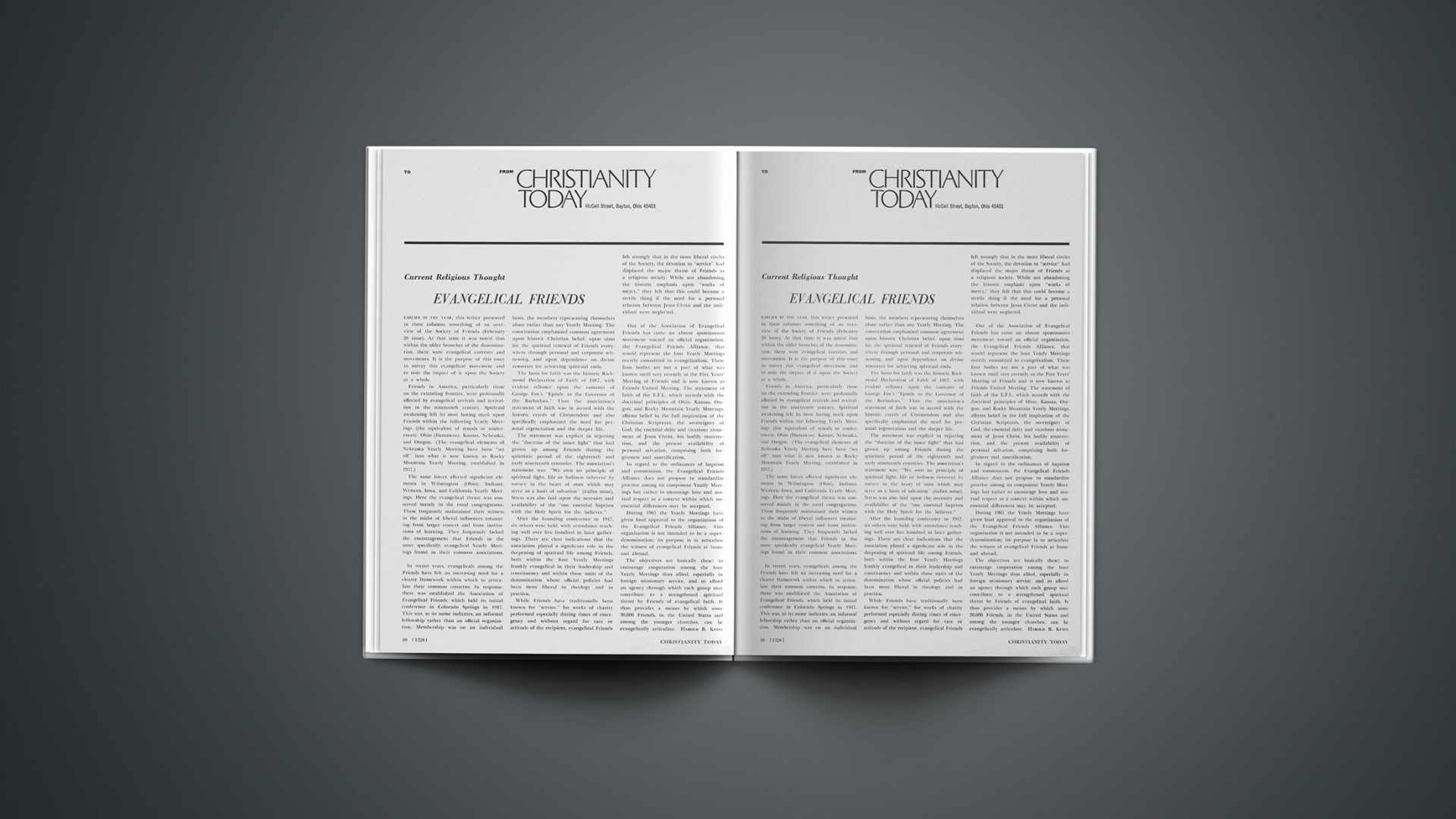

Earlier in the year, this writer presented in these columns something of an overview of the Society of Friends (February 26 issue). At that time it was noted that within the older brandies of the denomination, there were evangelical currents and movements. It is the purpose of this essay to survey this evangelical movement and to note the impact of it upon the Society as a whole.
Friends in America, particularly those on the extending frontier, were profoundly affected by evangelical revivals and revivalism in the nineteenth century. Spiritual awakening left its most lasting mark upon Friends within the following Yearly Meetings (the equivalent of synods or conferences): Ohio (Damascus), Kansas, Nebraska, and Oregon. (The evangelical elements of Nebraska Yearly Meeting have been “set off” into what is now known as Rocky Mountain Yearly Meeting, established in 1957.)
The same forces affected significant elements in Wilmington (Ohio), Indiana, Western, Iowa, and California Yearly Meetings. Here the evangelical thrust was conserved mainly in the rural congregations. These frequently maintained their witness in the midst of liberal influences emanating from larger centers and from institutions of learning. They frequently lacked the encouragement that Friends in the more specifically evangelical Yearly Meetings found in their common associations.
In recent years, evangelicals among the Friends have felt an increasing need for a clearer framework within which to articulate their common concerns. In response, there was established the Association of Evangelical Friends, which held its initial conference in Colorado Springs in 1947. This was, as its name indicates, an informal fellowship rather than an official organization. Membership was on an individual basis, the members representing themselves alone rather than any Yearly Meeting. The constitution emphasized common agreement upon historic Christian belief, upon aims for the spiritual renewal of Friends everywhere through personal and corporate witnessing, and upon dependence on divine resources for achieving spiritual ends.
The basis for faith was the historic Richmond Declaration of Faith of 1887, with evident reliance upon the contents of George Fox’s “Epistle to the Governor of the Barbadoes.” Thus the association’s statement of faith was in accord with the historic creeds of Christendom and also specifically emphasized the need for personal regeneration and the deeper life.
The statement was explicit in rejecting the “doctrine of the inner light” that had grown up among Friends during the quietistic period of the eighteenth and early nineteenth centuries. The association’s statement was: “We own no principle of spiritual light, life or holiness inherent by nature in the heart of man which may serve as a basis of salvation” (italics mine). Stress was also laid upon the necessity and availability of the “one essential baptism with the Holy Spirit for the believer.”
After the founding conference in 1947, six others were held, with attendance reaching well over five hundred in later gatherings. There are clear indications that the association played a significant role in the deepening of spiritual life among Friends, both within the four Yearly Meetings frankly evangelical in their leadership and constituency and within those units of the denomination whose official policies had been more liberal in theology and in practice.
While Friends have traditionally been known for “service,” for works of charity performed especially during times of emergency and without regard for race or attitude of the recipient, evangelical Friends felt strongly that in the more liberal circles of the Society, the devotion to “service” had displaced the major thrust of Friends as a religious society. While not abandoning the historic emphasis upon “works of mercy,” they felt that this could become a sterile thing if the need for a personal relation between Jesus Christ and the individual were neglected.
Out of the Association of Evangelical Friends has come an almost spontaneous movement toward an official organization, the Evangelical Friends Alliance, that would represent the four Yearly Meetings overtly committed to evangelicalism. These four bodies are not a part of what was known until very recently as the Five Years’ Meeting of Friends and is now known as Friends United Meeting. The statement of faith of the E.F.I., which accords with the doctrinal principles of Ohio, Kansas, Oregon, and Rocky Mountain Yearly Meetings, affirms belief in the full inspiration of the Christian Scriptures, the sovereignty of God, the essential deity and vicarious atonement of Jesus Christ, his bodily resurrection, and the present availability of personal salvation, comprising both forgiveness and sanctification.
In regard to the ordinances of baptism and communion, the Evangelical Friends Alliance does not propose to standardize practice among its component Yearly Meetings but rather to encourage love and mutual respect as a context within which unessential differences may be accepted.
During 1965 the Yearly Meetings have given final approval to the organization of the Evangelical Friends Alliance. This organization is not intended to be a super denomination; its purpose is to articulate the witness of evangelical Friends at home and abroad.
The objectives are basically these: to encourage cooperation among the four Yearly Meetings thus allied, especially in foreign missionary service, and to afford an agency through which each group may contribute to a strengthened spiritual thrust by Friends of evangelical faith. It thus provides a means by which some 30,000 Friends, in the United States and among the younger churches, can be evangelically articulate.